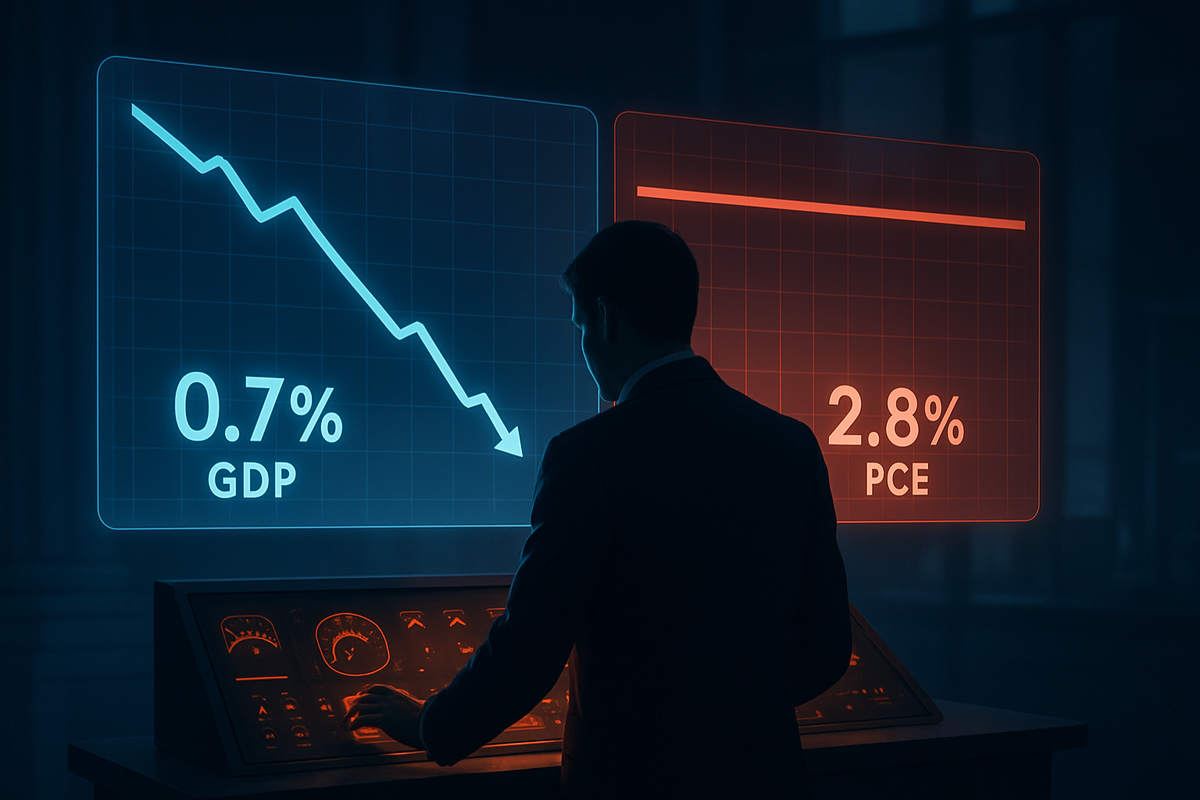
The American economy is currently sending a pair of deeply conflicting signals that have left both Wall Street and the Federal Reserve in a state of strategic paralysis. On March 13, 2026, the Bureau of Economic Analysis (BEA) released a stark downward revision of the fourth-quarter 2025 Gross Domestic Product (GDP) to a mere 0.7% annualized growth rate. This lackluster performance, largely attributed to the ripple effects of the 43-day partial government shutdown late last year, stands in jarring contrast to the latest Personal Consumption Expenditures (PCE) price index, which remains stubbornly parked at 2.8% for February.
For investors and policymakers, this combination is the hallmark of "stagflation"—the dreaded economic cocktail of stalling growth and persistent inflation. The Federal Reserve, led by Chair Jerome Powell in the waning months of his term, now faces an agonizing dilemma: cut interest rates to jumpstart a sputtering economy and risk reigniting price pressures, or keep rates high to extinguish inflation and risk pushing the nation into a full-scale recession. The immediate implication is a "frozen" monetary policy that has sent volatility indices spiking as markets realize the era of predictable "soft landings" may have officially ended.
The Collision of Data: A Breakdown of the Q4 Revision and Sticky PCE
The descent to 0.7% GDP growth marks a significant cooling from the initial 1.4% advance estimate, revealing that the "fiscal cliff" created by the late-2025 government gridlock was steeper than many anticipated. The shutdown, which lasted from October into November, severely curtailed federal spending and shook consumer confidence during the critical holiday lead-up. While many analysts expected a swift "V-shaped" recovery in the first quarter of 2026, today’s revision suggests that the private sector's engine is struggling to restart. Business investment has plateaued, and the initial boost from the AI infrastructure boom appears to be entering a more cautious, "show-me-the-money" phase.
Simultaneously, the February PCE data—the Federal Reserve’s preferred inflation gauge—came in at 2.8%, refusing to budge toward the central bank’s 2% target. This "sticky" inflation is being driven by structural factors that interest rates alone seem unable to fix, including rising insurance premiums, a shortage of affordable housing, and the "Liberation Day" tariffs that have increased the cost of imported electronics and components. The timeline of the past six months shows a Fed that was ready to declare victory over inflation in mid-2025, only to be blindsided by a resurgence in energy costs and a labor market that remains tight despite the broader economic slowdown.
Key stakeholders, including Treasury Secretary Janet Yellen and various FOMC members, have spent the last 48 hours managing expectations. The initial market reaction to today's GDP print was a flight to safety, with the 10-year Treasury yield dipping as investors bet on eventual rate cuts, while the S&P 500 saw heavy selling in the banking and discretionary sectors. The consensus among traders has shifted from expecting four rate cuts in 2026 to perhaps only one or two, as the "inflation floor" at 2.8% remains remarkably durable.
Corporate Winners and Losers in a Low-Growth, High-Price World
The "K-shaped" economic reality is creating a stark divide among public companies. Among the primary losers are regional banks, which are caught in a brutal vice. Zions Bancorporation (NASDAQ: ZION) and Comerica Incorporated (NYSE: CMA) have seen their net interest margins compressed as they are forced to offer higher deposit rates to compete for capital, while the 0.7% GDP environment has caused a significant slowdown in new commercial and industrial loan applications. The SPDR S&P Regional Banking ETF (NYSEARCA: KRE) reflected this stress, dropping nearly 5% following the GDP release.
In the retail sector, the struggle is equally pronounced for mid-tier discretionary players. Macy’s, Inc. (NYSE: M) and The Home Depot, Inc. (NYSE: HD) have faced headwinds as consumers pull back from "big ticket" and non-essential spending to cover the rising costs of necessities. Conversely, value-oriented giants are emerging as relative winners. Walmart Inc. (NYSE: WMT) recently reached a historic $1 trillion market cap, benefiting from a massive "trade-down" effect as middle-class families seek out its private-label brands to combat the 2.8% inflation rate. Similarly, off-price retailers like The TJX Companies, Inc. (NYSE: TJX) continue to outperform as they pick up market share from struggling department stores.
The technology sector is also undergoing a fundamental repricing. While Nvidia Corp (NASDAQ: NVDA) remains a powerhouse, its stock has become sensitive to the broader macro slowdown, as investors worry that the 0.7% growth rate will force enterprises to stretch out their AI spending cycles. Meanwhile, software firms with high valuations but stalling growth, such as Atlassian Corp (NASDAQ: TEAM), have seen significant sell-offs. On the defensive side, government contractors like Booz Allen Hamilton Holding Corp (NYSE: BAH) and CACI International Inc (NYSE: CACI) have proven resilient, as their long-term federal contracts provide a "moat" against the temporary disruptions caused by the recent government shutdown.
Wider Significance: The Return of the 1970s Playbook?
The current economic landscape bears a haunting resemblance to the "stop-go" cycles of the late 1970s. For years, the prevailing narrative was that the Fed could fine-tune the economy toward a soft landing. However, the 0.7% GDP revision and 2.8% PCE data suggest that the "neutral rate" of interest may be higher than previously thought, and that the "last mile" of inflation is the hardest to travel. This event fits into a broader trend of "deglobalization" and supply-chain fragmentation, which are inherently inflationary and limit the effectiveness of traditional monetary policy.
The regulatory and policy implications are profound. With Jerome Powell’s term set to expire in May 2026, the White House is under immense pressure to nominate a successor who can navigate this narrow corridor. Speculation is rife that a more "dovish" appointment could be made to prevent the 0.7% growth rate from turning into a negative print, even if it means tolerating 3% inflation for a longer period. This shift would represent a historical departure from the "inflation first" mandate that has guided the Fed since the Paul Volcker era.
Furthermore, the ripple effects on international markets are becoming clear. As the U.S. economy slows, global demand is cooling, putting pressure on European and Asian exporters. The "U.S. Exceptionalism" that characterized the 2024-2025 period is fading, leading to a more volatile foreign exchange market. Historically, when the U.S. enters a period of stagflation, it often leads to a resurgence in hard assets, a trend already visible in the recent outperformance of gold miners like Newmont Corporation (NYSE: NEM).
What Comes Next: Strategic Pivots and Potential Scenarios
In the short term, the Federal Reserve is expected to maintain a "hawkish pause" at its upcoming meeting. They cannot cut rates while PCE is at 2.8% without losing credibility, but they cannot hike rates further with GDP at 0.7% without being blamed for an impending recession. This "wait-and-see" approach will likely lead to a period of range-bound trading for the major indices, as the market looks for a "tie-breaker" in the form of first-quarter 2026 earnings reports or the March employment data.
Long-term, companies will need to adapt to a "low-growth, high-cost" environment. We are likely to see a wave of consolidation in the banking and retail sectors as weaker players are absorbed by those with stronger balance sheets. Strategic pivots toward automation and AI-driven efficiency will become mandatory, not optional, as firms look to preserve margins against the backdrop of 2.8% inflation. Investors should prepare for a "stock picker’s market," where the broad index performance is lackluster but individual companies with pricing power and essential services thrive.
The most optimistic scenario is a "productivity miracle" where AI investments finally begin to show up in the GDP figures, allowing the economy to grow out of its slump without sparking further inflation. The pessimistic scenario, however, is a "hard landing" in late 2026 if the Fed holds rates too high for too long, potentially forcing a massive emergency stimulus package that could send inflation spiraling back toward the 4-5% range seen years ago.
Summary and Investor Outlook
The release of the revised 0.7% Q4 GDP and the 2.8% February PCE index marks a pivotal moment in the 2026 economic calendar. The primary takeaway is that the U.S. economy is more fragile than the "resilient" narrative suggested, and inflation is more deeply embedded in the service economy than many hoped. The Federal Reserve is now boxed into a corner, with its next move likely dictated more by the fear of a deep recession than the desire for 2% inflation.
Moving forward, the market is likely to remain on edge. Investors should watch for the expiration of Jerome Powell’s term in May and the subsequent nomination process, as this will provide the clearest signal of the future interest rate path. Additionally, any further "fiscal friction" in Washington D.C. could be the tipping point that pushes the current 0.7% growth into negative territory.
For the coming months, the mantra for investors should be "defensive quality." Focus on companies like Walmart Inc. (NYSE: WMT) or JPMorgan Chase & Co. (NYSE: JPM) that have the scale to navigate a slow economy and the pricing power to withstand sticky inflation. The "easy money" of the post-pandemic recovery is gone; the era of stagflationary navigation has begun.
This content is intended for informational purposes only and is not financial advice.