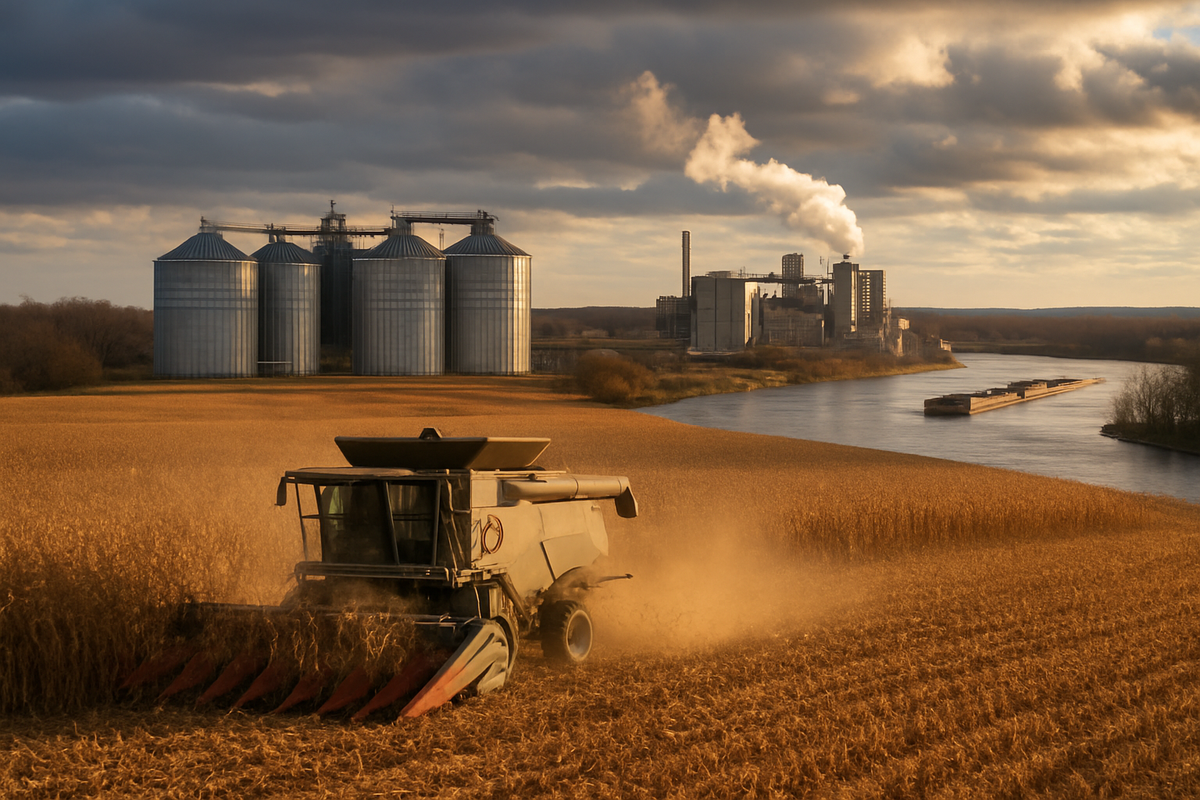
As the final trading days of 2025 unfold, the global agricultural commodity markets are grappling with a complex paradox: record-breaking production levels coupled with persistent logistical bottlenecks and geopolitical volatility. While American farmers have just concluded a historic harvest—bringing in a staggering 16.75 billion bushels of corn—the financial rewards remain elusive as a "wall of supply" from both North and South America keeps a firm lid on prices. Heading into 2026, the market is defined by a bearish-to-neutral sentiment, with traders closely monitoring the transition from U.S. bins to Brazilian fields.
The immediate implications for the market are a double-edged sword. For consumers and livestock producers, the abundance of corn, soybeans, and wheat offers a reprieve from the inflationary spikes of previous years. However, for the major agribusiness players and the American farmer, the end of 2025 is a period of tightening margins and strategic waiting. With corn prices hovering near $4.48 per bushel and soybeans struggling to maintain the $10.60 level, the industry is increasingly reliant on a rebound in export demand and clarity on domestic biofuel policies to ignite the next market rally.
Record Yields Meet Geopolitical Tremors
The 2025/2026 marketing year has been defined by the sheer scale of global output. In the United States, the corn harvest reached an average yield of 186 bushels per acre, a record that has pushed ending stocks to over 2 billion bushels despite a frantic export pace. Wheat has followed a similar trajectory of abundance, with record-breaking harvests in Canada (40 million tons) and Argentina (24 million tons) driving global ending stocks to their highest levels since 2020. This surplus has acted as a buffer against the year’s most significant geopolitical disruption: the formal collapse of the successor to the Black Sea Grain Initiative on November 26, 2025.
The timeline leading to this year-end tension began in late autumn when Russia declared the maritime corridor "no longer viable," followed by a series of drone attacks on Ukrainian port infrastructure in Odesa during late December. While these events would have caused a price vertical in 2022, the 2025 market responded with only a modest "risk premium" in wheat futures, which climbed to roughly $5.17 per bushel. The presence of a "US-backed peace blueprint" currently circulating in diplomatic circles has further tempered fears, suggesting that while the physical flow of grain from the Black Sea is restricted, the global market no longer views it as an existential threat to food security.
Initial market reactions in these final weeks of December have been characterized by technical buying and "short covering" by hedge funds. However, the shadow of South America looms large. Brazil is currently on track for a record soybean harvest of up to 178 million metric tons, which is effectively neutralizing any bullish news coming out of the U.S. or Europe. As of December 26, the agricultural complex is in a "wait-and-see" mode, balancing the reality of overflowing silos against the potential for a La Niña-induced drought in the upcoming Brazilian "safrinha" corn season.
Corporate Divergence: Winners and Losers in a High-Supply Era
The financial performance of the industry's titans in late 2025 reveals a stark divide between those who profit from volume and those who profit from price volatility. Archer-Daniels-Midland (NYSE: ADM) has faced a challenging fourth quarter, significantly slashing its full-year earnings guidance. The company’s crushing subsegment saw profits plunge nearly 93% as ample global supplies crushed the "crush margins" that had fueled record profits in previous years. Furthermore, ADM has been hampered by "muted demand" for soybean oil, a direct result of the U.S. government’s deferral of the 45Z Clean Fuel Production Credit, which has left the renewable diesel industry in a state of regulatory limbo.
In contrast, Bunge Global SA (NYSE: BG) has emerged as a winner in the current landscape. By successfully integrating Viterra earlier in the year, Bunge has leveraged its expanded footprint in South America to capitalize on record exports from Brazil and Argentina. While Bunge also noted the pressure of high stocks-to-use ratios, its ability to navigate global logistics allowed it to beat Q3 and Q4 earnings expectations. For these "ABCD" grain majors, the strategy has shifted from chasing high prices to maximizing the efficiency of their global supply chains.
The equipment and input sectors are facing their own headwinds. Deere & Company (NYSE: DE) reported a cautious outlook for 2026, projecting a significant drop in net income as high interest rates and the threat of new trade tariffs dampen farmer sentiment. Although Deere successfully cleared much of its large-tractor inventory in late 2025, the company anticipates a 15% to 20% decline in North American large ag sales. Conversely, Corteva, Inc. (NYSE: CTVA) has found success in the "seed and tech" space. Raising its full-year guidance, Corteva has benefited from strong demand for its high-tech seed varieties in Brazil, proving that even in a low-price environment, farmers are willing to invest in yield-protecting technology.
Biofuels, Logistics, and the "Green" Transition
The wider significance of the 2025 market environment lies in the shifting role of agricultural commodities as energy feedstocks. The delay in the 45Z tax credit has created a bottleneck in the transition toward Sustainable Aviation Fuel (SAF). This policy uncertainty has effectively decoupled soybean oil prices from historical norms, as refiners wait for a clear signal before committing to long-term contracts. This trend highlights a broader industry shift: corn and soybeans are no longer just food and feed; they are increasingly viewed through the lens of carbon intensity and energy policy.
Logistical challenges have also reached a critical juncture. For the fourth consecutive year, the Mississippi River faced historic low-water levels during the fall harvest, forcing a "structural pivot" in U.S. grain transport. With barge freight rates surging 31% in a single month, many exporters were forced to abandon the Gulf of Mexico route in favor of rail shipments to the West Coast. This logistical strain has effectively lowered the "basis" price that farmers receive at the local elevator, further squeezing rural incomes even as international prices remain stable.
Historically, such a prolonged period of low water on the Mississippi would have been an anomaly; in 2025, it is being treated as a "new normal" that requires permanent infrastructure adaptations. Meanwhile, the Panama Canal’s return to full operational capacity in late 2025 has provided a much-needed relief valve for global trade, though grain shippers now find themselves competing for slots with high-value Liquefied Petroleum Gas (LPG) and container vessels, signaling a permanent increase in the cost of moving bulk commodities.
The 2026 Horizon: Strategic Pivots and Weather Risks
Looking ahead to the first half of 2026, the market will be dominated by two factors: the South American weather and the "2026 Separation Plan" of industry leaders. Corteva, Inc. (NYSE: CTVA) is preparing to split into two independent public entities, a move that could trigger a wave of consolidation or restructuring across the crop protection and seed sectors. For investors, this represents a potential strategic pivot as companies seek to unlock value by decoupling their high-growth technology wings from their more cyclical chemical businesses.
Short-term opportunities may emerge if the burgeoning La Niña weather pattern disrupts Brazil’s second-crop corn. Any yield drag in South America would quickly tighten the global balance sheet, potentially sparking a rally in the March and May 2026 futures contracts. However, the long-term challenge remains the "China Wild Card." With Chinese port inventories of soybeans exceeding 10 million tons at the end of 2025, the world’s largest importer is under no immediate pressure to buy, giving Beijing significant leverage in ongoing trade and tariff negotiations with the United States.
Market Wrap-Up and Investor Takeaways
The end of 2025 marks a turning point for agricultural commodities. The era of "scarcity pricing" triggered by the 2022 invasion of Ukraine has been firmly replaced by an era of "abundance management." The key takeaway for the market is that while supply is plentiful, the infrastructure to move it and the policies to consume it (particularly in the biofuel sector) are currently the primary sources of friction. The market is moving forward with a heavy supply overhang, but with enough geopolitical and climatic "tinder" to ignite volatility at a moment's notice.
For investors, the coming months require a focus on margins over volume. Watch for the resolution of the 45Z tax credit in early 2026, as this will be the primary catalyst for the soybean complex. Additionally, the performance of Nutrien Ltd. (NYSE: NTR) and other fertilizer giants will serve as a bellwether for 2026 planting intentions; if input costs remain high while grain prices stay low, we may see a significant shift in acreage away from corn in the next U.S. planting cycle. In this environment, the "winners" will be those companies with the diversified global footprints to navigate a world where the grain is plentiful, but the profit is hard-earned.
This content is intended for informational purposes only and is not financial advice.