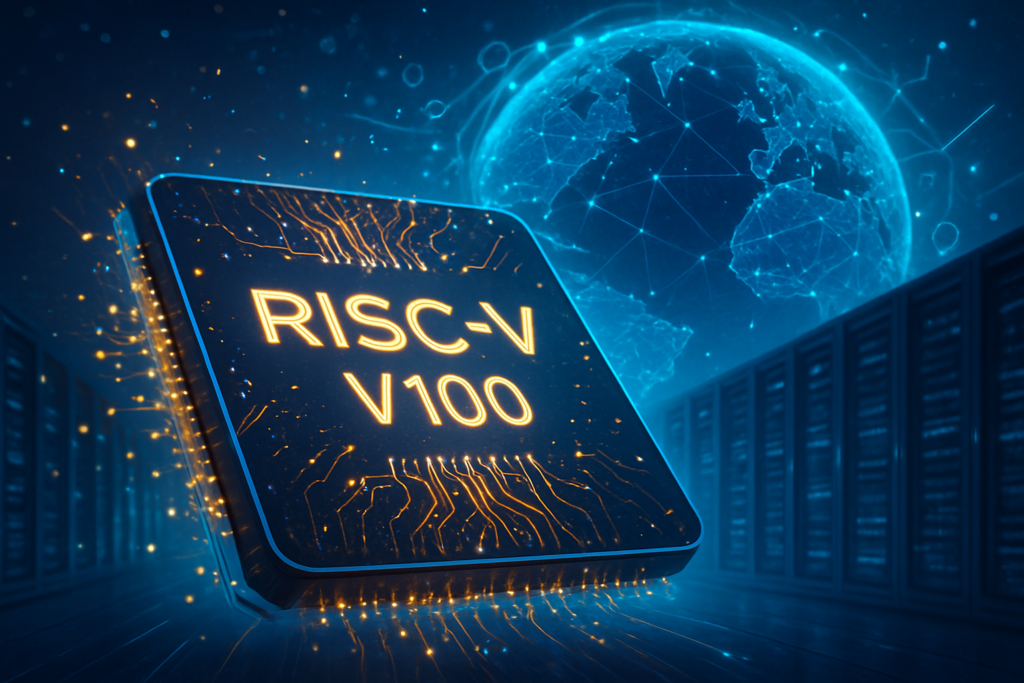
In a move that marks a paradigm shift for the global semiconductor industry, Chinese chipmaker SpacemiT has officially launched its Vital Stone V100 processor, the world’s first RISC-V chip to successfully bridge the gap between low-power edge computing and full-scale data center performance. Released this January 2026, the V100 is built on a massive 64-core interconnect, signaling a direct assault on the high-performance computing (HPC) dominance currently held by the x86 and Arm architectures.
The launch is bolstered by a massive $86.1 million (600 million yuan) Series B funding round, led by the Beijing Artificial Intelligence Industry Investment Fund. This capital infusion is explicitly aimed at establishing "AI Sovereignty"—a strategic push to provide global enterprises and sovereign nations with a high-performance, open-standard alternative to the proprietary licensing models of Arm Holdings (Nasdaq: ARM) and the architectural lock-in of Intel Corporation (Nasdaq: INTC) and Advanced Micro Devices, Inc. (Nasdaq: AMD).
A New Benchmark in Silicon Scalability
The Vital Stone V100 is engineered around SpacemiT’s proprietary X100 core, a 4-issue, 12-stage out-of-order microarchitecture that represents a significant leap for the RISC-V ecosystem. The headline feature is its high-density 64-core interconnect, which allows for the level of parallel processing required for modern cloud workloads and AI inference. Each core operates at a clock speed of up to 2.5 GHz, delivering performance benchmarks that finally rival enterprise-grade incumbents, specifically achieving over 9 points per GHz on the SPECINT2006 benchmark.
Technical experts have highlighted the V100’s "AI Fusion" computing model as its most innovative trait. Unlike traditional server chips that rely on a separate Neural Processing Unit (NPU), the V100 integrates the RISC-V Intelligence Matrix Extension (IME) and 256-bit Vector 1.0 capabilities directly into the CPU instruction set. This integration allows the 64-core cluster to achieve approximately 32 TOPS (INT8) of AI performance without the latency overhead of off-chip communication. The processor is fully compliant with the RVA23 profile—the highest 64-bit standard—and includes full virtualization support (Hypervisor 1.0, AIA 1.0), making it a "drop-in" replacement for virtualized data center environments that previously required x86 or Arm-based hardware.
Disrupting the Arm and x86 Duopoly
The emergence of the Vital Stone V100 poses a credible threat to the established market leaders. For years, Arm Holdings (Nasdaq: ARM) has dominated the mobile and edge markets while slowly encroaching on the server space through partnerships with cloud giants. However, the V100 offers a reported 30% performance-per-watt advantage over comparable Arm Cortex-A55 clusters in edge-server scenarios. For cloud providers and data center operators, this efficiency translates directly into lower operational costs and reduced carbon footprints, making the V100 an attractive proposition for the next generation of "green" data centers.
Furthermore, the $86 million Series B funding provides SpacemiT with the "war chest" necessary to scale mass production and build out the "RISC-V+AI+Triton" software ecosystem. This ecosystem is crucial for attracting developers away from the mature software stacks of Intel and NVIDIA Corporation (Nasdaq: NVDA). By positioning the V100 as an open-standard alternative, SpacemiT is tapping into a growing demand from tech giants in Asia and Europe who are eager to diversify their hardware supply chains and avoid the geopolitical risks associated with proprietary US-designed architectures.
The Geopolitical Strategy of AI Sovereignty
Beyond technical specs, the Vital Stone V100 is a political statement. The concept of "AI Sovereignty" has become a central theme in the 2026 tech landscape. As trade restrictions and export controls continue to reshape the global supply chain, nations are increasingly wary of relying on any single proprietary architecture. By leveraging the open-source RISC-V standard, SpacemiT offers a path to silicon independence, ensuring that the foundational hardware for artificial intelligence remains accessible regardless of diplomatic tensions.
This shift mirrors the early days of the Linux operating system, which eventually broke the monopoly of proprietary server software. Just as Linux provided a transparent, community-driven alternative to Unix, the V100 is positioning RISC-V as the "Linux of hardware." Industry analysts suggest that this movement toward open standards could democratize AI development, allowing smaller firms and developing nations to build custom, high-performance silicon tailored to their specific needs without paying the "architecture tax" associated with legacy providers.
The Road Ahead: Mass Production and the K3 Evolution
The immediate future for SpacemiT involves a rapid scale-up of the Vital Stone V100 to meet the demands of early adopters in the robotics, autonomous systems, and edge-server sectors. The company has already indicated that the $86 million funding will also support the development of their next-generation K3 chip, which is expected to further increase core density and push clock speeds beyond the 3 GHz barrier.
However, challenges remain. While the hardware is impressive, the "software gap" is the primary hurdle for RISC-V adoption. SpacemiT must convince major software vendors to optimize their stacks for the X100 core. Experts predict that the first wave of large-scale adoption will likely come from hyperscalers like Alibaba Group Holding Limited (NYSE: BABA), who have already invested heavily in their own RISC-V designs and are eager to see a robust merchant silicon market emerge to drive down costs across the industry.
A Turning Point in Computing History
The launch of the Vital Stone V100 and the successful Series B funding of SpacemiT represent a watershed moment for the semiconductor industry. It marks the point where RISC-V transitioned from an "experimental" architecture suitable for IoT devices to a "server-class" contender capable of powering the most demanding AI workloads. In the context of AI history, this may be remembered as the moment when the hardware monopoly of the late 20th century finally began to yield to a truly global, open-source model.
As we move through 2026, the tech industry will be watching SpacemiT closely. The success of the V100 in real-world data center deployments will determine whether "AI Sovereignty" is a viable strategic path or a temporary geopolitical hedge. Regardless of the outcome, the arrival of a 64-core RISC-V server chip has forever altered the competitive landscape, forcing incumbents to innovate faster and more efficiently than ever before.
This content is intended for informational purposes only and represents analysis of current AI developments.
TokenRing AI delivers enterprise-grade solutions for multi-agent AI workflow orchestration, AI-powered development tools, and seamless remote collaboration platforms.
For more information, visit https://www.tokenring.ai/.