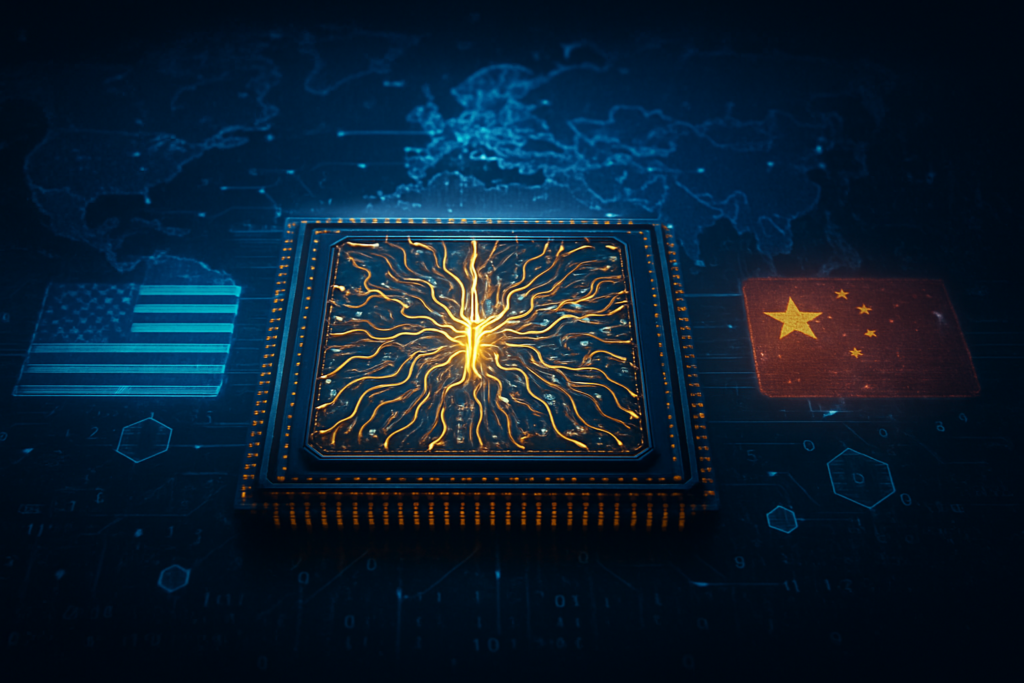
In a move that has sent shockwaves through both Silicon Valley and the geopolitical corridors of Beijing, the Trump administration has officially rolled back key restrictions on high-end artificial intelligence hardware. Effective January 16, 2026, the U.S. Department of Commerce has issued a landmark policy update authorizing the export of the NVIDIA (NASDAQ: NVDA) H200 Tensor Core GPU to the Chinese market. The decision marks a fundamental departure from the previous administration’s "blanket ban" strategy, replacing it with a sophisticated "Managed Access" framework designed to maintain American technological dominance while re-establishing U.S. economic leverage.
The policy shift is not a total liberalization of trade but rather a calculated gamble. Under the new rules, NVIDIA and other semiconductor leaders like AMD (NASDAQ: AMD) can sell their flagship Hopper-class and equivalent hardware to approved Chinese commercial entities, provided they navigate a gauntlet of new regulatory hurdles. By allowing these exports, the administration aims to blunt the rapid ascent of domestic Chinese AI chipmakers, such as Huawei, which had begun to monopolize the Chinese market in the absence of American competition.
The Technical Leap: Restoring the Power Gap
The technical implications of this policy are profound. For the past year, Chinese tech giants like Alibaba (NYSE: BABA) and ByteDance were restricted to the NVIDIA H20—a heavily throttled version of the Hopper architecture designed specifically to fall under the Biden-era performance caps. The H200, by contrast, is a powerhouse of the "Hopper" generation, boasting 141GB of HBM3e memory and a staggering 4.8 TB/s of bandwidth. Research indicates that the H200 is approximately 6.7 times faster for AI training tasks than the crippled H20 chips previously available in China.
This "Managed Access" framework introduces three critical safeguards that differentiate it from pre-2022 trade:
- The 25% "Government Cut": A mandatory tariff-style fee on every H200 sold to China, essentially turning high-end AI exports into a significant revenue stream for the U.S. Treasury.
- Mandatory U.S. Routing: Every H200 destined for China must first be routed from fabrication sites in Taiwan to certified "Testing Hubs" in the United States. These labs verify that the hardware has not been tampered with or "overclocked" to exceed specified performance limits.
- The 50% Volume Cap: Shipments to China are legally capped at 50% of the total volume sold to domestic U.S. customers, ensuring that American AI labs retain a hardware-availability advantage.
Market Dynamics: A Windfall for Silicon Valley
The announcement has had an immediate and electric effect on the markets. Shares of NVIDIA (NASDAQ: NVDA) surged 8% in pre-market trading, as analysts began recalculating the company’s "Total Addressable Market" (TAM) to include a Chinese demand surge that has been bottled up for nearly two years. For NVIDIA CEO Jensen Huang, the policy is a hard-won victory after months of lobbying for a "dependency model" rather than a "decoupling model." By supplying the H200, NVIDIA effectively resets the clock for Chinese developers, who might now abandon domestic alternatives like Huawei’s Ascend series in favor of the superior CUDA ecosystem.
However, the competition is not limited to NVIDIA. The policy update also clears a path for AMD’s MI325X accelerators, sparking a secondary race between the two U.S. titans to secure long-term contracts with Chinese cloud providers. While the "Government Cut" will eat into margins, the sheer volume of anticipated orders from companies like Tencent (HKG: 0700) and Baidu (NASDAQ: BIDU) is expected to result in record-breaking quarterly revenues for the remainder of 2026. Startups in the U.S. AI space are also watching closely, as the 50% volume cap ensures that domestic supply remains a priority, preventing a price spike for local compute.
Geopolitics: Dependency over Decoupling
Beyond the balance sheets, the Trump administration's move signals a strategic pivot in the "AI Cold War." By allowing China access to the H200—but not the state-of-the-art "Blackwell" (B200) or the upcoming "Rubin" architectures—the U.S. is attempting to create a permanent "capability gap." The goal is to keep China’s AI ecosystem tethered to American software and hardware standards, making it difficult for Beijing to achieve true technological self-reliance.
This approach acknowledges the reality that strict bans were accelerating China’s domestic innovation. Experts from the AI research community have noted that while the H200 will allow Chinese firms to train significantly larger models than before, they will still remain 18 to 24 months behind the frontier models being trained in the U.S. on Blackwell-class clusters. Critics, however, warn that the H200 is still more than capable of powering advanced surveillance and military-grade AI, raising questions about whether the 25% tariff is a sufficient price for the potential national security risks.
The Horizon: What Comes After Hopper?
Looking ahead, the "Managed Access" policy creates a roadmap for how future hardware generations might be handled. The Department of Commerce has signaled that as "Rubin" chips become the standard in the U.S., the currently restricted "Blackwell" architecture might eventually be moved into the approved export category for China. This "rolling release" strategy ensures that the U.S. always maintains a one-to-two generation lead in hardware capabilities.
The next few months will be a testing ground for the mandatory U.S. routing and testing hubs. If the logistics of shipping millions of chips through U.S. labs prove too cumbersome, it could lead to supply chain bottlenecks. Furthermore, the world is waiting for Beijing’s official response. While Chinese firms are desperate for the hardware, the 25% "tax" to the U.S. government and the intrusive testing requirements may be seen as a diplomatic affront, potentially leading to retaliatory measures on raw materials like gallium and germanium.
A New Chapter in AI Governance
The approval of NVIDIA H200 exports to China marks the end of the "Total Ban" era and the beginning of a "Pragmatic Engagement" era. The Trump administration has bet that economic leverage and technological dependency are more powerful tools than isolation. By turning the AI arms race into a regulated, revenue-generating trade channel, the U.S. is attempting to control the speed of China’s development without fully severing the ties that bind the two largest economies.
In the coming weeks, all eyes will be on the first shipments leaving U.S. testing facilities. Whether this policy effectively sustains American leadership or inadvertently fuels a Chinese AI resurgence remains to be seen. For now, NVIDIA and its peers are back in the game in China, but they are playing under a new and much more complex set of rules.
This content is intended for informational purposes only and represents analysis of current AI developments.
TokenRing AI delivers enterprise-grade solutions for multi-agent AI workflow orchestration, AI-powered development tools, and seamless remote collaboration platforms.
For more information, visit https://www.tokenring.ai/.