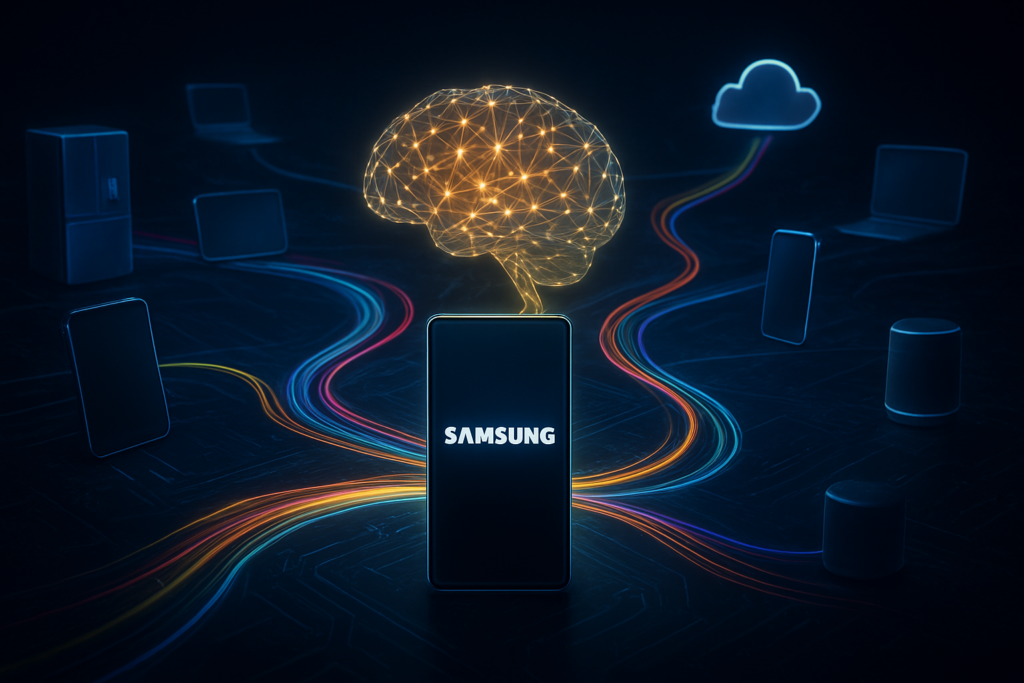
In a bold move that signals the complete "AI-ification" of the consumer electronics landscape, Samsung Electronics (KRX: 005930) announced at CES 2026 its ambitious goal to double the reach of Galaxy AI to 800 million devices by the end of the year. This massive expansion, powered by a deepened partnership with Alphabet Inc. (NASDAQ: GOOGL), aims to transition AI from a premium novelty into an "invisible" and essential layer across the entire Samsung ecosystem, including smartphones, tablets, wearables, and home appliances.
The announcement marks a pivotal moment for the tech giant as it seeks to reclaim its dominant position in the global smartphone market and outpace competitors in the race for on-device intelligence. By leveraging Google’s latest Gemini 3 models and integrating advanced reasoning capabilities from partners like Perplexity AI, Samsung is positioning itself as the primary gateway for generative AI in the hands of hundreds of millions of users worldwide.
Technical Foundations: The Exynos 2600 and the Bixby "Brain Transplant"
The technical backbone of this 800-million-unit surge is the new "AX" (AI Transformation) strategy, which moves beyond simple software features to a deeply integrated hardware-software stack. At the heart of the 2026 flagship lineup, including the upcoming Galaxy S26 series, is the Exynos 2600 processor. Built on Samsung’s cutting-edge 2nm Gate-All-Around (GAA) process, the Exynos 2600 features a Neural Processing Unit (NPU) that is reportedly six times faster than the previous generation. This allows for complex "Mixture of Experts" (MoE) models, like Samsung’s proprietary Gauss 2, to run locally on the device with unprecedented efficiency.
Samsung has standardized on Google Gemini 3 and Gemini 3 Flash as the core engines for Galaxy AI’s cloud and hybrid tasks. A significant technical breakthrough for 2026 is what industry insiders are calling the Bixby "Brain Transplant." While Google Gemini handles generative tasks and creative workflows, Samsung has integrated Perplexity AI to serve as Bixby’s web-grounded reasoning engine. This tripartite system—Bixby for system control, Gemini for creativity, and Perplexity for cited research—creates a sophisticated digital assistant capable of handling complex, multi-step queries that were previously impossible on mobile hardware.
Furthermore, Samsung is utilizing "Netspresso" technology from Nota AI to compress large language models by up to 90% without sacrificing accuracy. This optimization, combined with the integration of High-Bandwidth Memory (HBM3E) in mobile chipsets, enables high-speed local inference. This technical leap ensures that privacy-sensitive tasks, such as real-time multimodal translation and document summarization, remain on-device, addressing one of the primary concerns of the AI era.
Market Dynamics: Challenging Apple and Navigating the "Memory Crunch"
This aggressive scaling strategy places immense pressure on Apple (NASDAQ: AAPL), whose "Apple Intelligence" has remained largely confined to its high-end Pro models. By democratizing Galaxy AI across its mid-range Galaxy A-series (A56 and A36) and its "Bespoke AI" home appliances, Samsung is effectively winning the volume race. While Apple may maintain higher profit margins per device, Samsung’s 800-million-unit target ensures that Google Gemini becomes the default AI experience for the vast majority of the world’s mobile users.
Alphabet Inc. stands as a major beneficiary of this development. The partnership secures Gemini’s place as the dominant mobile AI model, providing Google with a massive distribution channel that bypasses the need for users to download standalone apps. For Google, this is a strategic masterstroke in its ongoing rivalry with OpenAI and Microsoft (NASDAQ: MSFT), as it embeds its ecosystem into the hardware layer of the world’s most popular Android devices.
However, the rapid expansion is not without its strategic risks. Samsung warned of an "unprecedented" memory chip shortage due to the skyrocketing demand for AI servers and high-performance mobile RAM. This "memory crunch" is expected to drive up DRAM prices significantly, potentially forcing a price hike for the Galaxy S26 series. While Samsung’s semiconductor division will see record profits from this shortage, its mobile division may face tightened margins, creating a complex internal balancing act for the South Korean conglomerate.
Broader Significance: The Era of Agentic AI
The shift toward 800 million AI devices represents a fundamental change in the broader AI landscape, moving away from the "chatbot" era and into the era of "Agentic AI." In this new phase, AI is no longer a destination—like a website or an app—but a persistent, proactive layer that anticipates user needs. This mirrors the transition seen during the mobile internet revolution of the late 2000s, where connectivity became a baseline expectation rather than a feature.
This development also highlights a growing divide in the industry regarding data privacy and processing. Samsung’s hybrid approach—balancing local processing for privacy and cloud processing for power—sets a new industry standard. However, the sheer scale of data being processed by 800 million devices raises significant concerns about data sovereignty and the environmental impact of the massive server farms required to support Google Gemini’s cloud-based features.
Comparatively, this milestone is being viewed by historians as the "Netscape moment" for mobile AI. Just as the web browser made the internet accessible to the masses, Samsung’s integration of Gemini and Perplexity into the Galaxy ecosystem is making advanced generative AI a daily utility for nearly a billion people. It marks the end of the experimental phase of AI and the beginning of its total integration into human productivity and social interaction.
Future Horizons: Foldables, Wearables, and Orchestration
Looking ahead, the near-term focus will be on the launch of the Galaxy Z Fold7 and a rumored "Z TriFold" device, which are expected to showcase specialized AI multitasking features that take advantage of larger screen real estate. We can also expect to see "Galaxy AI" expand deeper into the wearable space, with the Galaxy Ring and Galaxy Watch 8 utilizing AI to provide predictive health insights and automated coaching based on biometric data patterns.
The long-term challenge for Samsung and Google will be maintaining the pace of innovation while managing the energy and hardware costs associated with increasingly complex models. Experts predict that the next frontier will be "Autonomous Device Orchestration," where your Galaxy phone, fridge, and car communicate via a shared Gemini-powered "brain" to manage your life seamlessly. The primary hurdle remains the "memory crunch," which could slow down the rollout of AI features to budget-tier devices if component costs do not stabilize by 2027.
A New Chapter in AI History
Samsung’s target of 800 million Galaxy AI devices by the end of 2026 is more than just a sales goal; it is a declaration of intent to lead the next era of computing. By partnering with Google and Perplexity, Samsung has built a formidable ecosystem that combines hardware excellence with world-class AI models. The key takeaways from this development are the democratization of AI across all price points and the transition of Bixby into a truly capable, multi-model assistant.
This move will likely be remembered as the point where AI became a standard utility in the consumer's pocket. In the coming months, all eyes will be on the official launch of the Galaxy S26 and the real-world performance of the Exynos 2600. If Samsung can successfully navigate the looming memory shortage and deliver on its "invisible AI" promise, it may well secure its leadership in the tech industry for the next decade.
This content is intended for informational purposes only and represents analysis of current AI developments.
TokenRing AI delivers enterprise-grade solutions for multi-agent AI workflow orchestration, AI-powered development tools, and seamless remote collaboration platforms.
For more information, visit https://www.tokenring.ai/.