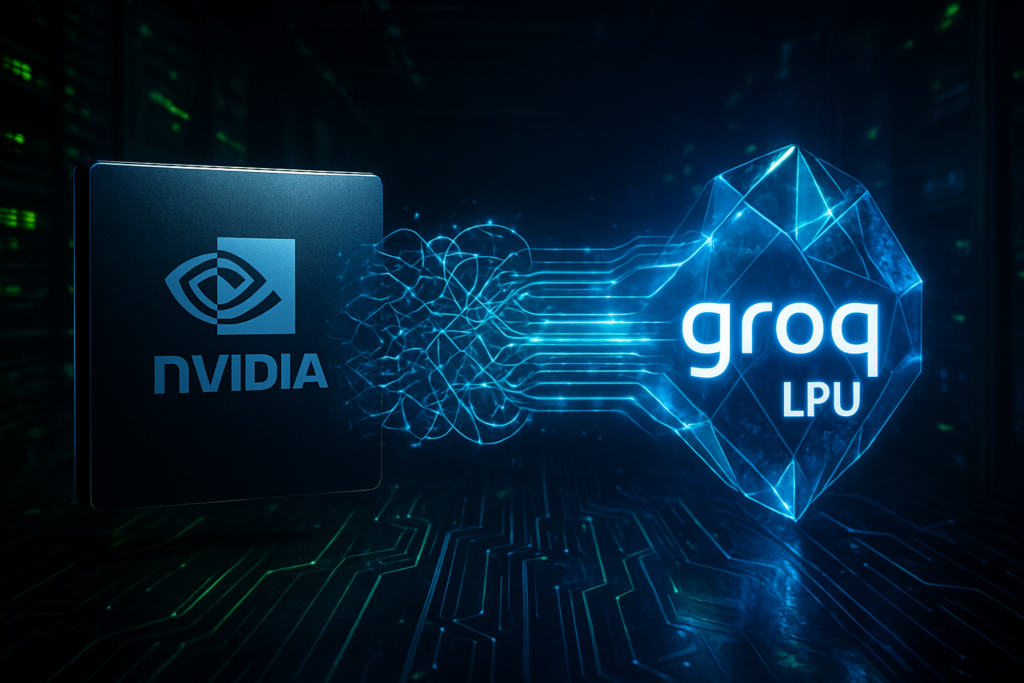
In a move that has sent shockwaves through Silicon Valley and the halls of global antitrust regulators, NVIDIA (NASDAQ: NVDA) has effectively neutralized its most formidable rival in the AI inference space through a complex $20 billion "reverse acquihire" and licensing agreement with Groq. Announced in the final days of 2025, the deal marks a pivotal shift for the chip giant, moving beyond its historical dominance in AI training to seize total control over the burgeoning real-time inference market. Personally orchestrated by NVIDIA CEO Jensen Huang, the transaction allows the company to absorb Groq’s revolutionary Language Processing Unit (LPU) technology and its top-tier engineering talent while technically keeping the startup alive to evade intensifying regulatory scrutiny.
The centerpiece of this strategic masterstroke is the migration of Groq founder and CEO Jonathan Ross—the legendary architect behind Google’s original Tensor Processing Unit (TPU)—to NVIDIA. By bringing Ross and approximately 80% of Groq’s engineering staff into the fold, NVIDIA has successfully "bought the architect" of the only hardware platform that consistently outperformed its own Blackwell architecture in low-latency token generation. This deal ensures that as the AI industry shifts its focus from building massive models to serving them at scale, NVIDIA remains the undisputed gatekeeper of the infrastructure.
The LPU Advantage: Integrating Deterministic Speed into the NVIDIA Stack
Technically, the deal centers on a non-exclusive perpetual license for Groq’s LPU architecture, a system designed specifically for the sequential, "step-by-step" nature of Large Language Model (LLM) inference. Unlike NVIDIA’s traditional GPUs, which rely on massive parallelization and expensive High Bandwidth Memory (HBM), Groq’s LPU utilizes a deterministic architecture and high-speed SRAM. This approach eliminates the "jitter" and latency spikes common in GPU clusters, allowing for real-time AI responses that feel instantaneous to the user. Initial industry benchmarks suggest that by integrating Groq’s IP, NVIDIA’s upcoming "Vera Rubin" platform (slated for late 2026) could deliver a 10x improvement in tokens-per-second while reducing energy consumption by nearly 90% compared to current Blackwell-based systems.
The hire of Jonathan Ross is particularly significant for NVIDIA’s software strategy. Ross is expected to lead a new "Ultra-Low Latency" division, tasked with weaving Groq’s deterministic execution model directly into the CUDA software stack. This integration solves a long-standing criticism of NVIDIA hardware: that it is "over-engineered" for simple inference tasks. By adopting Groq’s SRAM-heavy approach, NVIDIA is also creating a strategic hedge against the volatile HBM supply chain, which has been a primary bottleneck for chip production throughout 2024 and 2025.
Industry experts have reacted with a mix of awe and concern. "NVIDIA didn't just buy a company; they bought the future of the inference market and took the best engineers off the board," noted one senior analyst at Gartner. While the AI research community has long praised Groq’s speed, there were doubts about the startup’s ability to scale its manufacturing. Under NVIDIA’s wing, those scaling issues disappear, effectively ending the era where specialized "NVIDIA-killers" could hope to compete on raw performance alone.
Bypassing the Regulators: The Rise of the 'Reverse Acquihire'
The structure of the $20 billion deal is a sophisticated legal maneuver designed to bypass the Hart-Scott-Rodino (HSR) Act and similar antitrust hurdles in the European Union and United Kingdom. By paying a massive licensing fee and hiring the staff rather than acquiring the corporate entity of Groq Inc., NVIDIA avoids a formal merger review that could have taken years. Groq continues to exist as a "zombie" entity under new leadership, maintaining its GroqCloud service and retaining its name. This creates the legal illusion of continued competition in the market, even as its core intellectual property and human capital have been absorbed by the dominant player.
This "license-and-hire" playbook follows a trend established by Microsoft (NASDAQ: MSFT) with Inflection AI and Amazon (NASDAQ: AMZN) with Adept earlier in the decade. However, the scale of the NVIDIA-Groq deal is unprecedented. For major AI labs like OpenAI and Alphabet (NASDAQ: GOOGL), the deal is a double-edged sword. While they will benefit from more efficient inference hardware, they are now even more beholden to NVIDIA’s ecosystem. The competitive implications are dire for smaller chip startups like Cerebras and Sambanova, who now face a "Vera Rubin" architecture that combines NVIDIA’s massive ecosystem with the specific architectural advantages they once used to differentiate themselves.
Market analysts suggest this move effectively closes the door on the "custom silicon" threat. Many tech giants had begun designing their own in-house inference chips to escape NVIDIA’s high margins. By absorbing Groq’s IP, NVIDIA has raised the performance bar so high that the internal R&D efforts of its customers may no longer be economically viable, further entrenching NVIDIA’s market positioning.
From Training Gold Rush to the Inference Era
The significance of the Groq deal cannot be overstated in the context of the broader AI landscape. For the past three years, the industry has been in a "Training Gold Rush," where companies spent billions on H100 and B200 GPUs to build foundational models. As we enter 2026, the market is pivoting toward the "Inference Era," where the value lies in how cheaply and quickly those models can be queried. Estimates suggest that by 2030, inference will account for 75% of all AI-related compute spend. NVIDIA’s move ensures it won't be disrupted by more efficient, specialized architectures during this transition.
This development also highlights a growing concern regarding the consolidation of AI power. By using its massive cash reserves to "acqui-license" its fastest rivals, NVIDIA is creating a moat that is increasingly difficult to cross. This mirrors previous tech milestones, such as Intel's dominance in the PC era or Cisco's role in the early internet, but with a faster pace of consolidation. The potential for a "compute monopoly" is now a central topic of debate among policymakers, who worry that the "reverse acquihire" loophole is being used to circumvent the spirit of competition laws.
Comparatively, this deal is being viewed as NVIDIA’s "Instagram moment"—a preemptive strike against a smaller, faster competitor that could have eventually threatened the core business. Just as Facebook secured its social media dominance by acquiring Instagram, NVIDIA has secured its AI dominance by bringing Jonathan Ross and the LPU architecture under its roof.
The Road to Vera Rubin and Real-Time Agents
Looking ahead, the integration of Groq’s technology into NVIDIA’s roadmap points toward a new generation of "Real-Time AI Agents." Current AI interactions often involve a noticeable delay as the model "thinks." The ultra-low latency promised by the Groq-infused "Vera Rubin" chips will enable seamless, voice-first AI assistants and robotic controllers that can react to environmental changes in milliseconds. We expect to see the first silicon samples utilizing this combined IP by the third quarter of 2026.
However, challenges remain. Merging the deterministic, SRAM-based architecture of Groq with the massive, HBM-based GPU clusters of NVIDIA will require a significant overhaul of the NVLink interconnect system. Furthermore, NVIDIA must manage the cultural integration of the Groq team, who famously prided themselves on being the "scrappy underdog" to NVIDIA’s "Goliath." If successful, the next two years will likely see a wave of new applications in high-frequency trading, real-time medical diagnostics, and autonomous systems that were previously limited by inference lag.
Conclusion: A New Chapter in the AI Arms Race
NVIDIA’s $20 billion deal with Groq is more than just a talent grab; it is a calculated strike to define the next decade of AI compute. By securing the LPU architecture and the mind of Jonathan Ross, Jensen Huang has effectively neutralized the most credible threat to his company's dominance. The "reverse acquihire" strategy has proven to be an effective, if controversial, tool for market consolidation, allowing NVIDIA to move faster than the regulators tasked with overseeing it.
As we move into 2026, the key takeaway is that the "Inference Gap" has been closed. NVIDIA is no longer just a GPU company; it is a holistic AI compute company that owns the best technology for both building and running the world's most advanced models. Investors and competitors alike should watch closely for the first "Vera Rubin" benchmarks in the coming months, as they will likely signal the start of a new era in real-time artificial intelligence.
This content is intended for informational purposes only and represents analysis of current AI developments.
TokenRing AI delivers enterprise-grade solutions for multi-agent AI workflow orchestration, AI-powered development tools, and seamless remote collaboration platforms.
For more information, visit https://www.tokenring.ai/.