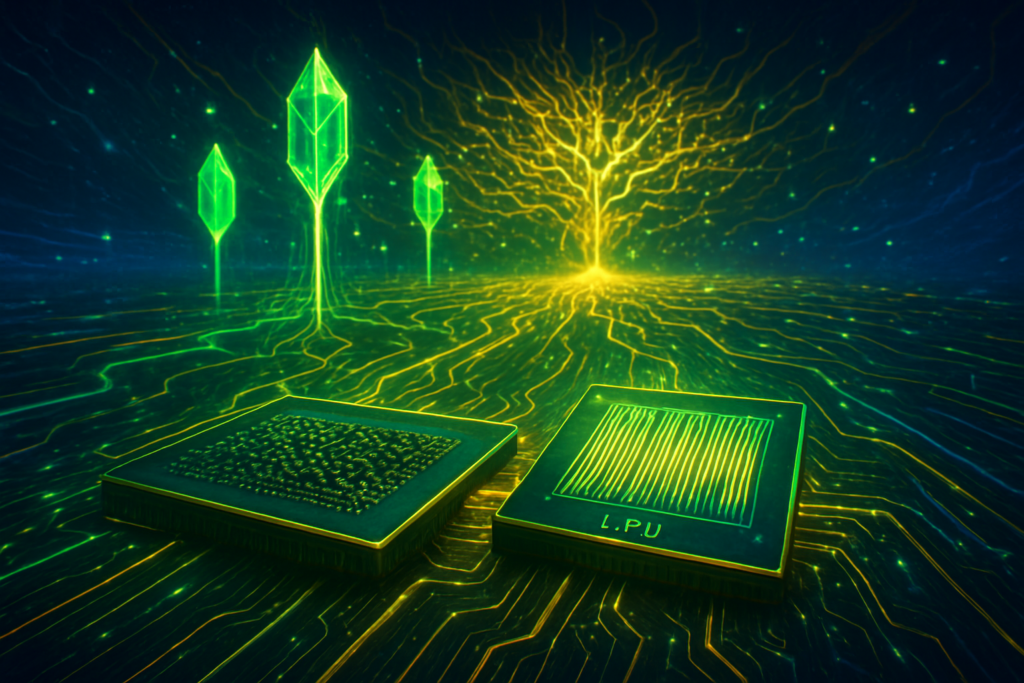
In a move that has sent shockwaves through the semiconductor industry, NVIDIA (NASDAQ: NVDA) has finalized a landmark $20 billion "license-and-acquihire" deal with the high-speed AI chip startup Groq. Announced in late December 2025, the transaction represents Nvidia’s largest strategic maneuver since its failed bid for Arm, signaling a definitive shift in the company’s focus from the heavy lifting of AI training to the lightning-fast world of real-time AI inference. By absorbing the leadership and core intellectual property of the company that pioneered the Language Processing Unit (LPU), Nvidia is positioning itself to own the entire lifecycle of the "AI Factory."
The deal is structured to navigate an increasingly complex regulatory landscape, utilizing a "reverse acqui-hire" model that brings Groq’s visionary founders, Jonathan Ross and Sunny Madra, directly into Nvidia’s executive ranks while securing long-term licensing for Groq’s deterministic hardware architecture. As the industry moves away from static chatbots and toward "agentic AI"—autonomous systems that must reason and act in milliseconds—Nvidia’s integration of LPU technology effectively closes the performance gap that specialized ASICs (Application-Specific Integrated Circuits) had begun to exploit.
The LPU Integration: Solving the "Memory Wall" for the Vera Rubin Era
At the heart of this $20 billion deal is Groq’s proprietary LPU technology, which Nvidia plans to integrate into its upcoming "Vera Rubin" architecture, slated for a 2026 rollout. Unlike traditional GPUs that rely heavily on High Bandwidth Memory (HBM)—a component that has faced persistent supply shortages and high power costs—Groq’s LPU utilizes on-chip SRAM. This technical pivot allows for "Batch Size 1" processing, enabling the generation of thousands of tokens per second for a single user without the latency penalties associated with data movement in traditional architectures.
Industry experts note that this integration addresses the "Memory Wall," a long-standing bottleneck where processor speeds outpace the ability of memory to deliver data. By incorporating Groq’s deterministic software stack, which predicts exact execution times for AI workloads, Nvidia’s next-generation "AI Factories" will be able to offer unprecedented reliability for mission-critical applications. Initial benchmarks suggest that LPU-enhanced Nvidia systems could be up to 10 times more energy-efficient per token than current H100 or B200 configurations, a critical factor as global data center power consumption reaches a tipping point.
Strengthening the Moat: Competitive Fallout and Market Realignment
The move is a strategic masterstroke that complicates the roadmap for Nvidia’s primary rivals, including Advanced Micro Devices (NASDAQ: AMD) and Intel (NASDAQ: INTC), as well as cloud-native chip efforts from Alphabet (NASDAQ: GOOGL) and Amazon (NASDAQ: AMZN). By bringing Jonathan Ross—the original architect of Google’s TPU—into the fold as Nvidia’s new Chief Software Architect, CEO Jensen Huang has effectively neutralized one of his most formidable intellectual competitors. Sunny Madra, who joins as VP of Hardware, is expected to spearhead the effort to make LPU technology "invisible" to developers by absorbing it into the existing CUDA ecosystem.
For the broader startup ecosystem, the deal is a double-edged sword. While it validates the massive valuations of specialized AI silicon companies, it also demonstrates Nvidia’s willingness to spend aggressively to maintain its ~90% market share. Startups focusing on inference-only hardware now face a competitor that possesses both the industry-standard software stack and the most advanced low-latency hardware IP. Analysts suggest that this "license-and-acquihire" structure may become the new blueprint for Big Tech acquisitions, allowing giants to bypass traditional antitrust blocks while still securing the talent and tech they need to stay ahead.
Beyond GPUs: The Rise of the Hybrid AI Factory
The significance of this deal extends far beyond a simple hardware upgrade; it represents the maturation of the AI landscape. In 2023 and 2024, the industry was obsessed with training larger and more capable models. By late 2025, the focus has shifted entirely to inference—the actual deployment and usage of these models in the real world. Nvidia’s "AI Factory" vision now includes a hybrid silicon approach: GPUs for massive parallel training and LPU-derived cores for instantaneous, agentic reasoning.
This shift mirrors previous milestones in computing history, such as the transition from general-purpose CPUs to specialized graphics accelerators in the 1990s. By internalizing the LPU, Nvidia is acknowledging that the "one-size-fits-all" GPU era is evolving. There are, however, concerns regarding market consolidation. With Nvidia controlling both the training and the most efficient inference hardware, the "CUDA Moat" has become more of a "CUDA Fortress," raising questions about long-term pricing power and the ability of smaller players to compete without Nvidia’s blessing.
The Road to 2026: Agentic AI and Autonomous Systems
Looking ahead, the immediate priority for the newly combined teams will be the release of updated TensorRT and Triton libraries. These software updates are expected to allow existing AI models to run on LPU-enhanced hardware with zero code changes, a move that would facilitate an overnight performance boost for thousands of enterprise customers. Near-term applications are likely to focus on voice-to-voice translation, real-time financial trading algorithms, and autonomous robotics, all of which require the sub-100ms response times that the Groq-Nvidia hybrid architecture promises.
However, challenges remain. Integrating two radically different hardware philosophies—the stochastic nature of traditional GPUs and the deterministic nature of LPUs—will require a massive engineering effort. Experts predict that the first "true" hybrid chip will not hit the market until the second half of 2026. Until then, Nvidia is expected to offer "Groq-powered" inference clusters within its DGX Cloud service, providing a playground for developers to optimize their agentic workflows.
A New Chapter in the AI Arms Race
The $20 billion deal for Groq marks the end of the "Inference Wars" of 2025, with Nvidia emerging as the clear victor. By securing the talent of Ross and Madra and the efficiency of the LPU, Nvidia has not only upgraded its hardware but has also de-risked its supply chain by moving away from a total reliance on HBM. This transaction will likely be remembered as the moment Nvidia transitioned from a chip company to the foundational infrastructure provider for the autonomous age.
As we move into 2026, the industry will be watching closely to see how quickly the "Vera Rubin" architecture can deliver on its promises. For now, the message from Santa Clara is clear: Nvidia is no longer just building the brains that learn; it is building the nervous system that acts. The era of real-time, agentic AI has officially arrived, and it is powered by Nvidia.
This content is intended for informational purposes only and represents analysis of current AI developments.
TokenRing AI delivers enterprise-grade solutions for multi-agent AI workflow orchestration, AI-powered development tools, and seamless remote collaboration platforms.
For more information, visit https://www.tokenring.ai/.