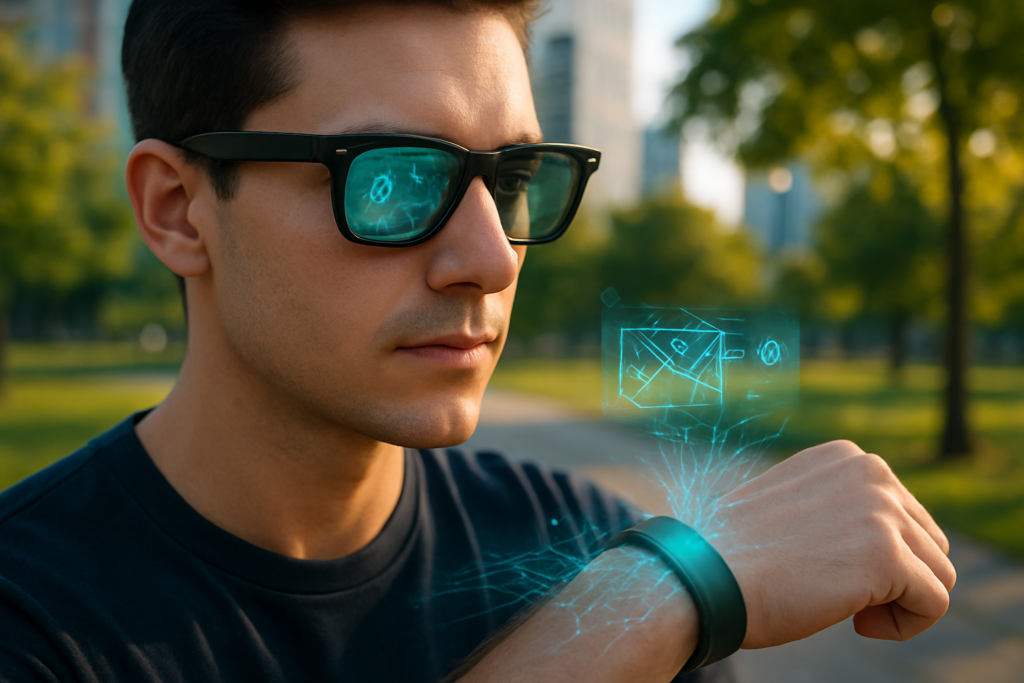
In a move that many industry analysts are calling the most significant hardware release since the original iPhone, Meta Platforms, Inc. (NASDAQ: META) has officially transitioned from the "metaverse" era to the age of ambient computing. The launch of the Ray-Ban Meta Display in late 2025 marks a definitive shift in how humans interact with digital information. No longer confined to a glowing rectangle in their pockets, users are now adopting a form factor that integrates seamlessly into their daily lives, providing a persistent, AI-driven digital layer over the physical world.
Since its release on September 30, 2025, the Ray-Ban Meta Display has rapidly moved from a niche enthusiast gadget to a legitimate contender for the title of primary computing device. By combining the iconic style of Ray-Ban frames with a sophisticated monocular display and a revolutionary neural wristband, Meta has successfully addressed the "social friction" that doomed previous attempts at smart glasses. This is not just an accessory for a phone; it is the beginning of a platform shift that prioritizes heads-up, hands-free interaction powered by advanced generative AI.
Technical Breakthroughs: LCOS Displays and Neural Control
The technical specifications of the Ray-Ban Meta Display represent a massive leap over the previous generation of smart glasses. At the heart of the device is a 600×600 pixel monocular display integrated into the right lens. Utilizing Liquid Crystal on Silicon (LCOS) waveguide technology, the display achieves a staggering 5,000 nits of brightness. This allows the digital overlay—which appears as a floating heads-up display (HUD)—to remain crisp and legible even in the harsh glare of direct midday sunlight. Complementing the display is an upgraded 12MP ultra-wide camera that not only captures 1440p video but also serves as the "eyes" for the onboard AI, allowing the device to process and react to the user’s environment in real-time.
Perhaps the most transformative component of the system is the Meta Neural Band. Included in the $799 bundle, this wrist-worn device uses Surface Electromyography (sEMG) to detect electrical signals traveling from the brain to the hand. This allows for "micro-gestures"—such as a subtle tap of the index finger against the thumb—to control the glasses' interface without the need for cameras to track hand movements. This "silent" control mechanism solves the long-standing problem of social awkwardness associated with waving hands in the air or speaking to a voice assistant in public. Experts in the AI research community have praised this as a masterclass in human-computer interaction (HCI), noting that the neural band offers a level of precision and low latency that traditional computer mice or touchscreens cannot match.
Software-wise, the device is powered by the Llama 4 family of models, which enables a feature Meta calls "Contextual Intelligence." The glasses can identify objects, translate foreign text in real-time via the HUD, and even provide "Conversation Focus" by using the five-microphone array to isolate and amplify the voice of the person the user is looking at in a noisy room. This deep integration of multimodal AI and specialized hardware distinguishes the Ray-Ban Meta Display from the simple camera-glasses of 2023 and 2024, positioning it as a fully autonomous computing node.
A Seismic Shift in the Big Tech Landscape
The success of the Ray-Ban Meta Display has sent shockwaves through the tech industry, forcing competitors to accelerate their own wearable roadmaps. For Meta, this represents a triumphant pivot from the much-criticized, VR-heavy "Horizon Worlds" vision to a more practical, AR-lite approach that consumers are actually willing to wear. By leveraging the Ray-Ban brand, Meta has bypassed the "glasshole" stigma that plagued Google (NASDAQ: GOOGL) a decade ago. The company’s strategic decision to reallocate billions from its Reality Labs VR division into AI-enabled wearables is now paying dividends, as they currently hold a dominant lead in the "smart eyewear" category.
Apple Inc. (NASDAQ: AAPL) and Google are now under immense pressure to respond. While Apple’s Vision Pro remains the gold standard for high-fidelity spatial computing, its bulk and weight make it a stationary device. Meta’s move into lightweight, everyday glasses targets a much larger market: the billions of people who already wear glasses or sunglasses. Startups in the AI hardware space, such as those developing AI pins or pendants, are also finding themselves squeezed, as the glasses form factor provides a more natural home for a camera and a display. The battle for the next platform is no longer about who has the best app store, but who can best integrate AI into the user's field of vision.
Societal Implications and the New Social Contract
The wider significance of the Ray-Ban Meta Display lies in its potential to change social norms and human attention. We are entering the era of "ambient computing," where the internet is no longer a destination we visit but a layer that exists everywhere. This has profound implications for privacy. Despite the inclusion of a bright LED recording indicator, the ability for a device to constantly "see" and "hear" everything in a user's vicinity raises significant concerns about consent in public spaces. Privacy advocates are already calling for stricter regulations on how the data captured by these glasses is stored and utilized by Meta’s AI training sets.
Furthermore, there is the question of the "digital divide." At $799, the Ray-Ban Meta Display is priced similarly to a high-end smartphone, but it requires a subscription-like ecosystem of AI services to be fully functional. As these devices become more integral to navigation, translation, and professional productivity, those without them may find themselves at a disadvantage. However, compared to the isolation of VR headsets, the Ray-Ban Meta Display is being viewed as a more "pro-social" technology. It allows users to maintain eye contact and remain present in the physical world while accessing digital information, potentially reversing some of the anti-social habits formed by the "heads-down" smartphone era.
The Road to Full Augmented Reality
Looking ahead, the Ray-Ban Meta Display is clearly an intermediate step toward Meta’s ultimate goal: full AR glasses, often referred to by the codename "Orion." While the current monocular display is a breakthrough, it only covers a small portion of the user's field of view. Future iterations, expected as early as 2027, are predicted to feature binocular displays capable of projecting 3D holograms that are indistinguishable from real objects. We can also expect deeper integration with the Internet of Things (IoT), where the glasses act as a universal remote for the smart home, allowing users to dim lights or adjust thermostats simply by looking at them and performing a neural gesture.
In the near term, the focus will be on software optimization. Meta is expected to release the Llama 5 model in mid-2026, which will likely bring even more sophisticated "proactive" AI features. Imagine the glasses not just answering questions, but anticipating needs—reminding you of a person’s name as they walk toward you or highlighting the specific grocery item you’re looking for on a crowded shelf. The challenge will be managing battery life and heat dissipation as these models become more computationally intensive, but the trajectory is clear: the glasses are getting smarter, and the phone is becoming a secondary accessory.
Final Thoughts: A Landmark in AI History
The launch of the Ray-Ban Meta Display in late 2025 will likely be remembered as the moment AI finally found its permanent home. By moving the interface from the hand to the face and the control from the finger to the nervous system, Meta has created a more intuitive and powerful way to interact with the digital world. The combination of LCOS display technology, 12MP optics, and the neural wristband has created a platform that is more than the sum of its parts.
As we move into 2026, the tech world will be watching closely to see how quickly developers build for this new ecosystem. The success of the device will ultimately depend on whether it can provide enough utility to justify its place on our faces all day long. For now, the Ray-Ban Meta Display stands as a bold statement of intent from Meta: the future of computing isn't just coming; it's already here, and it looks exactly like a pair of classic Wayfarers.
This content is intended for informational purposes only and represents analysis of current AI developments.
TokenRing AI delivers enterprise-grade solutions for multi-agent AI workflow orchestration, AI-powered development tools, and seamless remote collaboration platforms.
For more information, visit https://www.tokenring.ai/.