The end of an earnings season can be a great time to discover new stocks and assess how companies are handling the current business environment. Let’s take a look at how Mercury General (NYSE: MCY) and the rest of the property & casualty insurance stocks fared in Q4.
Property & Casualty (P&C) insurers protect individuals and businesses against financial loss from damage to property or from legal liability. This is a cyclical industry, and the sector benefits when there is 'hard market', characterized by strong premium rate increases that outpace loss and cost inflation, resulting in robust underwriting margins. The opposite is true in a 'soft market'. Interest rates also matter, as they determine the yields earned on fixed-income portfolios. On the other hand, P&C insurers face a major secular headwind from the increasing frequency and severity of catastrophe losses due to climate change. Furthermore, the liability side of the business is pressured by 'social inflation'—the trend of rising litigation costs and larger jury awards.
The 37 property & casualty insurance stocks we track reported a strong Q4. As a group, revenues beat analysts’ consensus estimates by 5%.
While some property & casualty insurance stocks have fared somewhat better than others, they have collectively declined. On average, share prices are down 2.3% since the latest earnings results.
Mercury General (NYSE: MCY)
Founded in 1961 and maintaining a network of over 6,300 independent agents across the country, Mercury General (NYSE: MCY) is an insurance company that primarily sells automobile insurance policies through independent agents in 11 states, with a strong focus on California.
Mercury General reported revenues of $1.54 billion, up 14.1% year on year. This print exceeded analysts’ expectations by 11.7%. Overall, it was an incredible quarter for the company with a beat of analysts’ EPS estimates and an impressive beat of analysts’ revenue estimates.
Gabe Tirador, the Company's CEO, commented on the 2025 results: "We are proud of our team's accomplishments in 2025. The Palisades and Eaton wildfires were the most significant catastrophes in Mercury's history, driving our first quarter combined ratio to 119.2%, but our business in subsequent quarters performed strongly ending with an 88.6% combined ratio in the fourth quarter and 96.3% for the full year. And our team demonstrated exceptional resilience and commitment to our policyholders, managing more than 2,900 wildfire claims and paying over $1.4 billion to date."
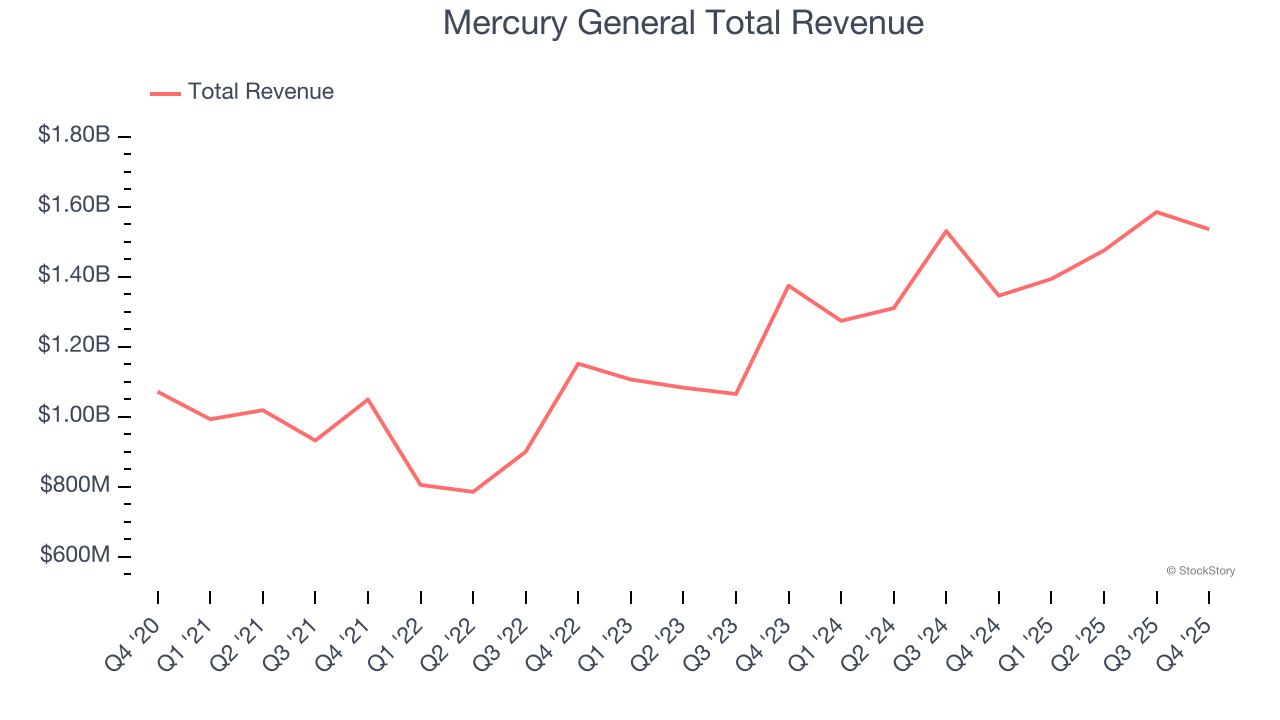
Unsurprisingly, the stock is down 6.1% since reporting and currently trades at $90.29.
Is now the time to buy Mercury General? Access our full analysis of the earnings results here, it’s free.
Best Q4: HCI Group (NYSE: HCI)
Starting as a Florida "take-out" insurer that assumed policies from the state-backed Citizens Property Insurance Corporation, HCI Group (NYSE: HCI) provides property and casualty insurance, primarily homeowners coverage, while leveraging proprietary technology to improve underwriting and claims processing.
HCI Group reported revenues of $246.2 million, up 52.1% year on year, outperforming analysts’ expectations by 3.8%. The business had an incredible quarter with a solid beat of analysts’ book value per share estimates and a beat of analysts’ EPS estimates.
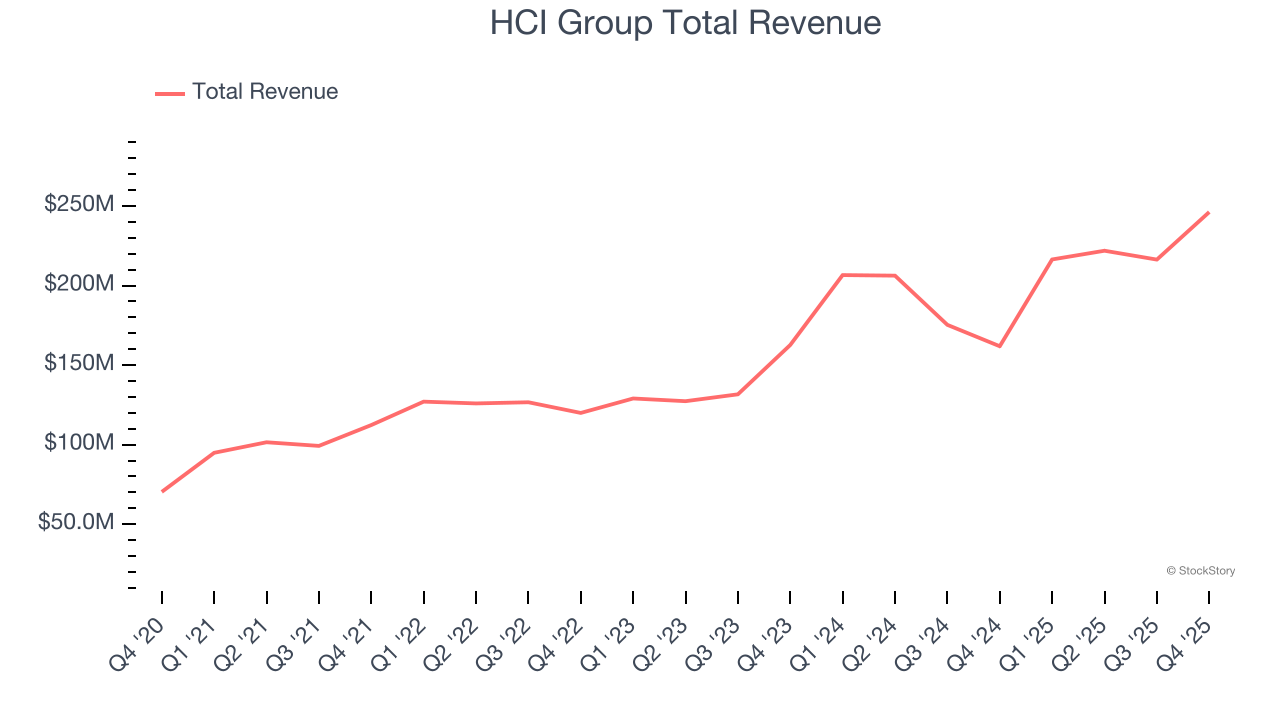
The market seems content with the results as the stock is up 2.7% since reporting. It currently trades at $167.85.
Is now the time to buy HCI Group? Access our full analysis of the earnings results here, it’s free.
Weakest Q4: Old Republic International (NYSE: ORI)
Founded during the Roaring Twenties in 1923 and weathering nearly a century of economic cycles, Old Republic International (NYSE: ORI) is a diversified insurance holding company that provides property, liability, title, and mortgage guaranty insurance through its various subsidiaries.
Old Republic International reported revenues of $2.36 billion, up 9.5% year on year, exceeding analysts’ expectations by 1.6%. Still, it was a softer quarter as it posted a significant miss of analysts’ EPS estimates and a significant miss of analysts’ book value per share estimates.
As expected, the stock is down 2.9% since the results and currently trades at $41.86.
Read our full analysis of Old Republic International’s results here.
Kinsale Capital Group (NYSE: KNSL)
Founded in 2009 during the aftermath of the financial crisis when many insurers were retreating from riskier markets, Kinsale Capital Group (NYSE: KNSL) is an insurance company that specializes in writing policies for hard-to-place, unusual, or high-risk businesses that standard insurers typically avoid.
Kinsale Capital Group reported revenues of $483.3 million, up 17.3% year on year. This print beat analysts’ expectations by 3.3%. It was a very strong quarter as it also put up an impressive beat of analysts’ net premiums earned estimates and a solid beat of analysts’ revenue estimates.
The stock is down 7.8% since reporting and currently trades at $369.75.
Read our full, actionable report on Kinsale Capital Group here, it’s free.
Stewart Information Services (NYSE: STC)
Founded in 1893 during America's westward expansion when property records were often disputed, Stewart Information Services (NYSE: STC) provides title insurance and real estate services, helping homebuyers, sellers, and lenders verify property ownership and protect against title defects.
Stewart Information Services reported revenues of $795.5 million, up 19.7% year on year. This result topped analysts’ expectations by 2.6%. Overall, it was a stunning quarter as it also recorded a beat of analysts’ EPS estimates and an impressive beat of analysts’ revenue estimates.
The stock is down 2.7% since reporting and currently trades at $67.
Read our full, actionable report on Stewart Information Services here, it’s free.
Want to invest in winners with rock-solid fundamentals? Check out our Top 5 Quality Compounder Stocks and add them to your watchlist. These companies are poised for growth regardless of the political or macroeconomic climate.
StockStory’s analyst team — all seasoned professional investors — uses quantitative analysis and automation to deliver market-beating insights faster and with higher quality.