As the United States enters the second year of the second Trump administration, the focus of global forecasting has shifted from the shock of the 2024 results to the high-stakes chess match of the 2026 Midterm elections. On January 15, 2026, prediction markets are signaling a dramatic pivot in American power: Polymarket and Manifold Markets currently place the odds of a Democratic takeover of the House of Representatives at a staggering 78% and 87%, respectively. Traders are betting heavily that the razor-thin Republican majority (220–213) will crumble under the weight of historical midterm trends and a series of brewing "catastrophe markets" abroad.
While the domestic political map looks grim for the incumbent party, the "signal" from geopolitical markets is even more intense. In the wake of the successful January 3rd capture of Nicolás Maduro in Venezuela—an event priced into markets hours before official confirmation—traders have turned their capital toward Iran. With a "Winter Uprising" rocking Tehran and U.S. military strikes before June 30 now sitting at a 74% probability, these platforms are no longer just betting hubs; they have become the primary "parallel intelligence" infrastructure for global observers.
The Market: What's Being Predicted
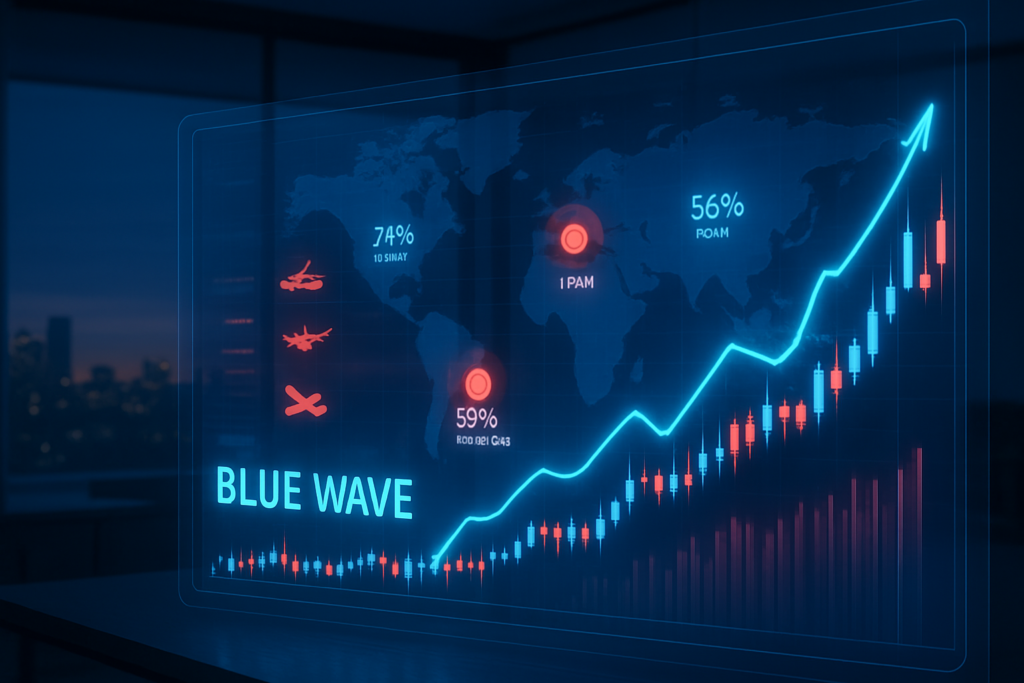
The 2026 Midterm markets are currently the highest-volume domestic contracts on Polymarket, drawing in tens of millions in liquidity. The primary contract, "Which party will control the House after the 2026 election?", has seen a massive "Blue Wave" shift. Democrats are trading at 79¢, reflecting a belief that a net gain of just three seats is a historical inevitability during a GOP trifecta. On Manifold, the "Split Congress" scenario (Democratic House, Republican Senate) is the dominant forecast at 62%, as the Senate map remains structurally difficult for Democrats to flip entirely.
Beyond the ballot box, "catastrophe markets" regarding Iran and Venezuela are seeing unprecedented volatility. On Polymarket, a contract titled "U.S. Military Action against Iran by June 30, 2026" has surged from 10% in late December to 74% today. This follows reports of over 2,500 deaths in the Iranian "Winter Uprising." Meanwhile, in Venezuela, despite the capture of Maduro, the "U.S. Invasion" contract remains a point of contention, trading at 22%. Traders are debating whether "special operations" qualify as an invasion, a semantic dispute that has led to millions of dollars being locked in escrow as the decentralized oracle UMA prepares a resolution.
Why Traders Are Betting
The divergence between market odds and official rhetoric is driven by what traders call "Alpha Raccoons"—pseudo-anonymous participants who appear to possess insider information or advanced surveillance data. During the "Maduro Trade" in early January, odds of the Venezuelan leader being "out of power" spiked from 8% to 65% a full six hours before News Corp (NASDAQ: NWSA) or the New York Times Company (NYSE: NYT) broke the story. Traders weren't watching cable news; they were monitoring the "Pizza Index" (late-night spikes in Pentagon deliveries) and tracking the repositioning of U.S. naval assets via open-source intelligence.
In the case of the 2026 Midterms, the heavy "Yes" on a Democratic House flip is fueled by "Skin in the Game." Unlike traditional pundits, prediction market participants are financially incentivized to ignore political spin. While GOP strategists point to a strong economy, traders are focused on the "incumbent fatigue" and the historically narrow margin of the current House majority. Institutional desks at firms like Susquehanna have increasingly used these markets to hedge against potential regulatory shifts that a "Blue House" might bring, particularly for tech giants like Alphabet Inc. (NASDAQ: GOOGL) and Microsoft Corp (NASDAQ: MSFT), which face ongoing antitrust scrutiny.
Broader Context and Implications
The rise of these markets represents a paradigm shift in how the public consumes "truth." In early 2026, the signal value of a Polymarket percentage often carries more weight in diplomatic circles than a State Department briefing. These "catastrophe markets" provide a brutal, real-time assessment of risk that traditional forecasting methods cannot match. When the odds of a strike on Iran hit 74%, insurance premiums for oil tankers in the Strait of Hormuz rise in tandem, showing a direct link between prediction markets and the global economy.
However, this "high signal" comes with significant regulatory and ethical concerns. The Public Integrity in Financial Prediction Markets Act of 2026, currently being debated in the House, seeks to address the "moral hazard" of betting on war. Critics argue that allowing individuals to profit from military strikes incentivizes sabotage or the leaking of classified information. Furthermore, the reliance of these platforms on cloud infrastructure from Amazon.com Inc. (NASDAQ: AMZN) has raised questions about "decentralization" and whether the government could theoretically "pull the plug" on markets that predict its own military secrets.
What to Watch Next
The immediate horizon is dominated by the June 30th "Strike Deadline." If U.S. military action in Iran does not occur by this date, the market could see a massive "liquidity drain" as traders recalibrate for a more diplomatic approach. Conversely, any official move toward a "government-in-exile" for Venezuela could send the "Regime Change" contracts on Kalshi and Polymarket into a frenzy.
On the domestic front, the first major "move" in the Midterm markets is expected following the President's State of the Union address in February. Traders will be looking for any signs of policy shifts that could alienate the moderate suburban voters who hold the key to the House. Additionally, watch for "whale activity" from new wallets; in 2025, several large-scale bets preceded major cabinet reshuffles, suggesting that the "insider proxy" effect remains the most potent force in these markets.
Bottom Line
As of January 15, 2026, prediction markets are flashing red for both the Republican House majority and the stability of the Middle East. The 79% probability of a Democratic House takeover suggests that traders view the current GOP trifecta as a short-term phenomenon, likely to be checked by voters in November. Simultaneously, the 74% odds of military action in Iran indicate that the world is on the precipice of a significant kinetic conflict, one that the markets have been "pricing in" for weeks.
These platforms have successfully transitioned from a curiosity into a "truth engine" that operates faster than traditional media. Whether it is the capture of a dictator or the flip of a Congressional seat, the markets are no longer just predicting the future—they are providing the earliest, most accurate map of the world as it actually exists. For global observers, the message is clear: if you want to know what happens next, don't watch the news—watch the tape.
This article is for informational purposes only and does not constitute financial or betting advice. Prediction market participation may be subject to legal restrictions in your jurisdiction.
PredictStreet focuses on covering the latest developments in prediction markets.
Visit the PredictStreet website at https://www.predictstreet.ai/.