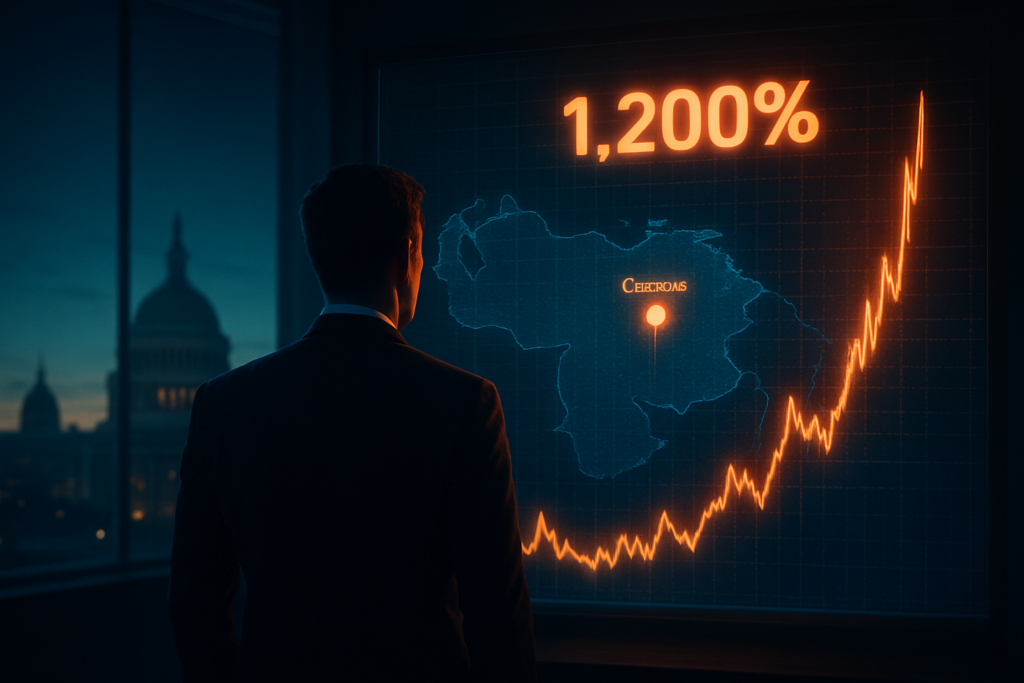
The capture of Venezuelan President Nicolás Maduro by U.S. forces on January 3, 2026, was a geopolitical shockwave that few saw coming. But while the world’s intelligence agencies and newsrooms were caught off guard, a single anonymous trader on the prediction platform Polymarket appeared to have a front-row seat to the planning. In a series of high-conviction bets placed just hours before the "snatch-and-extract" operation in Caracas, a user known as "Burdensome-Mix" turned a modest $32,000 into a windfall of over $400,000.
The trade has since become the center of a firestorm in Washington D.C. and New York, reigniting the debate over the legality and ethics of prediction markets. With odds on Maduro’s removal hovering at a mere 7% just before the raid, the sudden influx of "informed" capital has led lawmakers to question whether these platforms have become the ultimate venue for modern-day insider trading. The event, now dubbed the "Maduro Trade," is currently the primary exhibit in a push for federal regulation that could fundamentally alter the landscape of event-based betting.
The Market: What's Being Predicted
The controversy centers on several interlinked contracts hosted on Polymarket, a decentralized prediction platform that has surged in popularity despite its regulatory battles in the United States. The most prominent contract, "Maduro out by January 31, 2026?", saw relatively low volume throughout December as analysts remained skeptical of any immediate regime change in Venezuela. For much of the holiday season, shares were trading at approximately $0.07, representing a consensus probability of just 7%.
However, the liquidity of the market changed drastically on December 26, 2025, when the "Burdensome-Mix" account was created. The trader began accumulating "Yes" shares aggressively across four specific contracts: Maduro’s removal, the presence of U.S. forces in Venezuela, and a controversial market titled "Will the US invade Venezuela by January 31?" By the early hours of January 3, the trader had amassed a position of $32,537.
When news of the capture broke, the contracts "Yes" shares immediately spiked to $1.00. While the removal and troop presence contracts resolved smoothly, the "Invasion" contract, which saw over $10.5 million in total volume, became a flashpoint. Polymarket's refusal to initially pay out "Yes" holders—arguing that a tactical raid did not constitute a full-scale "invasion"—led to a "semantic freeze" that left millions in limbo and infuriated the trading community.
Why Traders Are Betting
The sheer precision of the "Maduro Trade" has led experts to believe this wasn't the result of superior geopolitical analysis, but rather what critics call the "Alpha Raccoon" effect. This term describes traders who exploit massive information asymmetry, likely derived from government or military leaks. Analysts note that "Burdensome-Mix" held four times more contracts than the next-highest bidder, suggesting a level of "conviction" that is rarely seen in speculative markets without inside knowledge.
Suspicion has also fallen on the intersection of the political and financial worlds. Scrutiny has specifically targeted the dual roles of prominent figures like Donald Trump Jr., whose firm 1789 Capital has invested heavily in the sector. With Trump Jr. serving as a strategic advisor to the regulated exchange Kalshi and an advisory board member for Polymarket, critics argue that the proximity between prediction market stakeholders and the executive branch creates a moral hazard where non-public military plans could be commodified.
From a trading perspective, the Maduro event showcased the limits of traditional forecasting. While mainstream media was focused on diplomatic stalemates, the "whisper" in the prediction markets was shouting. Proponents of the markets, such as economist Robin Hanson, argue that this is actually a feature, not a bug. They contend that the "Maduro Trade" forced private information into a public price, providing a more accurate signal to the world than any news outlet could offer.
Broader Context and Implications
The fallout from the Maduro Trade is now fueling a significant legislative push. On January 9, 2026, Rep. Ritchie Torres (D-NY) introduced the Public Integrity in Financial Prediction Markets Act of 2026. The bill aims to criminalize insider trading on these platforms by federal officials and their families. Torres has been vocal about his concerns, describing the current state of prediction markets as "the most corrupt corner of Washington."
In Albany, the New York State Assembly is moving forward with the ORACLE Act (A9251). If passed, the act would effectively ban New York residents from trading on contracts linked to political or catastrophic events, potentially classifying them as unlicensed gambling. This mirrors the aggressive stance taken by the CFTC under Chair Michael Selig, who has been pressured by a group of 12 Democratic senators, led by Catherine Cortez Masto, to investigate the "improbable" timing of the Caracas-related trades.
The financial community remains deeply divided. While some see these markets as essential tools for "hedging uncertainty"—a sentiment echoed by Thomas Peterffy, Chairman of Interactive Brokers (Nasdaq: IBKR)—others, like Daniel Taylor of the Wharton School, warn that the lack of robust oversight by the CFTC undermines the integrity of the entire financial system. Unlike the SEC's clear mandate over equities, the "event contract" space remains a regulatory gray zone.
What to Watch Next
The immediate focus for the industry is the progress of the Torres bill in D.C. and the ORACLE Act in New York. If these laws pass, they could force platforms like Polymarket to implement rigorous KYC (Know Your Customer) and "insider" screening processes similar to those used by traditional stock exchanges. We are also expecting a formal report from the CFTC by the end of Q1 2026 regarding the specific trades made by the "Burdensome-Mix" account.
Another key milestone is the resolution of the "Invasion" contract dispute. The outcome of this arbitration will set a precedent for how prediction markets handle "edge cases" where the technical definition of an event differs from the public's perception. If Polymarket is forced to pay out, it could face a liquidity crunch; if it refuses, it may lose the trust of its most active whales.
Finally, market watchers are looking at the 2026 midterm election markets. If "informed" trades continue to appear hours before major policy shifts or announcements, the calls for a total ban on political betting will likely become deafening. The maturation of these platforms hinges on their ability to prove they are tools for collective intelligence, not just laundry mats for classified leaks.
Bottom Line
The "Maduro Trade" has proven that prediction markets are no longer just a niche hobby for data nerds; they are potent, sometimes dangerous, tools of financial intelligence. A single trader turning $32,000 into $400,000 by betting on a secret military operation has stripped away the illusion that these platforms are immune to the same "insider" pressures that haunt Wall Street.
As we move further into 2026, the question is not whether prediction markets will exist, but who will be allowed to use them and under what constraints. While the efficiency of the "Maduro price signal" was undeniably high, the cost of that efficiency may be a wave of regulation that brings the "Wild West" era of Polymarket to a definitive end. For now, the "Alpha Raccoons" are in the spotlight, and Washington is finally reaching for the trap.
This article is for informational purposes only and does not constitute financial or betting advice. Prediction market participation may be subject to legal restrictions in your jurisdiction.
PredictStreet focuses on covering the latest developments in prediction markets.
Visit the PredictStreet website at https://www.predictstreet.ai/.