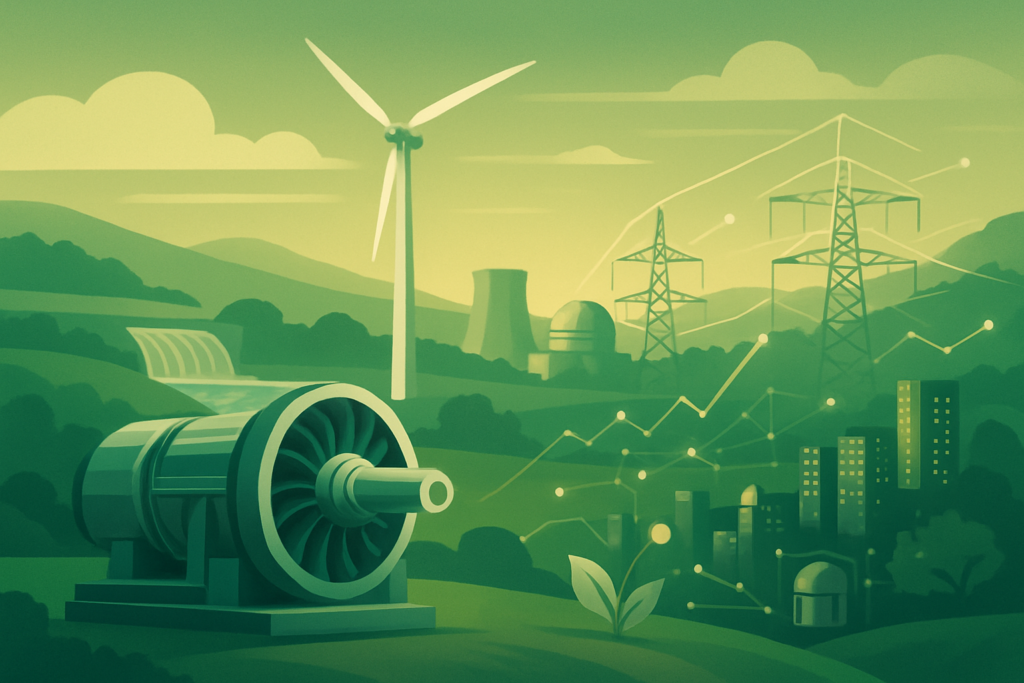
GE Vernova (NYSE: GEV) is a prominent energy equipment manufacturing and services company that has garnered significant attention, particularly as of December 10, 2025. Spun off from General Electric on April 2, 2024, GEV has quickly established itself as a critical player in the global energy transition, focusing on electrifying and decarbonizing the world. Its relevance is heightened by the increasing worldwide demand for electricity, significantly influenced by the proliferation of artificial intelligence (AI) data centers and the broader push for electrification across various industries and transportation.
GE Vernova’s core mission is to accelerate the energy transition by providing essential products and services across three primary segments: Power (gas, nuclear, hydro, and steam technologies), Wind (onshore and offshore wind turbines), and Electrification (grid solutions, power conversion, solar, and storage). Led by CEO Scott Strazik, the company is actively engaged in modernizing electrical grids and developing advanced energy technologies, with strategic investments in AI, robotics, and automation aimed at enhancing efficiency and reducing costs. Its substantial and expanding backlog, projected to reach approximately $200 billion by the end of 2028, underscores its pivotal role in future energy infrastructure development.
As of December 2025, GEV is in focus due to its robust financial performance, significantly raised multi-year financial outlook, enhanced shareholder returns (doubled quarterly dividend and increased share buyback authorization), and its critical role in addressing the "AI Power Crisis." The company's proactive approach to supply chain resilience, including strategic stockpiling of critical minerals like yttrium, further highlights its operational foresight in a turbulent geopolitical landscape.
2. Historical Background
GE Vernova officially launched as an independent public company on April 2, 2024, marking a pivotal moment in the energy sector. This spin-off was part of a strategic transformation initiated by General Electric (GE) to create three distinct, publicly traded entities: GE HealthCare, GE Aerospace, and GE Vernova. The decision, announced on November 9, 2021, aimed to provide deeper operational focus, accountability, and agility for each business.
GE Vernova's roots trace back over 130 years within General Electric's diverse portfolio, inheriting a legacy of innovation. During its time as a division of GE, the energy businesses that would form GE Vernova achieved numerous milestones, including the founding of GE Power (initially GE Energy) in 2008, the acquisition of Alstom's energy business in 2014-2015 leading to GE Renewable Energy, and groundbreaking advancements in gas turbine efficiency and wind technology. Scott Strazik was named CEO of the energy businesses in November 2021, and the name "GE Vernova" was unveiled in July 2022, signifying Earth's colors and new innovation. Its global headquarters opened in Cambridge, Massachusetts, in November 2023.
The formal separation involved several critical steps: GE's Board approved the spin-off in February 2024, followed by the record date for GE shareholders to receive GEV stock in March 2024. On April 2, 2024, GEV completed its spin-off, beginning regular-way trading on the NYSE under the ticker symbol GEV.
Since its spin-off, GEV has achieved significant milestones, including strong initial financial performance in Q1 2024, a remarkable stock surge of approximately 140% since its IPO, and strategic investments of nearly $600 million in U.S. factories. The company released its first Sustainability Report, continued innovation in hydrogen-ready gas turbines and advanced grid solutions, and secured its first international onshore wind repower upgrade contract with Taiwan Power Company in December 2025. Its updated financial projections for 2028, anticipating $52 billion in revenue and a 20% adjusted EBITDA margin, further underscore its post-spin-off momentum.
3. Business Model
GE Vernova's business model as of December 10, 2025, is centered on providing essential equipment, services, and software across the energy transition landscape, with a clear focus on electrifying and decarbonizing the world. The company capitalizes on increasing global demand for electricity, particularly from AI data centers and the broader push for sustainable energy.
Business Segments:
GE Vernova operates through three primary segments:
- Power: Focuses on gas, nuclear, hydro, and steam power technologies and services. The Gas Power business is a significant revenue driver due to robust demand for new equipment and services.
- Wind: Encompasses Onshore Wind, Offshore Wind, and Wind Turbine Blades. While making progress, this segment faces challenges, with organic revenue expected to decline in the low-double digits for 2025.
- Electrification: The fastest-growing segment, providing critical grid components and solutions, including Electrification Software, Grid Solutions, and Power Conversion & Storage. Demand is accelerating due to increased global grid investments.
These segments are supported by Accelerators, which include Advanced Research, Consulting Services, and Financial Services.
Revenue Sources:
GE Vernova generates revenue primarily from:
- Equipment Sales: Selling advanced energy equipment such as gas turbines, wind turbines, generators, transformers, and HVDC systems.
- Services: Providing comprehensive maintenance, upgrades, lifecycle services, and long-term service agreements, which contribute significantly to recurring revenue.
- Software Solutions: Offering electrification software like the GridOS® platform for optimizing energy operations.
For 2025, GEV anticipates total revenue towards the higher end of $36 billion to $37 billion, with mid-single-digit organic growth in Power, robust 25% organic growth in Electrification, and a high-single-digit organic decline in Wind.
Product Lines & Services:
- Power Segment: Includes diverse gas turbines (H-class, F-class, E-class, aeroderivative), steam turbines, generators, HRSGs, and decarbonization solutions like hydrogen-fueled turbines and carbon capture. Services cover equipment, lifecycle, controls, and long-term agreements.
- Wind Segment: Develops onshore and offshore wind turbines and blades, focusing on advanced drivetrains and controls.
- Electrification Segment: Provides grid solutions (transformers, switchgears, HVDC systems), power conversion & storage (FLEXINVERTER for solar/storage), and electrification software (Proficy portfolio, GridOS®).
Customer Base:
GE Vernova serves a diverse global customer base, including:
- Utilities & Independent Power Producers
- Municipalities & Cooperatives
- Data Centers & Hyperscalers (a rapidly growing segment due to AI demand)
- Industrial Customers (cement, cruise lines, mining, oil & gas)
- Governments and Energy Companies
The business model leverages its established expertise and large installed base while aggressively investing in solutions for decarbonization and electrification, benefiting from a growing backlog.
4. Stock Performance Overview
GE Vernova (GEV) began trading as an independent company on the New York Stock Exchange (NYSE) on April 2, 2024. Therefore, a direct 5-year and 10-year stock performance analysis for GEV is not applicable. This analysis focuses on its performance since inception, providing historical context from its former parent company, General Electric (GE), for longer-term perspectives.
1-Year Horizon (April 2024 – December 2025): Significant Growth
GE Vernova's stock has demonstrated remarkable growth since its spin-off. It started trading around $142 per share and, as of December 10, 2025, reached an all-time high of approximately $707.74. This represents an increase of over 370% since its spin-off, reflecting a compound annual growth rate of 118.53% over nearly two years.
Notable Stock Price Movements and Key Events Post-Spin-Off:
- April 2, 2024: Spin-off from GE and NYSE debut.
- July 24, 2024 (Q2 2024 Earnings): Reported net income of $1.28 billion (turnaround from loss), 1% revenue growth, and raised 2024 guidance, leading to a 2.4% pre-market gain.
- October 23, 2024 (Q3 2024 Earnings): Beat EPS estimates with $0.35, revenue up 8% to $8.9 billion, orders up 17% organically, and $1.0 billion in free cash flow.
- July 23, 2025 (Q2 2025 Earnings): Stock surged 13% after beating estimates, driven by power and electrification units. Raised full-year revenue and free cash flow forecasts, despite potential tariff impact on offshore wind.
- October 22, 2025 (Q3 2025 Earnings): Mixed results; revenue of $9.97 billion surpassed estimates, but EPS of $1.64 missed. Orders jumped 55% organically, though onshore wind weakness persisted.
- December 2025: Surged to a new record high of $707.74, up 13.2% in early trading. This followed a forecast of higher 2026 revenue, an increased share repurchase authorization to $10 billion, and a doubled quarterly dividend to $0.50 per share. Analysts noted all turbine production slots are sold out through 2028.
Context for 5-Year and 10-Year Horizons (Pre-Spin-Off GE Performance):
For periods prior to April 2024, GEV's performance was intertwined with General Electric. GE faced significant restructuring from 2015-2024, divesting non-core businesses after years of underperformance. The decision to split GE into three independent companies was announced in November 2021, aiming to unlock shareholder value. While GE's stock performance was challenged in the preceding decade, the spin-off of focused companies like GEV was largely met with positive analyst reception.
5. Financial Performance
GE Vernova has demonstrated strong financial performance and an optimistic outlook following its spin-off from General Electric. As of December 10, 2025, the company is exhibiting robust growth, expanding margins, and strategic capital allocation.
Context of Spin-Off:
GE Vernova officially spun off from GE on April 2, 2024, becoming an independent, publicly traded company (NYSE: GEV). This separation aimed to create focused industry leaders in energy, aerospace, and healthcare. GE shareholders received one share of GEV for every four shares of GE common stock.
Detailed Financial Performance as of December 10, 2025:
Latest Earnings (Q3 2025 and FY2025 Outlook):
- Orders: Surged to $14.6 billion, a 55% organic increase year-over-year.
- Revenue: $10.0 billion for Q3 2025, up 12% year-over-year (10% organically).
- Net Income: $0.5 billion, with a net income margin of 4.5%.
- Adjusted EBITDA: $0.8 billion, with an adjusted EBITDA margin of 8.1% (8.5% organically).
- EPS: $1.64, missing consensus estimates of $1.72.
- Cash from Operating Activities: $1.0 billion.
- Free Cash Flow (FCF): $0.7 billion.
- Full Year 2025 Outlook: Reaffirmed revenue towards the higher end of $36-$37 billion, adjusted EBITDA margin of 8%-9%. FCF guidance raised to $3.0-$3.5 billion.
Revenue Growth:
- TTM (Sept 30, 2025): $37.67 billion, up 9.44% YoY.
- Annual Revenue 2024: $34.935 billion, up 5.1% from 2023.
- Outlook for 2026: $41-$42 billion.
- Long-Term Outlook (by 2028): Raised to $52 billion (from $45 billion), implying low-double-digit organic CAGR from 2025.
Profit Margins:
- Q3 2025: Net income margin 4.5%, adjusted EBITDA margin 8.1% (8.5% organically).
- Outlook for 2025: Adjusted EBITDA margin 8%-9%.
- Outlook for 2026: Adjusted EBITDA margin 11%-13%.
- Long-Term Outlook (by 2028): Aiming for adjusted EBITDA margin of at least 20% (up from 14%).
Debt Levels:
GE Vernova maintains a strong balance sheet. As of September 30, 2025, long-term debt was reported as $0 million, with $7.9 billion in cash and equivalents. The company is largely considered "debt-free."
Cash Flow:
- Q3 2025: FCF $0.7 billion, operating cash flow $1.0 billion.
- Annual FCF 2024: $1.725 billion, up 243.63% from 2023.
- Outlook for 2025 FCF: Raised to $3.0-$3.5 billion.
- Outlook for 2026 FCF: Projected at $4.5-$5.0 billion.
- Cumulative FCF (2025-2028): Significantly increased to $22 billion (from $14 billion).
Key Valuation Metrics (as of December 10, 2025):
- Market Capitalization: Approximately $156.91-$168.73 billion.
- P/E Ratio: 99.6x to 112.99x (premium to industry average).
- Price/Sales (P/S) Ratio: 4.49x.
- Dividend: Doubled to $0.50 per share, payable Q1 2026.
- Share Buyback Program: Increased to $10 billion (from $6 billion).
- Current Stock Price: Surged to an all-time high of $707.74.
The company's investor update on December 9, 2025, was met with strong positive market reaction, driven by bullish long-term guidance and enhanced capital return plans, positioning GEV for sustained growth.
6. Leadership and Management
As of December 10, 2025, GE Vernova is led by a focused executive team and an experienced Board of Directors, all driving the company's mission to electrify and decarbonize the world.
CEO:
Scott Strazik serves as CEO and President. Appointed in April 2024, he brings over 20 years of GE leadership experience, having previously led GE's Gas Power and broader GE Power businesses. Strazik emphasizes a Lean culture for operational and financial performance, alongside investments in sustainable technologies. His 2025 compensation totaled $24.33 million, and he holds 0.034% of company shares.
Leadership Team:
GE Vernova's Executive Leadership Team, rated "A+" by Comparably, includes:
- Kenneth Parks: CFO
- Vic Abate: CEO, Wind
- Steven Baert: Chief People Officer
- Kristin Carvell: Chief Communications Officer
- Pablo Koziner: Chief Commercial & Operations Officer
- Lola Lin: Chief Legal Officer and Secretary
- Hon. Roger Martella: Chief Corporate Officer
- Philippe Piron: CEO, Electrification Systems
- Scott Reese: CEO, Electrification Software
- Maví Zingoni: CEO, Power
- Daniel Garceau: Chief Supply Chain Officer
The management team has an average tenure of approximately 1.7 years, indicating a relatively new team post-spin-off.
Board of Directors:
The Board oversees management and ensures long-term shareholder interests. Key members include:
- Stephen Angel: Non-Executive Chairman
- Scott Strazik: CEO of GE Vernova
- Nicholas Akins: Former Chairman and CEO of AEP
- Arnold Donald: Former President and CEO of Carnival
- Matthew Harris: Founding Partner of Global Infrastructure Partners
- Martina Hund-Mejean: Director
- Jesus Malave: CFO of Lockheed Martin
- Paula Rosput Reynolds: CEO of PreferWest
- Kim Rucker: Former General Counsel at Andeavor
- Jessica Uhl: Former CFO of Shell (transitioned to management in Jan 2024)
The board also has an average tenure of around 1.7 years.
Strategic Direction:
GE Vernova's strategy centers on leading the global energy transition. Key aspects include:
- Electrifying and Decarbonizing: Leveraging its 130-year legacy and installed base that powers ~25% of global electricity.
- Strong Financial Trajectory: Projecting $52 billion in revenue and 20% adjusted EBITDA margin by 2028, with $22 billion in cumulative free cash flow (2025-2028).
- Investing in Breakthrough Technologies: Planning $9 billion in cumulative CapEx and R&D through 2028, focusing on SMRs, carbon capture, and advanced grid solutions.
- Capitalizing on Electrification Demand: Benefiting from surging electricity demand from data centers and AI, with a projected backlog of $200 billion by 2028.
- Shareholder Returns: Doubled quarterly dividend to $0.50/share and increased share repurchase authorization to $10 billion, aiming to return at least one-third of cash generation to shareholders.
Corporate Governance Reputation:
GE Vernova is committed to strong governance, outlined in its Governance Principles and Board committee charters. It emphasizes independent risk oversight, with standing committees (Audit, Compensation, Nominating & Governance, Safety & Sustainability). The company adheres to a Code of Conduct and maintains an open reporting culture. This robust framework suggests a proactive approach to governance.
7. Products, Services, and Innovations
GE Vernova (GEV) is a prominent global energy company strategically focused on electrifying and decarbonizing the world. As of December 10, 2025, its offerings, innovation, and market strategies reflect a strong commitment to addressing the evolving demands of the energy sector.
Current Product and Service Offerings
GE Vernova's portfolio is structured around three core segments: Power, Wind, and Electrification.
1. Power Segment:
- Gas Turbines: Leading provider of H-class (9HA, 7HA), F-class (9F, 7F), E-class (9E, 7E), GT13E2, 6F, 6B, and aeroderivative gas turbines (LMS100, LM6000, LM2500, TM2500). These are crucial for grid firming, emergency power, and combined heat and power (CHP).
- Steam Turbines and Generators: Advanced solutions for various power plant applications.
- Heat Recovery Steam Generators (HRSG): Integral to power plant efficiency.
- Decarbonization Solutions: Focus on hydrogen-fueled gas turbines and carbon capture technology.
- Services: Comprehensive offerings including equipment upgrades, lifecycle services, long-term service agreements, and technical training.
2. Wind Segment:
- Onshore and Offshore Wind Turbines: Development of advanced drivetrain, controls, and blade technologies, including 100% recyclable wind turbine blades. Focus on efficient turbines like the 6.1 MW with a 158-meter rotor.
3. Electrification Segment:
- Grid Solutions: Provides switchgear, capacitors, instrument transformers, and software for grid modernization, crucial for integrating renewable energy.
- Power Conversion & Storage: Technologies like FLEXINVERTER for utility-scale solar and energy storage.
- Digital Solutions: Software for asset performance management and grid optimization.
Innovation Pipelines and Research & Development (R&D) Efforts
GE Vernova plans to invest approximately $1 billion annually in R&D, with a total of $9 billion in cumulative global capital expenditures and R&D through 2028. Key R&D areas include:
- Decarbonization Technologies: Direct Air Capture (DAC) systems, 100% hydrogen combustion capabilities, carbon capture and sequestration, and Small Modular Reactors (SMRs).
- Renewable Energy Acceleration: Developing adaptive wind farm controls, advanced drivetrain and blade technologies, and improving wind farm efficiency.
- Electrification and Grid Modernization: Research for the "grid of the future," critical infrastructure security, embedded systems, and cybersecurity.
- Digitalization, AI, Robotics & Software: Heavy investment in Generative AI, robotics, and software for optimizing energy systems and asset management.
- Advanced Manufacturing Techniques: Autonomous inspection and supply chain optimization.
- Materials Science: Novel sorbents for CO2 capture and alternatives to critical materials like yttrium.
Patents
As of 2024, GE Vernova held 36,000 patents and patent applications across 60 countries. Recent patent grants in 2025 cover wind turbine technology, turbine blade design, gas turbine systems (e.g., exhaust gas recirculation), and advanced manufacturing processes.
Competitive Edge in the Energy Sector
GE Vernova's competitive advantages include:
- Proprietary Technology: Advanced gas turbine designs, materials science, and combustion technologies.
- Large Installed Base: The largest global installed gas turbine fleet, generating substantial recurring service revenue.
- Digital Solutions: Leveraging software for asset performance management and grid optimization.
- Focus on Decarbonization and Electrification: Strategic alignment with global decarbonization efforts and increasing demand from AI/data centers.
- Innovation and Operational Efficiency: Continuous R&D, solution standardization, and advanced manufacturing.
- Supply Chain Resilience: Proactive risk management, such as yttrium stockpiling, to ensure production continuity.
- Strategic Partnerships: Collaborations with government agencies, industry, and academia.
8. Competitive Landscape
GE Vernova (GEV) operates within a dynamic and highly competitive energy landscape, focusing on power generation, wind energy, and electrification solutions. As of December 10, 2025, the company navigates significant industry shifts driven by global decarbonization, increasing electricity demand, and rapid technological advancements.
Main Industry Rivals:
- Power Generation (Gas Turbines): Primary competitors include Mitsubishi Power and Siemens Energy.
- Wind Energy (Wind Turbines): Key rivals in both onshore and offshore markets are Vestas, Siemens Gamesa Renewable Energy, Nordex SE, Goldwind, Enercon, Envision Energy, and MingYang Smart Energy.
- Electrification (Grid Solutions): GEV competes with major electrical equipment manufacturers and service providers offering HVDC systems, FACTS, and substation solutions. Broader competitors in energy technology include Siemens Energy and Vestas Wind Systems.
Estimated Market Share in Key Segments:
- Power Generation (Gas Turbines): GE Vernova captured 34% of the global market share in total megawatts (MWs) sold for gas turbines in 2024 and 22% of unit orders. It expects annualized output to reach 24 GW by 2028, with production slots sold out through 2028.
- Wind Energy (Wind Turbines): GEV is a top-tier player, among the world's top three cumulative wind turbine suppliers (with Vestas and Siemens Gamesa) as of end-2023. It was also among the top five turbine suppliers in Europe in 2024.
- Electrification (Grid Solutions): While specific percentages are not detailed, GEV anticipates its electrification segment backlog to double from $30 billion to $60 billion by year-end 2028, indicating strong projected growth and potential for market share gains.
Competitive Strengths:
- Strong Market Position: Dominant in power generation and grid technologies, contributing to ~30% of global electricity.
- Significant Order Backlog: Robust backlog ($135 billion, projected to $200 billion by 2028) provides strong revenue visibility.
- Technological Leadership: Proprietary gas turbine designs, materials science, and digital solutions. Exploring SMRs.
- Strategic Positioning: Well-aligned with global decarbonization and increasing electricity demand from AI/data centers.
- Financial Health: Strong performance, projected FCF of at least $22 billion (2025-2028), doubled dividend, and increased share repurchase authorization.
- Large Installed Base: Generates stable, recurring service revenue.
Weaknesses:
- Wind Segment Challenges: Persistent underperformance, high failure rates, and expected organic revenue declines and EBITDA losses.
- Supply Chain Vulnerabilities: Exposure to raw material shortages, high costs, and disruptions.
- Cyclical Markets and Competition: Exposure to economic fluctuations, intense competition, and potential oversupply.
- Regulatory and Geopolitical Uncertainties: Policy shifts, trade tensions, and geopolitical events can impact operations.
- High Capital Intensity: Requires significant capital investment.
9. Industry and Market Trends
GE Vernova (GEV) and the broader energy transition industry are navigating a complex landscape as of December 10, 2025, marked by robust growth in clean energy demand, evolving geopolitical dynamics, persistent supply chain challenges, and a mix of supportive and hindering policy shifts.
GE Vernova (GEV) Specific Trends and Outlook
GE Vernova is demonstrating strong financial performance and accelerating growth. For 2025, revenue is expected at the higher end of $36-$37 billion, with an 8%-9% adjusted EBITDA margin and $3.5-$4.0 billion in free cash flow. By 2028, GEV anticipates $52 billion in revenue and a 20% adjusted EBITDA margin, with cumulative free cash flow of at least $22 billion (2025-2028).
Key drivers include a growing equipment and services backlog (projected to $200 billion by 2028), strong equipment demand in Power and Electrification, and investments in AI, robotics, and breakthrough energy technologies (SMRs, carbon capture). While Power and Electrification show robust growth, the Wind segment faces ongoing challenges, with expected revenue declines and EBITDA losses.
Sector-Level Trends in the Energy Transition Industry
The global renewable energy market has surpassed $1.8 trillion in 2024 and is projected for continued double-digit growth. Solar and wind capacity additions are accelerating, potentially accounting for over 80% of new electricity capacity by 2030. Renewables are expected to surpass coal as the largest source of global electricity generation by late 2025 or mid-2026. However, the global renewable energy growth forecast for 2025-2030 has been revised downwards by 5% due to policy and market changes. Electrification trends, particularly from data centers, are significantly increasing electricity demand, making smart grids and battery storage essential.
Macro Drivers
- Geopolitical Shifts and Energy Security: Conflicts (Middle East, Ukraine) reinforce energy security concerns, driving diversification and strong policy support for LNG. Geopolitical battles over green technology are intensifying.
- Policy Environment: A potential shift in U.S. presidency (2025) could promote fossil fuels and cut clean energy provisions, though the global impact might be marginal as China leads in renewables. The Inflation Reduction Act (IRA) continues to spur U.S. clean energy investment. New international NDCs (Nationally Determined Contributions) for 2035 are expected.
- Inflation and Interest Rates: Inflation affects solar production costs, while higher interest rates impact project financing. Policy changes (e.g., RPI to CPI for UK subsidies) can also affect renewable investment trusts.
- Increasing Energy Demand from AI: The growth of AI and data centers is a major driver, boosting electricity demand and accelerating renewable energy project approvals.
Supply Chain Dynamics
The renewable energy supply chain faces complexity, global dependence, and vulnerabilities:
- Raw Material Shortages: Demand for critical minerals (lithium, cobalt, REEs) outpaces supply, with production concentrated in specific countries (China, DRC). Resource nationalism and long lead times for new mines exacerbate issues.
- Logistics and Transportation: Costly and complex shipping for large components, compounded by infrastructure gaps and trade barriers.
- Manufacturing and Production: High costs, global supply chain dependence, and skilled labor shortages hinder production. Bottlenecks in wind turbine components (blades, foundations, vessels) are emerging.
- Resilience Strategies: Industry focuses on diversification, localized supply chains, circular economy practices, and digitization/AI for forecasting and risk assessment.
Cyclical Effects
The energy transition industry is subject to cyclical effects:
- Investment Cycles: Global energy investment is projected to hit a record US$3.3 trillion in 2025, with US$2.2 trillion into clean energy. However, investment levels fluctuate with policy stability and economic forecasts.
- Policy Uncertainty: Policy fragmentation and shifts can introduce market uncertainty and temper growth rates.
- Project Delays and Costs: Supply chain bottlenecks, inflation, and lengthy permitting can cause delays and cost overruns.
10. Risks and Challenges
GE Vernova (GEV) faces a multifaceted risk landscape as of December 10, 2025, encompassing operational, regulatory, potential controversies, and market-related challenges. While the company has shown optimistic financial outlooks, inherent risks could impact its future performance.
Operational Risks
- Supply Chain Disruptions: Significant risks from high costs or unavailability of raw materials and components, potentially leading to project delays and increased costs.
- Project Execution and Cost Overruns: Large-scale power and grid projects carry inherent execution risks and potential for cost overruns, negatively impacting financial performance.
- Wind Business Challenges: The wind segment has experienced negative organic growth and faces ongoing issues with offshore wind "blade events" and project delays, contributing to skepticism and analyst downgrades.
- Cybersecurity Threats: Ongoing risks from cybersecurity threats could materially affect operations. The company employs third-party risk management processes and cybersecurity assessments.
- Technological Advancements: Rapid technological advancements pose a risk if GEV fails to innovate effectively.
Regulatory Risks
- Changes in Regulatory and Policy Environment: Shifts in government policies and incentives for renewable energy could directly impact demand for GEV's products and services.
- Influence on Energy Transition Policies: Operational and financial hurdles for GEV could influence the pace and direction of energy transition policies, potentially requiring additional government incentives.
- International Trade Policies and Geopolitical Risks: Global economic trends, trade policies (e.g., tariffs), and geopolitical risks can introduce regulatory uncertainties and impact global operations. The acquisition of Prolec GE is subject to regulatory approvals.
Potential Controversies
- Valuation and "Implausibly Positive" Margin Expectations: An October 2025 analyst downgrade cited "implausibly positive" margin expectations and "highly unproven" growth drivers (like AI demand) as concerns, suggesting potential controversy around the realism of GEV's ambitious forecasts.
- Insider Selling: An insider selling transaction by CFO Kenneth Scott Parks in August 2025 was noted as potentially contributing to negative market sentiment.
- Overvaluation Concerns in Broader Energy Transition Sector: GEV's challenges are sometimes seen as a "reality check" for the broader energy transition industry, suggesting parts of the sector might be overvalued.
Market Risks
- Premium Valuation and Overvaluation: GEV's stock trades at a premium, with a P/E ratio significantly higher than industry averages. Discounted Cash Flow (DCF) analysis in December 2025 suggested the stock was approximately 8.4% overvalued, implying high execution expectations.
- High Volatility and Market Sentiment: While GEV's beta of 0 suggests no correlation with overall market movements, its volatility is relatively high at 46.96. Market sentiment can shift rapidly, as seen with an October 2025 downturn after an analyst downgrade.
- Competition: Intense competition in the renewable energy sector could pressure margins.
- Macroeconomic and Geopolitical Conditions: Global economic trends, trade policies, and geopolitical risks can cause actual results to differ materially from expectations.
- Dependence on Energy Transition Momentum: Any slowdown or shift in the energy transition trend could impact demand for GEV's solutions. Over-reliance on the "AI boom" could also be a risk.
11. Opportunities and Catalysts
As of December 10, 2025, GE Vernova (GEV) is strategically positioned for significant growth, driven by escalating electricity demand, particularly from data centers, and the broader electrification of the economy. The company's recent 2025 Investor Update highlighted robust financial projections, expanded capital allocation plans, and a clear vision for capitalizing on the energy transition.
Growth Levers:
- AI and Data Center Electrification: The "AI boom" and soaring U.S. electricity demand from data centers are major drivers. GEV's expertise in high and medium voltage technologies positions it as a primary technology partner for hyperscalers, boosting its grid and gas-turbine businesses.
- Large and Growing Backlog: The total backlog is expected to grow from $135 billion to approximately $200 billion by 2028. The electrification segment's backlog is projected to double from $30 billion to $60 billion, providing strong visibility.
- Power and Electrification Segment Strength: Both segments are projected for high-teens organic revenue growth through 2028, with anticipated adjusted EBITDA margins of 22% each.
- Organic Investments and Innovation: GEV plans to invest $9 billion in cumulative global CapEx and R&D through 2028, focusing on advanced grid systems, low-carbon fuels, SMRs, AI, robotics, and automation.
- Services Revenue: More profitable, recurring Gas Power services revenue is anticipated to accelerate beginning in the 2030s.
Potential New Markets:
- Data Centers and Hyperscalers: A significant new market driven by AI, where GEV aims to be a primary technology partner.
- Electrification and Grid Modernization: Global push for electrification requires substantial grid upgrades, where GEV is a leading supplier.
- Decarbonization Technologies: Long-term strategy includes SMRs, hydrogen systems, carbon capture, and direct air capture, aligning with net-zero targets.
- Underserved Regions for Electricity: Opportunities to address electrification in regions lacking reliable power.
Merger and Acquisition (M&A) Opportunities:
- Prolec GE Acquisition: The acquisition of the remaining 50% stake in the Prolec GE joint venture for $5.275 billion (expected to close by mid-2026) will consolidate a leading grid equipment provider in North America, strengthening GEV's position in transformers and adding over $4 billion in revenue by 2028, immediately accretive to EBITDA.
- Targeted M&A in Core Businesses: GEV's capital allocation principles include targeted acquisitions to drive profitable growth within its core segments.
Near-Term Catalysts (as of 12/10/2025):
- 2025 Investor Update (December 9, 2025): This event was a significant catalyst, providing updated financial guidance (raised 2025 FCF, reaffirmed 2025 revenue, robust 2026 guidance, and significantly increased 2028 targets for revenue, EBITDA margin, and cumulative FCF).
- Dividend Doubling and Share Buyback Increase: Doubling the quarterly dividend to $0.50/share (payable Q1 2026) and increasing the share repurchase authorization to $10 billion demonstrates commitment to shareholder returns and financial strength.
- Upcoming Earnings Reports: Q4 2025 earnings (estimated Jan 28, 2026) and subsequent reports will provide further updates on execution against ambitious targets.
- Product Launches and Roadmap Updates: Ongoing updates on software roadmaps (iFIX, Historian, Operations Hub, APM), and expansion of g3 high voltage product portfolio (SF6-free substations) will showcase innovation.
- Policy Changes and Energy Transition Initiatives: Global decarbonization efforts and government incentives (like the IRA) continue to create a favorable market. Work with the U.S. government on yttrium stockpiles highlights policy impact.
- Workforce Expansion: Plans to increase its workforce by 5,000 (announced Oct 2025) signal growth and increased operational capacity.
12. Investor Sentiment and Analyst Coverage
Investor sentiment surrounding GE Vernova (GEV) as of December 10, 2025, is overwhelmingly positive, driven by strong Wall Street analyst ratings, significant institutional investment, and a recent surge in retail investor optimism following the company's 2025 Investor Update.
Wall Street Analyst Ratings
Wall Street analysts hold a highly favorable view, with a consensus rating of "Moderate Buy" and numerous recent price target increases.
- Consensus: "Moderate Buy" with a median target of $706.0 from 19 analysts in the last six months. Four firms issued "Strong Buy," twenty-one "Buy," seven "Hold," and two "Sell."
- Recent Upgrades/Target Increases:
- JPMorgan: Increased price target to Street-high $1,000 from $740, maintaining "Overweight."
- B of A Securities: Set new price target of $804.0, maintaining "Buy."
- UBS: Raised price target to $835 from $760, maintaining "Buy," citing potential conservatism in long-term guidance.
- Oppenheimer: Upgraded to "Outperform" with an $855 price target.
- RBC Capital: Upgraded to "Outperform" from "Sector Perform," with a price target of $761 (up from $630).
- Barclays: Upped price target to $720.0 from $710.0, maintaining "Overweight."
These positive revisions followed GEV's 2025 Investor Update, which significantly raised its multi-year financial outlook.
Recent Hedge Fund Activity
Hedge fund activity shows a mixed picture, with a net decrease in holdings by a tracked group of funds in the most recent reported quarter (likely Q3 2025). However, earlier data from Q4 2024 and Q2 2025 showed more institutional investors adding GEV shares than decreasing.
- Q4 2024: MOUNTAINEER PARTNERS MANAGEMENT, LLC removed 9.8 million shares; VANGUARD GROUP INC removed 3.5 million shares; CAPITAL INTERNATIONAL INVESTORS added 2.9 million shares.
- Q2 2025: GAMMA INVESTING LLC removed 2.1 million shares; D. E. SHAW & CO., INC. added 1.9 million shares (Q1 2025).
Despite some individual fund decreases, strong overall institutional ownership suggests continued confidence.
Significant Institutional Investor Positions
Institutional ownership is robust at 78.14%. As of September 30, 2025:
- Vanguard Group Inc.: 24.8 million shares (up 0.612%).
- FMR Llc: 22.6 million shares (down 8.522%).
- Blackrock, Inc.: 20.0 million shares (up 1.839%).
- State Street Corp: 11.2 million shares (up 1.266%).
- Geode Capital Management, LLC: 6.1 million shares (up 1.176%).
- JPMorgan Chase & Co.: Significantly increased position by 270.824%, holding 5.7 million shares.
Norges Bank also purchased a new stake in Q2 2025.
General Retail Investor Sentiment
Retail investor sentiment turned "extremely bullish" on Stocktwits following the December 10, 2025, investor event, accompanied by "extremely high" message volumes. This optimism is fueled by GEV's strengthened financial outlook, doubled quarterly dividend, and increased share buyback authorization. The company's focus on the energy transition, data centers, grid modernization, and nuclear investments has resonated positively. The stock's 10% premarket surge after the announcements indicates strong immediate market reaction.
13. Regulatory, Policy, and Geopolitical Factors
GE Vernova (GEV) operates within a rapidly evolving global energy landscape, characterized by significant shifts in regulatory frameworks, substantial government incentives aimed at decarbonization, and complex geopolitical dynamics as of December 10, 2025.
1. Relevant Laws and Regulatory Environment:
- United States: The Inflation Reduction Act (IRA) and Infrastructure Investment & Jobs Act (IIJA) continue to offer incentives for clean energy. However, a potential shift in administration (early 2025) could prioritize fossil fuels, potentially slowing wind/solar development. The ADVANCE Act (July 2024) and new executive orders (May 2025) aim to accelerate nuclear technology deployment. State regulators are updating electric system planning for grid modernization.
- European Union: The EU Green Deal and REPowerEU Plan drive clean energy transition. The EU Emissions Trading System (ETS) is expanding, with a new ETS II launching in 2027. Infrastructure modernization initiatives are proposed, and new ESG regulations (CSRD, FLR, EUDR) intensify reporting and supply chain transparency requirements from December 2025.
- China: The New Energy Law (effective Jan 1, 2025) promotes renewable energy, enhances energy security, and supports "dual carbon" goals (peak emissions before 2030, carbon neutrality by 2060). China's 2025 Hydrogen Energy Development Report outlines its hydrogen leadership roadmap.
2. Compliance Requirements:
- ESG Reporting: By 2025, ESG reporting is critical, with GEV needing to align with evolving regulations (ISSB, EU Green Deal, SEC climate disclosures). Mandatory water risk and biodiversity impact assessments are expected.
- Emissions Monitoring and Carbon Pricing: Robust measurement, reporting, and verification frameworks are required for participation in carbon pricing mechanisms like the EU ETS.
- Supply Chain Due Diligence: Regulations like EUDR and FLR necessitate enhanced due diligence for supply chains, ensuring deforestation-free products and no forced labor.
3. Government Incentives:
- Clean Energy Transition Funding: Governments globally are increasing RDD&D funding for clean energy technologies.
- U.S. Incentives: The IRA provides substantial tax credits for clean energy generation, manufacturing, and storage. GEV has invested in U.S. onshore wind manufacturing due to IRA certainty.
- EU Incentives: The EU is scaling up financial support for clean energy infrastructure (e.g., increased Connecting Europe Facility budget, REPowerEU support for solar/heat pumps).
- China Incentives: The new Energy Law encourages market-based measures and green electricity certificates. The "Made in China 2025" strategy has propelled domestic clean tech leadership.
- Global Nuclear Support: Increasing global recognition and financial support for nuclear energy, including SMRs.
4. Geopolitical Risks and Opportunities:
- Geopolitical Risks: U.S. policy uncertainty could slow renewables. Trade tensions and tariffs (e.g., proposed import tariffs, CBAM) could disrupt global trade and increase supply chain costs. Supply chain vulnerabilities (e.g., "foreign entities of concern" restrictions) could intensify pressures. Ongoing global conflicts create market volatility.
- Geopolitical Opportunities: The global push for energy security (especially in Europe) accelerates clean energy transition. Growing demand from AI and data centers drives interest in reliable, carbon-free power (SMRs, robust grid). Global decarbonization commitments translate into sustained investment. Renewables and nuclear market growth, alongside the development of a hydrogen economy, present substantial opportunities for GEV.
14. Outlook and Scenarios
GE Vernova (GEV) is poised for significant growth in the coming years, driven by its strategic positioning in the global energy transition, particularly in electrification and gas power. As of December 10, 2025, the company has provided an upbeat financial outlook, though potential headwinds, particularly concerning its wind power segment and valuation, are also present.
Short-Term vs. Long-Term Projections (as of 12/10/2025):
- 2025 Outlook: Revenue towards the higher end of $36-$37 billion, Adjusted EBITDA Margin 8%-9%, FCF raised to $3.5-$4 billion.
- 2026 Guidance: Revenue $41-$42 billion, Adjusted EBITDA Margin 11%-13%, FCF $4.5-$5 billion. Power segment organic revenue growth of 16%-18%, Electrification 20%.
- By 2028 Outlook: Revenue raised to $52 billion (from $45 billion), Adjusted EBITDA Margin at least 20% (from 14%). Cumulative FCF (2025-2028) increased to at least $22 billion (from $14 billion). Backlog expected to reach $200 billion.
- Longer-Term Projections (Beyond 2028): Positioned for substantially higher returns, driven by growing backlog, more profitable recurring Gas Power services revenue starting in the 2030s, and expanded investments in AI and automation. Stock price forecasts extend significantly, indicating substantial long-term appreciation potential.
Bull Case Scenarios:
The bullish outlook is driven by:
- Electrification Demand & AI Boom: Surging electricity use from AI and data centers is a major driver for GEV's grid and gas-turbine businesses. GEV aims to be a primary technology partner for hyperscalers.
- Strong Backlog and Pricing: A large and growing backlog provides strong revenue visibility and healthy margins from services and better equipment pricing. Gas turbine production slots are sold out through 2028.
- Gas Power Segment Growth: Expected to deliver substantially higher long-term service agreement (LTSA) revenue and significant margin expansion.
- Strategic Capital Allocation: Doubled quarterly dividend and increased share repurchase authorization signal strong financial health and commitment to shareholder returns.
- Acquisition of Prolec GE: Expected to strengthen GEV's position in North American grid equipment, add over $4 billion in revenue by 2028, and be immediately accretive to EBITDA.
Bear Case Scenarios:
Potential headwinds forming a bear case include:
- Valuation Concerns: Some analysts argue GEV's stock is "priced for perfection" with a stretched valuation, leaving little room for error.
- Wind Business Underperformance: The Wind business remains a persistent challenge, facing losses, tariffs, and project delays. Management cut FY25 wind revenue guidance, expecting a significant EBITDA loss for the segment.
- Execution Risks & Supply Chain: Concerns remain about consistent execution on large-scale projects, navigating supply chain inefficiencies, and managing elevated input costs.
- Sustainability of AI-driven Demand: Skepticism exists regarding the "highly unproven" risks related to the long-term sustainability of AI-driven demand in the U.S. market.
- Competition and Regulatory Headwinds: While GEV dominates the turbine market, reliance on fossil fuels through LTSAs could become a liability as decarbonization pressures intensify.
Potential Strategic Pivots:
GE Vernova is actively pursuing pivots:
- Increased R&D and Emerging Technologies: Focusing on SMRs, carbon capture, solid oxide fuel cells, and advanced grid-related technologies.
- Targeted Mergers & Acquisitions (M&A): The Prolec GE acquisition highlights a strategy to strengthen capabilities in critical growth areas.
- Focus on Recurring Services Revenue: A key long-term strategy involves growing profitable, recurring Gas Power services revenue.
- Operational Excellence and Cost Discipline: Essential for achieving ambitious 2028 EBITDA margin targets.
- Balanced Capital Allocation: Returning at least one-third of cash generation to shareholders while funding organic growth and targeted M&A.
15. Conclusion
As of December 10, 2025, GE Vernova (NYSE: GEV) stands as a compelling investment case, strategically positioned at the forefront of the global energy transition. Its recent spin-off from General Electric has allowed it to sharpen its focus on electrifying and decarbonizing the world, a mission that aligns perfectly with burgeoning global demand for reliable and sustainable power.
Summary of Key Findings:
GE Vernova's financial performance since its spin-off has been robust, marked by strong order growth, rising revenues, expanding margins, and significantly increased free cash flow guidance through 2028. The company's 2025 Investor Update painted an optimistic picture, projecting $52 billion in revenue and a 20% adjusted EBITDA margin by 2028, along with at least $22 billion in cumulative free cash flow. This confidence is underscored by a doubled quarterly dividend and an increased share repurchase authorization, signaling a strong commitment to shareholder returns.
Operationally, GEV benefits from a substantial and growing backlog, particularly in its Power and Electrification segments, which are thriving on the back of surging electricity demand from AI data centers and global grid modernization efforts. Its competitive edge stems from proprietary technology, a massive installed base generating recurring service revenue, and a relentless focus on innovation in areas like SMRs, hydrogen-ready turbines, and advanced grid solutions.
Balanced Perspective for Investors:
Bullish arguments center on GE Vernova's pivotal role in the energy transition, its robust financial trajectory, and its ability to capitalize on secular trends like AI-driven power demand. The strong backlog provides excellent revenue visibility, and the company's commitment to shareholder returns enhances its appeal. The strategic acquisition of the remaining stake in Prolec GE is expected to significantly bolster its Electrification segment.
However, a bearish perspective highlights ongoing challenges in the Wind segment, which continues to face organic revenue declines and profitability issues. Concerns about a premium valuation, execution risks on large projects, and vulnerabilities to supply chain disruptions (as seen with yttrium) also temper enthusiasm. The long-term sustainability of AI-driven demand and intense competition in certain markets remain considerations.
Crucial Aspects to Monitor:
Investors should closely watch several key areas:
- Wind Business Turnaround: The successful turnaround and profitability of the Wind segment are crucial for overall performance.
- Execution of Ambitious Targets: GEV's ability to consistently meet its significantly raised financial targets for revenue, margins, and free cash flow will be paramount.
- Supply Chain Resilience: Strategies for mitigating supply chain risks, diversifying sourcing, and managing commodity price volatility are crucial.
- Capital Allocation Effectiveness: How the company balances organic growth investments, targeted M&A, and shareholder returns will be important.
- Innovation and Technology Adoption: Continued investment and successful commercialization of breakthrough technologies are vital for maintaining a long-term competitive advantage.
- Global Economic and Geopolitical Factors: The broader energy sector remains susceptible to macroeconomic uncertainties, regulatory shifts, and geopolitical events, which can affect demand, project timelines, and supply chains.
In summary, GE Vernova is a company with significant potential, driving essential change in the global energy landscape. While the path forward will involve navigating inherent industry challenges, its strategic focus, strong financial health, and commitment to innovation position it as a key player in the transition to a more electrified and decarbonized world.
This content is intended for informational purposes only and is not financial advice