The global energy landscape was thrust into a state of high-stakes volatility today, March 19, 2026, following a sophisticated series of attacks on the Ras Laffan Industrial City in Qatar. As the world’s largest liquefied natural gas (LNG) export hub, the facility serves as the central nervous system for international gas supplies; its sudden neutralization has sent shockwaves through commodity exchanges from London to Amsterdam.
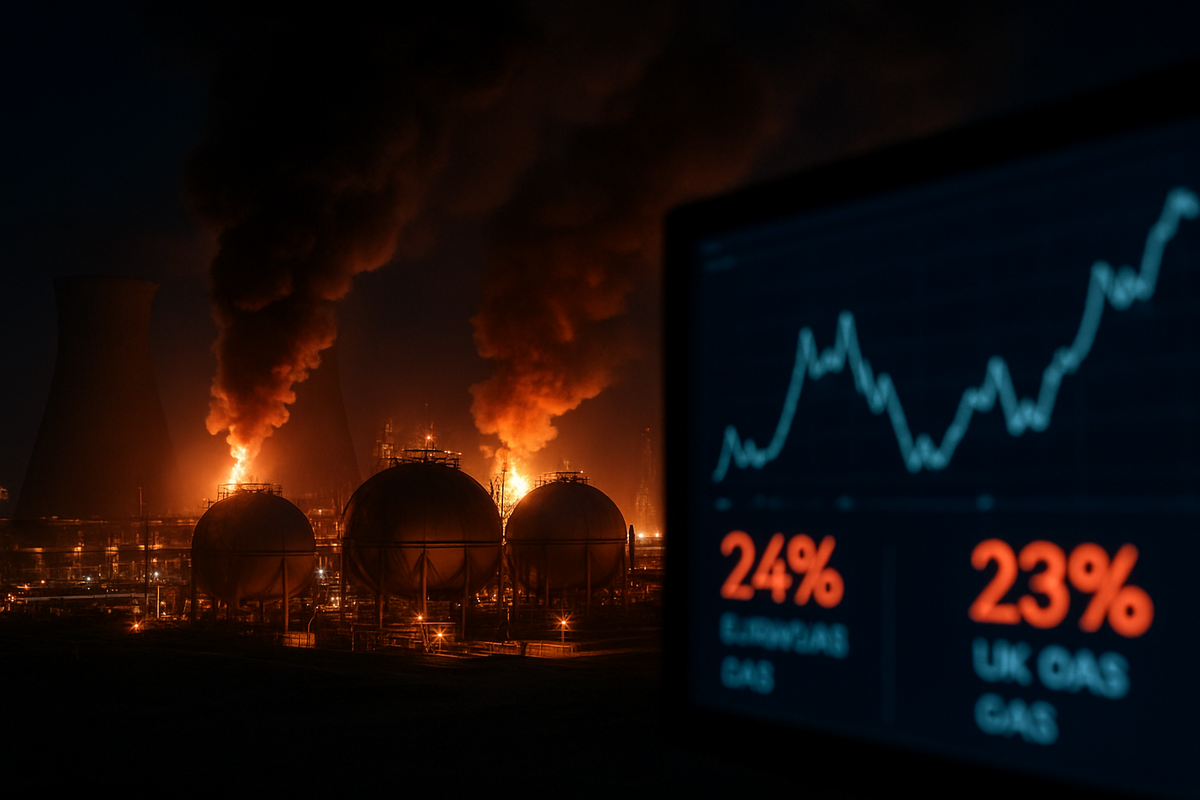
The immediate fallout was visible in wholesale energy markets, where European Dutch gas prices surged by 24%, while UK gas prices jumped 23% in a matter of hours. This supply shock arrives at a precarious moment for global energy security, as an escalating conflict between Iran and Israel threatens to turn the Persian Gulf into a maritime "no-go" zone, leaving households across Europe and Asia facing the prospect of record-breaking utility bills and industrial rationing.
The Strike at Ras Laffan: A Timeline of Chaos
The attack on the Ras Laffan facility occurred in the early hours of March 19, 2026. While the Qatari government has yet to release full forensic details, initial reports suggest a coordinated drone and missile strike targeting the primary "LNG trains"—the massive liquefaction units that cool gas for export. The facility, which is the primary outlet for the massive North Field, handles nearly 20% of the world’s LNG supply. The resulting fires were visible from space, and while emergency crews moved quickly to contain the damage, QatarEnergy announced a force majeure on several long-term contracts, effectively halting shipments to major hubs.
The timeline of this escalation dates back several weeks, as tensions between Iran and Israel reached a boiling point over disputed naval boundaries and proxy skirmishes in Lebanon. By mid-March, the "shadow war" had moved into the open, with both nations trading long-range strikes. The attack on Ras Laffan represents a significant shift in target selection, moving from military assets to the economic arteries of the global economy. In a cascading effect, energy operations in neighboring Abu Dhabi and Bahrain were also halted as a precautionary measure, as regional players including Abu Dhabi National Oil Company (ADNOC) and Bapco Energies scrambled to protect their own offshore infrastructure from potential follow-up strikes.
The initial market reaction was one of pure "panic buying." Traders at the Title Transfer Facility (TTF) in the Netherlands—the benchmark for continental Europe—described a "liquidity vacuum" as sellers disappeared, fearing a prolonged outage. By the mid-day session, the 24% spike in Dutch wholesale prices signaled that the market is now pricing in a "worst-case scenario" for the upcoming storage-refilling season.
Corporate Fallout: Winners, Losers, and the Energy Giants
For the major international oil companies (IOCs) that have spent decades partnering with Qatar, the attack is a double-edged sword. Shell PLC (LSE:SHEL) and Exxon Mobil Corporation (NYSE: XOM) are the primary Western stakeholders in Ras Laffan, with billions invested in the Pearl GTL and various LNG expansion projects. While the surge in global gas prices theoretically boosts the value of their non-Qatari assets, the physical damage to their crown jewel infrastructure in the Gulf represents a massive operational setback and a likely multi-billion dollar hit to near-term earnings.
On the losing side of the ledger are European utilities and industrial giants. Companies like Centrica PLC (LSE:CNA) in the UK and Uniper SE (ETR:UN01) in Germany are facing an immediate spike in procurement costs that may not be fully recoverable from consumers. Furthermore, heavy industrial users of gas, such as chemical manufacturer BASF SE (ETR:BAS), may be forced to curtail production if high prices persist, potentially triggering a wider manufacturing recession in the Eurozone.
Conversely, US-based LNG exporters could emerge as the market's "lenders of last resort." Cheniere Energy, Inc. (NYSE: LNG) and Sempra (NYSE: SRE) saw their shares climb in pre-market trading as investors bet on a surge in demand for American spot cargoes. With the Middle East increasingly viewed as a high-risk zone, the "security premium" attached to North American gas is reaching levels not seen since the initial days of the 2022 energy crisis.
Geopolitical Contagion and the Strait of Hormuz
The significance of this event extends far beyond the physical damage at Ras Laffan. It signifies a total breakdown in the regional security architecture of the Middle East. With the Iran-Israel conflict now directly impacting neutral energy infrastructure, the Strait of Hormuz—the world’s most critical chokepoint for both oil and gas—is effectively under a "functional blockade." The threat of Iranian retaliation against any vessel exiting the Persian Gulf has caused marine insurance premiums to skyrocket, making it nearly impossible for tankers to secure coverage for transit.
This event fits into a broader trend of "energy weaponization" that has characterized the mid-2020s. Similar to the sabotage of the Nord Stream pipelines in years past, the Ras Laffan attack proves that even the most well-defended energy hubs are vulnerable to modern asymmetric warfare. Regulatory bodies in the EU and the UK are already holding emergency meetings to discuss "Price Cap 2.0" initiatives, though experts warn that caps will do little to solve a physical lack of molecules.
The historical precedent for such a shock is often cited as the 1973 Oil Embargo, but the 2026 LNG crisis is arguably more complex. Unlike oil, which can be rerouted with some flexibility, LNG depends on specialized infrastructure. If Ras Laffan remains offline for months, the global market will face a structural deficit that no amount of "strategic reserves" can bridge, potentially leading to a permanent shift in how energy-intensive industries are located globally.
The Road Ahead: Rationing and Strategic Pivots
In the short term, the market is bracing for extreme volatility as satellite imagery and ground reports from Qatar clarify the extent of the damage. If the "LNG trains" can be repaired within weeks, the 20-30% price spikes may moderate. However, a long-term outage will force European and Asian nations into "energy defense" mode. This likely includes the mandatory reduction of gas use in power generation and the reactivation of any remaining coal or oil-fired plants to preserve gas for essential heating and industrial processes.
Longer term, this shock will accelerate the strategic pivot away from Middle Eastern gas dependency. We can expect a massive surge in investment toward "Project Independence" style initiatives, including faster deployment of floating storage and regasification units (FSRUs) in the Mediterranean and a renewed push for nuclear power in the UK and France. The "security of supply" has now officially replaced "price" as the primary driver of national energy policies.
Market opportunities will emerge in the renewable sector and long-duration energy storage. As gas prices remain structurally higher due to the new "geopolitical risk premium," the levelized cost of energy (LCOE) for wind, solar, and hydrogen projects becomes even more competitive. Investors should look for a "flight to safety" toward companies with diversified global portfolios and those providing the technology to decouple industrial processes from natural gas.
Summary and Market Outlook
The attack on Qatar’s Ras Laffan is a watershed moment for the 21st-century economy. The 24% and 23% jumps in Dutch and UK gas prices are merely the opening act of what could be a prolonged period of energy hyper-inflation. The core takeaways are clear: the global energy supply chain is more fragile than previously assumed, and the concentration of LNG production in the Persian Gulf remains a systemic vulnerability.
Moving forward, the market will be hyper-focused on two variables: the speed of repairs at Ras Laffan and the potential for a de-escalation in the Iran-Israel conflict. Until the "Hormuz Chokepoint" is deemed safe for commercial traffic again, the energy markets will remain in a state of "backwardation," with spot prices significantly higher than future contracts.
Investors should watch for the quarterly earnings reports of the major energy partners, specifically TotalEnergies SE (NYSE: TTE) and Eni S.p.A. (NYSE: E), to gauge the financial impact of the force majeure declarations. In the coming months, the resilience of the global economy will be tested as it navigates this "perfect storm" of geopolitical strife and energy scarcity.
This content is intended for informational purposes only and is not financial advice.