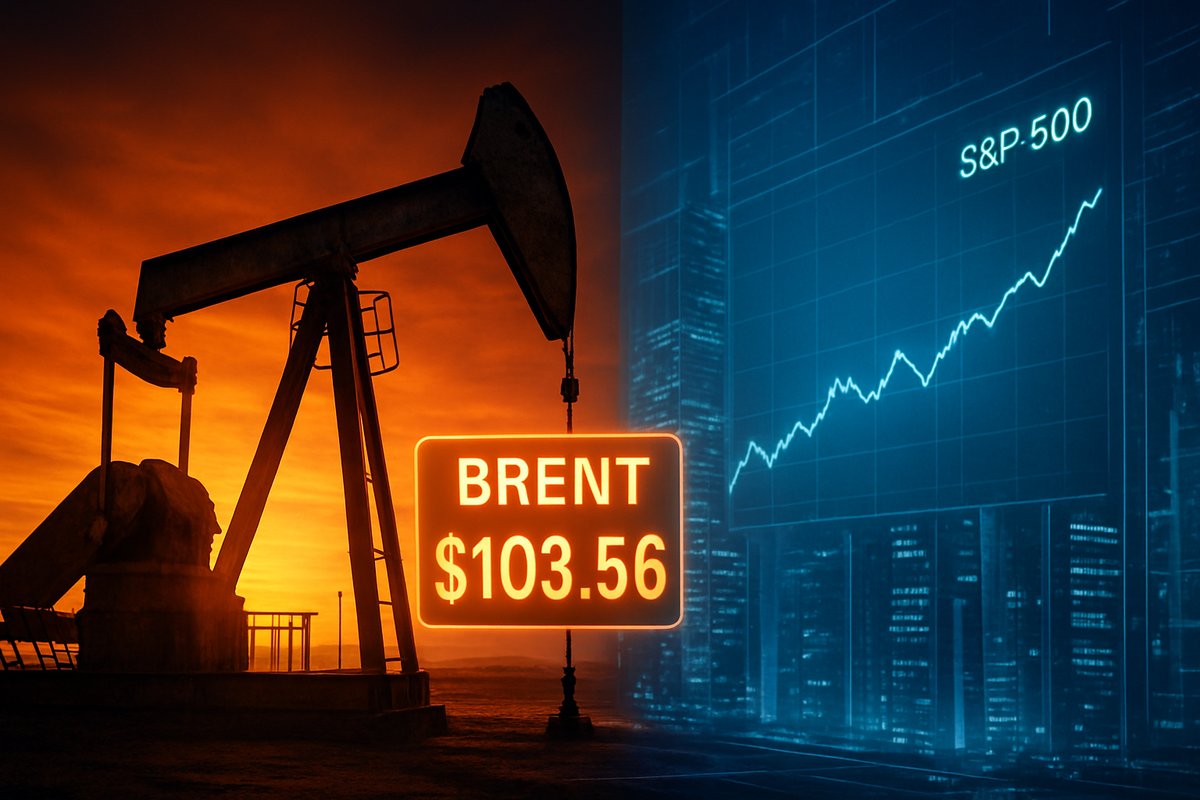
For decades, the sight of Brent crude oil crossing the triple-digit threshold was enough to send a shiver through Wall Street, signaling an impending era of stagflation and consumer retreat. Yet, as of March 17, 2026, the global benchmark has firmly established itself above $100 per barrel—peaking recently at a startling $119.50—while the S&P 500 remains remarkably steady, hovering just a few percentage points below its all-time highs. This decoupling marks a fundamental shift in the relationship between energy costs and equity markets, suggesting that the "oil tax" of yesteryear may no longer hold the same power over the modern American economy.
The resilience displayed by the broad market highlights a structural transformation in how the U.S. produces and consumes value. While the jump in energy prices has certainly stoked inflationary fears and complicated the Federal Reserve’s roadmap for interest rate adjustments, the panic selling that characterized previous energy shocks is notably absent. Investors are instead looking at a diversified index dominated by technology, services, and a domestic energy sector that is more profitable than ever. The result is a market that appears to have developed a high degree of immunity to the volatility of the oil patch.
The Geopolitical Catalyst and the March to $100
The current surge in oil prices was not a slow burn but a rapid escalation triggered by high-stakes geopolitical maneuvers in the Middle East. In late February 2026, a series of tactical strikes on Iranian nuclear infrastructure led to a retaliatory partial blockade of the Strait of Hormuz. This critical maritime chokepoint, through which roughly 20% of the world’s daily oil supply flows, became a flashpoint for global energy security. Within days, Brent crude jumped from the mid-$70s to over $100, catching many commodity traders off guard and forcing a massive repricing of energy futures.
Adding to the supply-side pressure, several key members of OPEC+ were forced to reduce output due to security risks and infrastructure damage resulting from the regional instability. By early March, the "Hormuz Premium" was fully baked into the price, leading to an intraday high of $119.50 on March 9. Historically, such a parabolic move would have triggered a 10% to 15% correction in the S&P 500. Instead, the index saw a modest pullback of only 2.6% to 5%, with trading volumes remaining orderly and institutional buying supporting tech and healthcare sectors during the dips.
Key players in this drama include the U.S. Department of Energy, which has had to balance the release of Strategic Petroleum Reserve (SPR) barrels against the need for long-term security, and the major oil conglomerates that have moved rapidly to fill the supply gap. Initial reactions from the manufacturing sector were predictably cautious, but the technology sector—now the primary engine of the S&P 500—responded with a collective shrug, as data center demand and artificial intelligence software sales showed no signs of slowing down despite the rising cost of the literal fuel that powers the traditional economy.
Winners and Losers in the Triple-Digit Era
The most obvious beneficiaries of the current price environment are the domestic energy titans. ExxonMobil (NYSE: XOM) has seen its shares surge more than 30% recently, hitting record highs in the $160 range. With a daily production capacity nearing 4.7 million barrels of oil equivalent, the company is generating massive free cash flow, much of which is being funneled back to shareholders through a $20 billion annual buyback program. Similarly, Chevron (NYSE: CVX) reached all-time highs near $200 per share, bolstered by its strategic acquisition of Hess and its low-cost operations in Guyana, which allow it to remain highly profitable even if prices were to retreat significantly.
Conversely, the transport and logistics sectors are facing the most direct headwinds. However, the impact has been more nuanced than in the past. Delta Air Lines (NYSE: DAL) reported a $400 million increase in quarterly fuel costs, yet its stock price actually rose 5% in mid-March. This counterintuitive move is due to the airline's ability to pass costs directly to consumers through higher fares, supported by a "booming" demand for premium travel. Tesla (NASDAQ: TSLA) initially saw some volatility as rising yields pressured growth stocks, but the high price of gasoline has simultaneously strengthened the long-term consumer case for electric vehicles. Tesla’s recent pivot toward its Optimus Gen 3 humanoid robot has also helped investors view the company as a robotics and AI firm rather than a simple automaker sensitive to energy inputs.
Retail and logistics giants like Amazon (NASDAQ: AMZN) have also shown surprising durability. While delivery costs are rising, Amazon’s ongoing transition to an electrified delivery fleet and its reliance on high-margin cloud services through AWS provide a significant buffer. The "losers" in this scenario are primarily confined to smaller, energy-intensive manufacturing firms and lower-income consumers who spend a disproportionate amount of their income at the pump, but their combined weight in the S&P 500 is no longer sufficient to drag down the entire index.
A Structural Shift: Why the Old Rules No Longer Apply
The decoupling of the S&P 500 from oil prices fits into a broader trend of "declining oil intensity" within the U.S. economy. By 2026, the amount of petroleum required to generate one dollar of GDP has hit an all-time low. This is the result of decades of improvements in energy efficiency, the electrification of industrial processes, and a fundamental shift toward a service-based economy. Industries like software, finance, and professional services rely far more on human capital and electricity (increasingly sourced from renewables and nuclear) than on the internal combustion engine.
Furthermore, the S&P 500’s composition has changed drastically. The index is now heavily weighted toward technology leaders like Nvidia (NASDAQ: NVDA), whose fortunes are tied to the global build-out of artificial intelligence infrastructure rather than the price of crude. In early 2026, AI-related investments were projected to account for nearly 40% of the index's earnings-per-share growth. As long as the "AI narrative" remains intact and data centers continue to expand, the tech sector acts as a massive liquidity buffer that can offset the inflationary drag of $100 oil.
This situation stands in stark contrast to the oil shocks of the 1970s or even 2008. In those eras, the U.S. was a massive net importer of oil, meaning high prices represented a direct transfer of wealth to foreign regimes. Today, the U.S. is the world's leading producer and a net exporter of petroleum. Rising prices now bolster the U.S. trade balance and drive record capital expenditure in the domestic energy belt, creating a "pro-cyclical" boost for a significant portion of the economy that partially cancels out the negative impact on consumers.
What Comes Next: The Fed and the Transition
In the short term, the primary risk to the market is not the oil price itself, but how the Federal Reserve reacts to it. The "last mile" of inflation back to the 2% target has become significantly more difficult with Brent at $110+. Investors should expect a "higher for longer" interest rate environment, as the Fed will be hesitant to cut rates while energy-driven inflation remains a threat. This could create a ceiling for equity valuations in the coming months, forcing companies to rely on actual earnings growth rather than multiple expansion to drive stock prices higher.
Longer term, this energy spike may serve as a massive accelerant for the energy transition. Strategic pivots are already visible; companies that were on the fence about electrifying their fleets or investing in energy-efficient hardware are now finding the ROI (return on investment) irresistible. We may see a wave of "forced innovation" where logistics firms adopt autonomous, electric trucking solutions faster than previously forecasted to bypass the volatility of the diesel market. Market opportunities will likely emerge in the "Energy Tech" space—companies that provide software for grid management, battery storage, and carbon capture.
Final Assessment: A More Mature Market
The Resilience of 2026 serves as a definitive case study in the evolution of the American financial system. The key takeaway for investors is that the S&P 500 has matured beyond its 20th-century dependence on fossil fuels. While oil at $100 still matters for the cost of living and geopolitical stability, its ability to derail a diversified, technology-heavy equity market has been permanently weakened. The "AI buffer" and the U.S.'s status as an energy powerhouse have rewritten the playbook for navigating commodity volatility.
Moving forward, the market will likely remain in a "cautiously optimistic" holding pattern. Investors should watch for any signs that high energy prices are beginning to cause "demand destruction"—where consumers stop spending on services because of the cost of gas. However, as of mid-March, the data suggests that the American consumer is holding firm. The lasting impact of this event may well be the final confirmation that the U.S. economy has successfully transitioned into a post-oil-dependent era, where the digital and the physical no longer move in lockstep.
This content is intended for informational purposes only and is not financial advice.