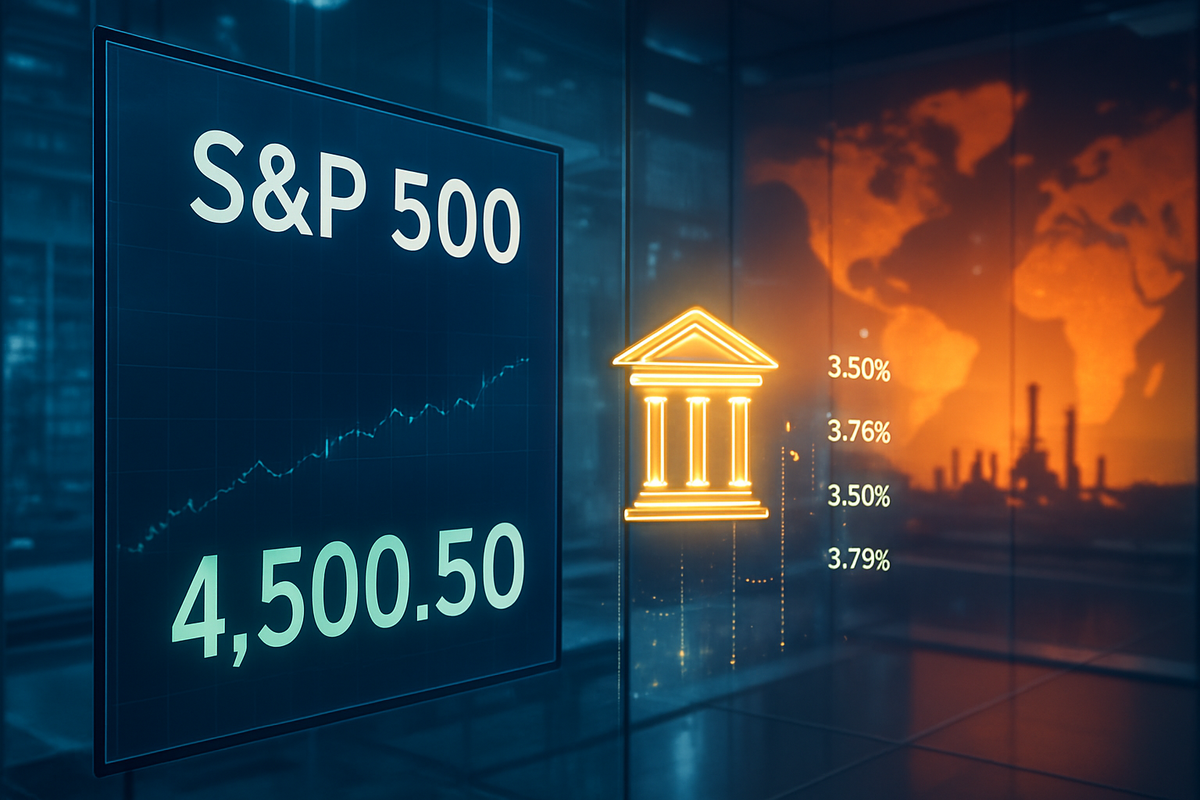
As the Federal Open Market Committee (FOMC) begins its two-day policy meeting this Tuesday, March 17, 2026, Wall Street is holding its collective breath. Investors have pushed major indices slightly higher in early trading, signaling a cautious optimism that the Federal Reserve will maintain its current interest rate stance while providing much-needed clarity on the trajectory of inflation. The S&P 500 (NYSE Arca: SPY) has seen a modest uptick of 0.4% this morning, as market participants digest a complex cocktail of soaring energy prices and a looming transition in central bank leadership.
The central bank’s decision, scheduled for Wednesday afternoon, comes at a pivotal moment for the global economy. After a series of rate cuts in late 2025, the "easing cycle" has hit a significant roadblock in the form of geopolitical instability in the Middle East. With crude oil prices surging more than 50% since the start of the year, the Fed's primary mission of price stability has been complicated by a renewed threat of "cost-push" inflation. This meeting is not just about the numbers; it is about the Fed's resolve to navigate a potential "stagflationary" environment where growth slows but prices continue to climb.
A Pause in the Easing Cycle
The road to this March meeting has been marked by a sudden and sharp departure from the optimistic narrative of late 2025. Throughout the fourth quarter of last year, the Federal Reserve successfully delivered three consecutive 25-basis-point cuts, bringing the federal funds rate to its current target range of 3.50% to 3.75%. However, the "soft landing" that seemed almost certain in January has been challenged by a dramatic escalation in Middle Eastern conflicts, specifically involving maritime security in the Strait of Hormuz. This geopolitical friction has sent Personal Consumption Expenditures (PCE) inflation projections back toward 2.8%, stalling the Fed’s progress toward its 2% target.
Compounding the market’s anxiety is the imminent departure of Chair Jerome Powell, whose term is set to expire in May 2026. The White House has already nominated Kevin Warsh as his successor, a move that has introduced a layer of policy uncertainty. Warsh is perceived by many on Wall Street as potentially more hawkish than Powell, leading to speculation that the Fed might adopt a more aggressive posture to stamp out the recent inflation "hiccup" before the leadership transition is finalized. Consequently, the "hold" expected this Wednesday is viewed as a strategic pause, allowing the committee to assess the durability of the energy shock.
The immediate reaction in the bond market has been a flattening of the yield curve, with the 10-year Treasury yield hovering near 4.21%. Investors are particularly focused on the "Summary of Economic Projections" (SEP), or the "dot plot," which will be released alongside the rate decision. This document will reveal whether Fed officials still anticipate further cuts in 2026 or if the recent spike in oil has forced them to adopt a "higher-for-longer" mantra for the remainder of the year.
Winners and Losers in a Shifting Interest Rate Landscape
The current market environment has created a stark divergence between sectors. The primary beneficiaries of the current volatility have been the domestic energy giants. As crude oil prices skyrocket, ExxonMobil (NYSE: XOM) and Chevron (NYSE: CVX) have emerged as the top performers in the S&P 500, with both companies seeing double-digit gains year-to-date. These firms benefit not only from higher commodity prices but also from their robust balance sheets, which allow them to return capital to shareholders even as other sectors struggle with rising input costs.
Conversely, the "Magnificent Seven" tech leaders are facing a more difficult valuation hurdle. While companies like NVIDIA (NASDAQ: NVDA) continue to see strong demand for artificial intelligence infrastructure, their stock prices have been sensitive to the "higher-for-longer" interest rate narrative. Higher rates discount the value of future earnings, a mathematical reality that has kept a lid on gains for Microsoft (NASDAQ: MSFT) and Apple (NASDAQ: AAPL) in early 2026. If the Fed signals a prolonged pause on Wednesday, these growth-oriented stocks may face continued pressure as investors pivot toward defensive sectors.
The financial sector presents a mixed bag for investors. Large-cap banks like JPMorgan Chase (NYSE: JPM) typically benefit from higher net interest margins when rates are elevated. However, the prospect of an economic slowdown driven by high energy costs could lead to an increase in credit loss provisions and a decline in loan demand. For the banking sector, the ideal outcome of tomorrow’s meeting would be a signal that the Fed can successfully balance inflation control without tipping the economy into a recession, a feat that remains the "holy grail" of central banking.
The Broader Significance: AI Productivity vs. Energy Realities
This Fed decision is a microcosm of a larger debate occurring in 2026: can technological advancement offset traditional commodity shocks? For much of the past two years, the market has been propelled by an "AI-driven productivity boom," which analysts believe will eventually lower costs across the economy. However, the immediate reality of $120-per-barrel oil acts as a powerful counter-force. The Fed is essentially caught between two eras—the deflationary pressures of high-tech automation and the inflationary pressures of a fragile global supply chain for energy.
Historically, the Fed has often "looked through" temporary energy spikes, choosing instead to focus on core inflation metrics that exclude volatile food and energy costs. However, the current geopolitical climate suggests this spike may be more than temporary. Comparisons are already being drawn to the energy shocks of the 1970s and 2022. The difference today is the level of national debt, which makes the cost of servicing that debt—influenced directly by the Fed's interest rate decisions—a major concern for fiscal policy as well.
Furthermore, the transition to a new Fed Chair represents a significant shift in institutional memory. Powell has been a steady hand through the post-pandemic recovery, but a new leader may feel the need to establish their "inflation-fighting" credentials early on. This meeting serves as a bridge between the Powell era and what many expect to be a more rigorous, data-dependent regime under the next chairperson. The ripple effects of this transition will be felt not just in the U.S., but across global markets as other central banks, such as the European Central Bank and the Bank of Japan, coordinate their own policy shifts.
What Comes Next: Scenarios and Strategic Pivots
In the short term, the market's trajectory will be dictated by the tone of the post-meeting press conference. If the Fed acknowledges the energy shock but maintains that the underlying trend of inflation is still downward, we could see a relief rally in the S&P 500. Under this scenario, the index could potentially move toward the 7,000 mark by early summer. However, if the Fed expresses alarm at the "stickiness" of PCE data and hints that rate hikes could be back on the table, a significant correction in the tech and consumer discretionary sectors is likely.
Longer-term, the strategic focus for investors will likely shift toward "quality" and "resilience." In an environment where the "neutral rate" of interest may be higher than previously thought (near 3.5% rather than 2.5%), companies with high debt-to-equity ratios will struggle to compete. We may see a strategic pivot in corporate America, where mergers and acquisitions slow down in favor of internal efficiency gains and debt reduction. The market will reward companies that can maintain margins despite higher energy and capital costs.
Looking toward the second half of 2026, the biggest opportunity may lie in the eventual stabilization of geopolitical tensions. If a diplomatic solution is reached in the Middle East, the sudden drop in energy prices could provide a massive tailwind for the economy, allowing the Fed to resume its easing cycle. In this "bull case" scenario, Goldman Sachs' year-end target of 7,600 for the S&P 500 becomes a realistic possibility. Investors should watch for any signs of de-escalation as a primary indicator for a market breakout.
Conclusion: A Market in Transition
The March 2026 Fed meeting is more than just a routine policy check-in; it is a defining moment for the mid-decade economy. While the expectation for a rate hold is nearly universal, the context of that hold—rising energy prices and a change in leadership—carries immense weight. The key takeaway for investors is that the era of "easy money" is firmly in the rearview mirror, and the market is now entering a period of high-stakes navigation where every basis point and every barrel of oil counts.
Moving forward, the S&P 500 is likely to remain in a period of consolidation as it seeks a new equilibrium. The resilience shown by the index today suggests that investors still have faith in corporate earnings, which are projected to grow by 12% this year. However, that optimism is fragile. The coming months will require a discerning eye, as the divergence between winners in the energy sector and losers in interest-sensitive growth sectors continues to widen.
For now, the mantra for the market is "trust, but verify." Investors should watch for the updated "dot plot" on Wednesday and pay close attention to the Fed’s rhetoric regarding the "transitory" vs. "structural" nature of current inflation. As we look toward the Powell-to-Warsh transition, the stability of the U.S. financial system remains the anchor of the global economy, even as the winds of geopolitical change blow stronger.
This content is intended for informational purposes only and is not financial advice.