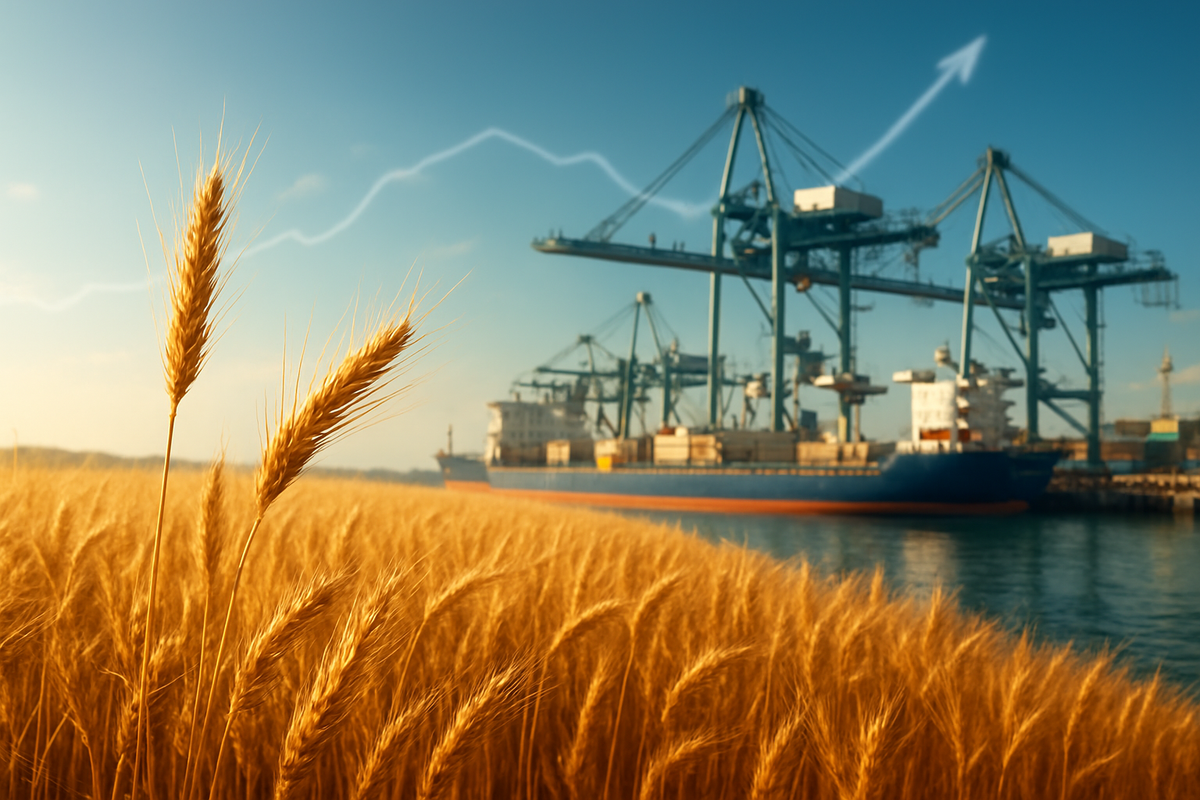
In a landmark decision that has sent ripples through international agricultural markets, the Government of India officially lifted its four-year-old ban on wheat exports in February and March 2026. Driven by a historic harvest projected at a staggering 118 to 119 million tonnes—with recent estimates even touching 120.21 million tonnes—and a massive buffer stock of 18.2 million metric tonnes (mt), the world’s second-largest wheat producer is once again opening its granaries to the global community.
This strategic pivot comes at a critical juncture for the global food supply chain. While many agricultural regions are still grappling with the lingering effects of high fertilizer costs and volatile fuel prices, India’s re-entry provides a much-needed stabilization factor. By introducing a calibrated export quota of 2.5 million tonnes of wheat and an additional 500,000 tonnes of sugar, New Delhi is positioning itself not just as a regional provider, but as a crucial safety valve for global food security, effectively capping price rallies in a market that has been characterized by extreme uncertainty since 2022.
A Strategic Re-entry: The End of the 2022 Export Freeze
The journey to this moment began on May 13, 2022, when India abruptly banned wheat exports following a devastating heatwave that threatened domestic food security and sent local prices soaring. For nearly four years, the ban remained a point of contention in global trade, until February 13, 2026, when the Ministry of Consumer Affairs, Food, and Public Distribution announced the formal easing of restrictions. The decision was catalyzed by the 2025–26 Rabi season, which produced a record-breaking crop that far exceeded domestic consumption requirements.
The execution of this policy shift is being managed with precision by the Directorate General of Foreign Trade (DGFT), which has opened monthly application windows for exporters to prevent a sudden domestic price shock. In addition to the 2.5 million tonnes of raw wheat, the government has permitted the export of 500,000 tonnes of wheat products, such as flour and semolina, aimed at capturing higher value in the international market. Furthermore, an additional 500,000-tonne quota for sugar was released to leverage a surplus in the sugar sector, although initial uptake has been slowed by competitive global pricing.
Stakeholders, including the Food Corporation of India (FCI) and major domestic trade bodies, have lauded the move as a necessary step to prevent "distress sales" by farmers during the peak harvest. The buffer stock, projected at 18.2 million tonnes by April 1, 2026, is more than double the mandatory requirement of roughly 7.5 million tonnes. This "mountain of grain" provides the government with the confidence to trade internationally without risking the stability of the Pradhan Mantri Garib Kalyan Anna Yojana (PMGKAY) food welfare program.
Market Movers: Winners and Losers in the Global Grain Trade
The lifting of the ban has immediate implications for several major public companies. ITC Limited (NSE: ITC), one of India’s largest agri-business conglomerates, stands as a primary beneficiary. With its extensive "e-Choupal" sourcing network, ITC is well-positioned to regain its former dominance in wheat exports to Southeast Asia and the Middle East. The company’s ability to move large volumes through its established logistics chain could see a significant boost in its agri-segment revenue for the 2026-27 fiscal year.
Similarly, Adani Wilmar Limited (NSE: AWL), which recently rebranded its agricultural division as AWL Agri, is expected to capitalize on the new quotas. The company has been aggressively expanding its footprint in the branded staples market and sees the export window as an opportunity to scale its international operations, particularly in neighboring markets like Bangladesh and Sri Lanka. For investors, the focus will be on whether these firms can maintain margins despite a global environment where wheat prices from competitors like Russia and Argentina are currently trading lower than Indian origins.
On the global stage, the "ABCD" quartet of grain traders—including Archer-Daniels-Midland Company (NYSE: ADM) and Bunge Global SA (NYSE: BG)—faces a more complex landscape. While the increased liquidity in the wheat market is generally positive for trading volumes, the sudden influx of Indian grain contributes to a "global grains glut" that has begun to thin processing and trading margins. Bunge, in particular, has noted a cautious outlook for 2026 as fierce competition from Black Sea and Indian origins may dampen the volatility that these firms typically thrive upon.
Stabilizing the Global Pantry: Buffer Stocks and Pricing Dynamics
India’s return to the market is a "sentiment-shifter" for global food inflation. By holding a massive 20 million tonne surplus (including private stocks), India effectively places a "price ceiling" on the Chicago Board of Trade (CBOT) wheat futures. Even if Indian wheat is not the cheapest on the water—currently quoted at $280–$290 per tonne compared to $220 for Russian wheat—its mere availability prevents the type of "panic buying" seen in previous years. This is especially vital as farmers in Europe and North America struggle with high input costs for nitrogen-based fertilizers and diesel, which have kept their floor prices high.
This move also aligns with broader geopolitical trends, including the 2026 India-U.S. trade agreements aimed at diversifying global supply chains. By becoming a reliable exporter again, India is asserting its role as a "Vishwa Bandhu" (Global Friend) in food security, particularly for the Global South. The move mirrors historical precedents where India has utilized its agricultural prowess to gain diplomatic leverage, such as during the grain-for-oil negotiations of previous decades, though today the focus is firmly on economic integration and price stabilization.
However, the regulatory environment remains cautious. The Indian government has made it clear that the export quota is "calibrated." If domestic inflation exceeds the 5% threshold or if the monsoon projections for the 2026 Kharif season appear unfavorable, the DGFT retains the right to tighten the spigot. This "managed opening" is a sophisticated evolution from the blunt bans of the past, reflecting a more mature approach to managing the delicate balance between farmer income and consumer prices.
The Path Ahead: Logistics and Regional Dominance
In the short term, the market will likely see a flurry of activity concentrated in neighboring regions. Due to high freight costs globally, Indian wheat is most competitive in Bangladesh, Sri Lanka, and parts of East Africa. These markets are expected to absorb the initial 2.5 million tonne quota rapidly. Strategic pivots may be required from Indian exporters to focus more on value-added "durum" and high-protein varieties to compete with the lower-priced bulk shipments from the Black Sea region.
Longer-term, the challenge for India will be its High Minimum Support Price (MSP) of ₹2,585 per quintal, which often keeps domestic prices above the international "free market" rate. To remain a consistent global player, the industry will need to invest heavily in logistics and storage infrastructure to reduce post-harvest losses, which currently remain a significant drag on efficiency. If India can successfully navigate these structural hurdles, it could transform from an occasional "emergency supplier" to a permanent, stabilizing pillar of the global agricultural market.
Scenario planning for late 2026 suggests that if the next harvest also breaks records, the government may expand the quota to 5 million tonnes or more. Such a move would further cement the downward trend in global food prices, providing relief to developing nations but potentially creating a challenging "low-price era" for Western farmers who lack the government-backed price supports found in the Indian system.
A New Era for Indian Agriculture
The lifting of the wheat export ban in early 2026 marks a turning point in India's agricultural policy and its relationship with the global economy. By leveraging a record production of nearly 120 million tonnes and a robust buffer stock of 18.2 million tonnes, India has moved from a position of defensive protectionism to one of confident market participation. The addition of sugar exports, despite initial economic hurdles, underscores a broader intent to be a comprehensive supplier of essential commodities.
As we look toward the remainder of 2026, the market appears more stable than it has been in years. The "India Factor" has effectively de-risked the global wheat supply, offering a buffer against potential shocks in other regions. For investors, the watchwords for the coming months will be "logistics" and "monsoon." The performance of domestic giants like ITC and Adani Wilmar will be tied directly to their ability to execute these exports efficiently, while the broader market will look to the sky, hoping that favorable weather continues to support India’s newfound role as the world's primary grain stabilizer.
This content is intended for informational purposes only and is not financial advice.