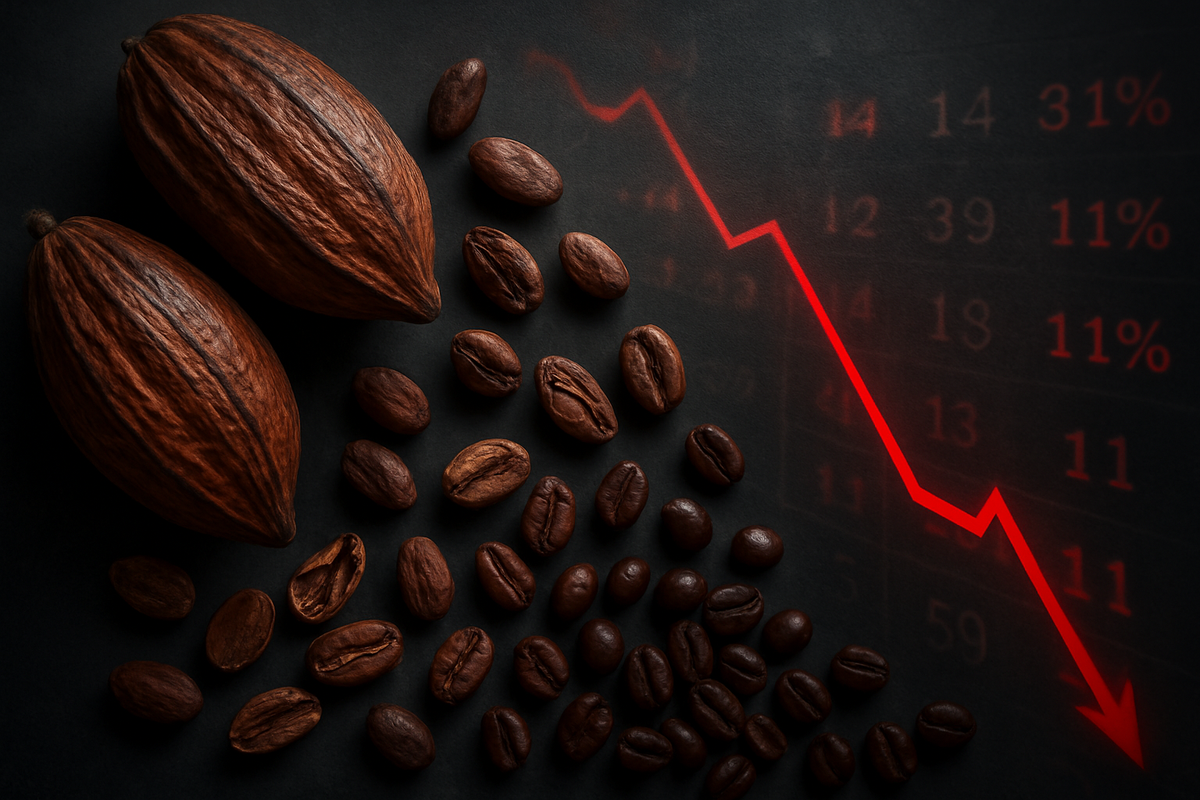
The honeymoon phase for commodity bulls has come to a screeching halt. After two years of historic price surges that sent the cost of chocolate and caffeine to eye-watering heights, the "softs" market has entered a period of violent correction. In February 2026, cocoa futures plummeted by more than 31%, while coffee futures followed suit with a nearly 11% decline. This sudden reversal marks a dramatic shift from the record-breaking highs of 2024 and 2025, signaling that the relentless upward pressure on global pantry staples has finally broken under the weight of market cyclicality.
For consumers and manufacturers alike, this correction is a double-edged sword. While it promises eventual relief from the "greedflation" and "shrinkflation" that defined the last 24 months, the speed of the collapse has left traders reeling. Data from Barchart in early March 2026 confirms that the speculative fever which drove cocoa above $12,000 per ton in early 2024 has evaporated, replaced by a fundamental realization: high prices are, quite literally, the cure for high prices.
The Great Softs Sell-off: A February to Remember
The collapse observed in February 2026 was not an isolated event but the culmination of a classic "blow-off top" in commodity pricing. Cocoa, which had been the poster child for agricultural volatility, saw its most aggressive monthly sell-off in decades. After peaking in early 2024 due to a catastrophic supply failure in West Africa—where the Ivory Coast and Ghana faced a "perfect storm" of Black Pod disease and El Niño-driven droughts—prices remained stubbornly high throughout 2025. However, as the 2025/26 harvest season began, improved weather conditions and a significant uptick in fertilizer application led to a projected surplus of approximately 308,000 tons. This shift in fundamentals triggered a mass exodus of speculative capital, resulting in the 31% monthly drop.
Coffee markets followed a similar, albeit slightly more muted, trajectory. Coffee futures had surged in 2025 as Brazil grappled with extreme frost threats and Vietnam—the world’s premier Robusta producer—endured its worst drought in a decade. By late 2025, Arabica prices had climbed toward the $3.00 per pound mark, a level not seen in a generation. The 11% drop in February 2026 reflects a "mean reversion" as supply chains finally unstuck and the feared 2026 "super-drought" in Minas Gerais failed to materialize. Traders who had been "long" on coffee found themselves trapped as the market recalibrated toward more sustainable long-term price averages.
Winners and Losers: Margin Relief vs. Inventory Devaluation
The primary beneficiaries of this price collapse are the massive consumer packaged goods (CPG) firms that have spent the last two years defending their profit margins. The Hershey Company (NYSE: HSY) and Mondelez International (NASDAQ: MDLZ) have been under immense pressure, with Hershey reporting significant earnings-per-share contractions in late 2025 as their expensive hedges were finally realized. With cocoa prices falling 31%, these companies stand to see a massive expansion in gross margins in the second half of 2026, provided they can maintain the high retail prices established during the crisis. Nestlé S.A. (OTC: NSRGY) is also expected to benefit as the input costs for its global confectionery and beverage portfolio decline.
On the other side of the ledger, the losers are the producers and the early-cycle speculators. Large-scale coffee retailers like Starbucks Corporation (NASDAQ: SBUX) face a complex situation. While lower bean costs are a net positive for Starbucks' operating margins, which had dipped toward 8% during the 2025 peak, the company recently moved away from aggressive hedging. This "unhedged" status made them vulnerable during the spike but now allows them to capture the benefits of falling prices faster than competitors like The J.M. Smucker Co. (NYSE: SJM), who may still be locked into higher-priced contracts from the 2025 peak. For the farmers in West Africa and Vietnam, the price drop is a harsh reminder of the volatility that keeps them in a cycle of poverty, as the windfall from the 2024-25 highs was often siphoned off by middlemen and government export taxes.
Understanding the "Commodity Cyclicality" Slam
The 2026 correction is a textbook example of "commodity cyclicality"—a phenomenon where high prices eventually destroy demand and incentivize a supply response that crashes the market. Between 2024 and 2025, the world experienced significant "demand destruction." As the price of a standard chocolate bar doubled in some markets, consumers pivoted to non-cocoa snacks, such as gummies or salty snacks. Global cocoa "grindings"—the industry standard for measuring demand—fell by double digits in Europe and Asia during 2025. When this lower demand met a recovering supply, the price equilibrium was forced violently downward.
This event mirrors historical precedents, such as the coffee crisis of 1977 and the cocoa glut of 2011. In both cases, multi-year supply shocks led to speculative bubbles that burst as soon as the first signs of a "normal" harvest appeared. Furthermore, the 2026 crash highlights the impact of "systematic" trading. Modern commodity markets are heavily influenced by algorithmic funds that follow momentum. When the technical support levels for cocoa and coffee were breached in early February, these algorithms triggered a cascade of sell orders, accelerating the descent and turning a fundamental correction into a full-scale rout.
What Lies Ahead: Stabilization or Further Slides?
Looking forward, the immediate question for the market is whether these commodities have found a "floor" or if the pendulum will swing toward an undervalued state. In the short term, volatility is expected to remain high as the market digests the March harvest reports from West Africa. If the surplus is as large as predicted, cocoa could see further slides toward the $4,500 range, a far cry from the $12,000 peak but still nearly double the pre-crisis historical average. For coffee, the focus shifts to the 2026 "flowering" season in Brazil; any hint of a La Niña weather pattern could abruptly halt the current downward trend.
Strategically, the major food companies are likely to pivot their marketing. After two years of pushing "cocoa-free" alternatives and smaller portions, we may see a return to "value-sized" chocolate bars and aggressive promotions as companies like Hershey and Mondelez seek to win back the volume they lost during the price spike. Investors should monitor whether these companies pass savings on to consumers or if they attempt to "harvest" the margin, which could lead to regulatory scrutiny or further consumer pushback.
The Bottom Line for Investors
The February 2026 correction in soft commodities marks the end of an extraordinary era of agricultural inflation. The 31% drop in cocoa and the 11% dip in coffee represent the market's natural immune response to unsustainable price levels. Key takeaways for the months ahead include:
- Watch the Margins: Keep a close eye on Q3 and Q4 2026 earnings reports for major confectioners and coffee roasters, as the lag between falling futures and improved margins begins to close.
- Inventory Risks: Companies that over-purchased at the 2025 peak may face significant inventory write-downs.
- Supply-Side Recovery: The structural issues in West Africa (aging trees and disease) have not vanished, meaning that while the speculative bubble has burst, the floor for prices is likely higher than it was in the 2010s.
As of March 12, 2026, the era of "cheap" chocolate and coffee has not necessarily returned, but the fever has broken. The market is transitioning from a period of scarcity-driven panic to one of cyclical normalization, providing a masterclass in why no commodity rally lasts forever.
This content is intended for informational purposes only and is not financial advice.