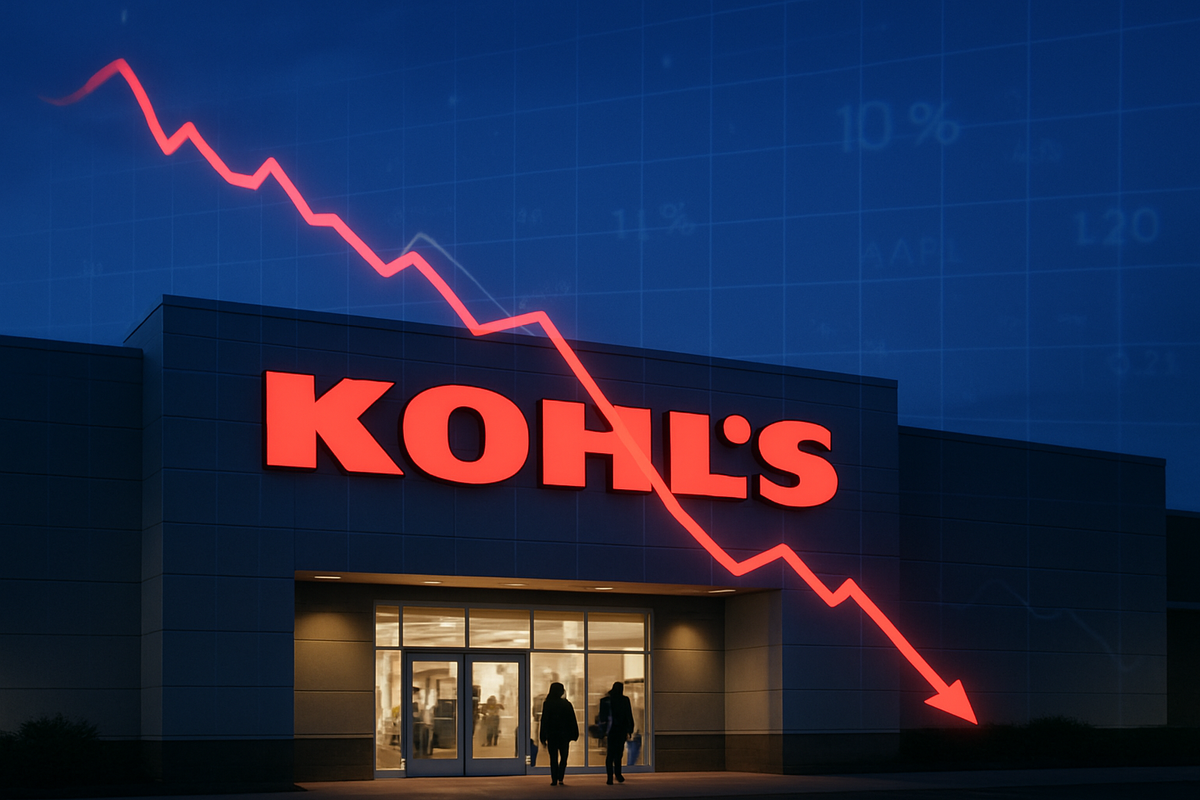
The retail sector witnessed a sharp divergence in performance and sentiment today as Kohl’s Corporation (NYSE: KSS) released its fourth-quarter 2025 results. Despite delivering a bottom-line performance that handily cleared Wall Street’s hurdles, the Wisconsin-based retailer saw its stock price crater by 10% in early Tuesday trading. The sell-off was triggered by a disappointing fiscal 2026 guidance that signaled a continued struggle to regain top-line momentum, highlighting the persistent challenges facing mid-tier department stores in an increasingly bifurcated consumer economy.
While the holiday quarter showcased the company's ability to extract profit through disciplined inventory management and cost-cutting, investors remained fixated on a 3.9% decline in revenue and a tepid forecast for the year ahead. The market's reaction underscores a growing impatience with "turnaround" narratives that prioritize margins over growth, as Kohl’s navigates a complex transition under new leadership aimed at stabilizing a business that has faced years of activist pressure and shifting consumer habits.
A Tale of Two Reports: Profitability vs. Growth
For the quarter ended January 31, 2026, Kohl’s reported adjusted diluted earnings per share (EPS) of $1.07, far exceeding the analyst consensus of $0.85. This earnings beat was a testament to the company’s aggressive operational tightening; gross margins expanded by 25 basis points to 33.1%, while selling, general, and administrative (SG&A) expenses were slashed by nearly 5%. Net income for the quarter surged to $125 million, a significant leap from the $48 million reported in the same period a year prior. However, the financial engineering required to produce these numbers could not mask a weakening top line. Net sales fell to $5.0 billion, a 3.9% year-over-year decrease, while comparable store sales—a critical metric for retail health—slumped by 2.8%.
The primary catalyst for the stock’s double-digit decline was the forward-looking guidance for fiscal 2026. Kohl’s projected that net sales would range from a 2% decline to flat growth, missing the more optimistic expectations held by the buy-side. Furthermore, the company set its 2026 EPS guidance at a midpoint of $1.30, notably lower than the $1.38 consensus estimate. During the earnings call, Chief Executive Officer Michael J. Bender, who took the helm following a period of leadership transition in 2025, characterized the current phase as "resetting our foundation." Bender emphasized that while the topline remains "softer than expectations," the focus remains on fortifying the balance sheet and improving operational agility to weather the ongoing retail storm.
Winners and Losers in the Shifting Retail Landscape
The immediate fallout of Kohl’s report has created a ripple effect across the retail sector, identifying clear winners and losers. Among the primary "losers" is Kohl’s itself, which now faces the daunting task of convincing shareholders that its "foundation reset" will eventually translate into sales growth. The company’s stock has now lost roughly a third of its value since the start of 2026, putting further pressure on management to prove that its partnership with Sephora and its pivot toward more "lifestyle" and "gifting" categories can actually drive foot traffic in a meaningful way.
Conversely, off-price giants like The TJX Companies (NYSE: TJX) and Ross Stores (NASDAQ: ROST) appear to be the strategic "winners" in this environment. As Kohl’s struggles to maintain its middle-market appeal, price-conscious consumers are increasingly migrating toward the "treasure hunt" model of off-price retail, which offers premium brands at a fraction of department store prices. Similarly, Macy’s (NYSE: M) has seen a stabilization in its stock price as it executes its "Bold New Chapter" strategy. By aggressively closing 150 underperforming stores and focusing on its high-margin Bloomingdale’s and Bluemercury assets, Macy’s is successfully pivoting toward a luxury-adjacent model that Kohl’s currently lacks the infrastructure to emulate.
The Broader Struggle of the Middle-Market Retailer
Kohl’s current predicament is symptomatic of a broader industry trend where "the middle" is being hollowed out. On one end, behemoths like Walmart (NYSE: WMT) and Amazon (NASDAQ: AMZN) dominate on price and convenience. On the other, luxury and specialty retailers capture high-end discretionary spend. Kohl’s, caught in the center, is finding it difficult to maintain a distinct value proposition. This event mirrors the historical struggles of former retail giants like J.C. Penney, serving as a cautionary tale of what happens when a brand's core identity becomes blurred in the eyes of the consumer.
The emphasis on "resetting the foundation" suggests that management is prioritizing survival and financial stability over aggressive expansion. This is a pragmatic but risky move. While reducing debt—Kohl’s reported $1.0 billion in free cash flow for 2025—is vital for long-term health, the lack of a clear growth catalyst leaves the company vulnerable to further market share erosion. Competitors like Target (NYSE: TGT) have leveraged digital transformation and a robust private-label portfolio to stay relevant; Kohl’s, meanwhile, remains heavily reliant on physical foot traffic in suburban strip centers, a segment of the market that has seen inconsistent recovery post-pandemic.
Looking Ahead: The Path to Recovery or Retrenchment
In the short term, Kohl’s will likely remain a "show-me" story for investors. The market will be closely watching the performance of its smaller-format stores and the continued rollout of Sephora shops within its locations. These initiatives are designed to modernize the shopping experience, but they require significant capital expenditure—estimated at $350 million to $400 million for 2026—at a time when sales are projected to be stagnant. If these strategic pivots do not yield a turnaround in comparable store sales by the second half of 2026, the company may face renewed calls for more radical changes, including potential real estate monetization or further executive restructuring.
Long-term, Kohl's success depends on its ability to evolve from a traditional department store into a curated "lifestyle destination." This requires not just operational efficiency, but a revitalization of its merchandising strategy to appeal to a younger, more diverse demographic. The "reset" described by Bender is a necessary first step, but the window for execution is closing. As consumer spending remains volatile amidst fluctuating interest rates and inflationary pressures, the margin for error for middle-market retailers has never been thinner.
Conclusion: A Critical Juncture for Kohl’s
The reaction to Kohl’s Q4 2025 earnings serves as a stark reminder that in the current market, past performance is secondary to future outlook. While the company proved it can manage its bottom line effectively, the 10% drop in share price reflects a fundamental lack of confidence in its growth trajectory. The "foundation reset" is a prudent strategy for financial health, but it does little to address the existential question of how Kohl's will compete in a retail world dominated by digital speed and off-price value.
Moving forward, investors should keep a close eye on quarterly comparable sales and the debt-to-equity ratio. If Kohl’s can stabilize its sales decline while maintaining its current margin discipline, it may eventually find a floor. However, until the company can demonstrate a clear path to top-line growth, it remains a high-risk play in a sector that is increasingly unforgiving of stagnation. For now, the "reset" continues, but the market is clearly demanding more than just a solid foundation; it wants to see a house that people are actually buying into.
This content is intended for informational purposes only and is not financial advice.