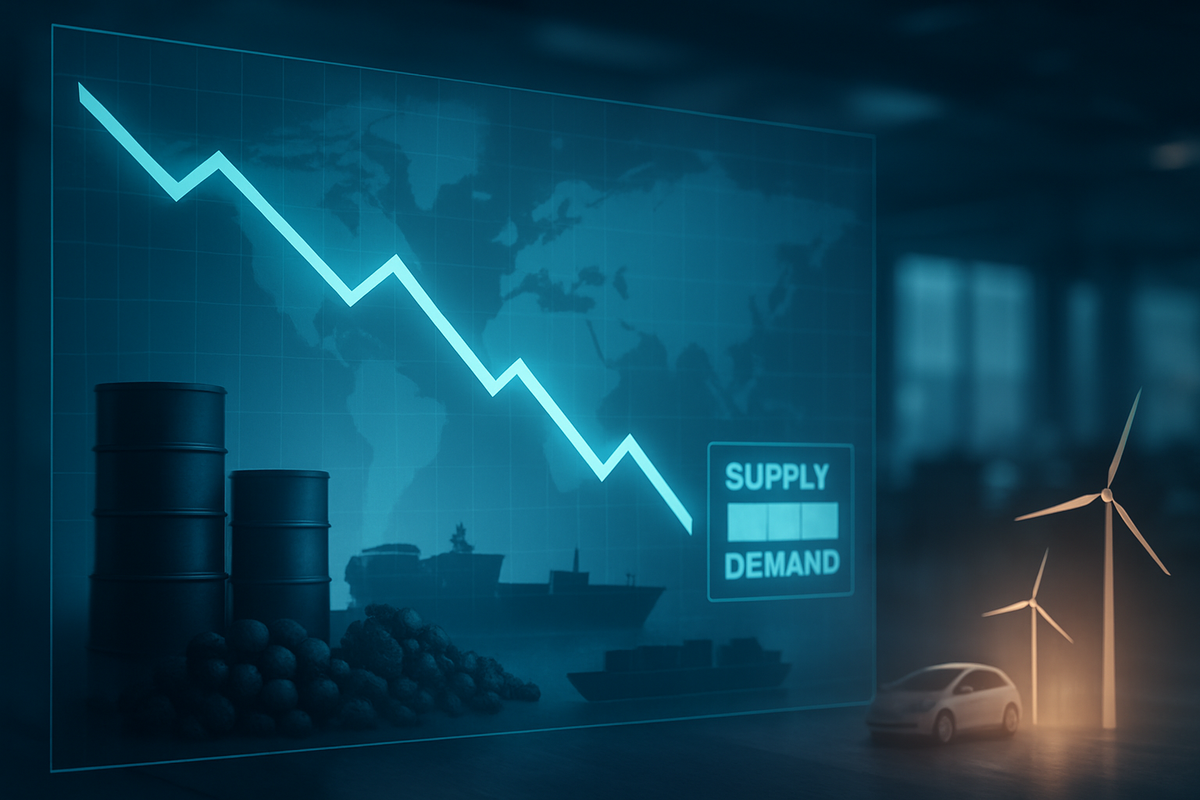
The era of post-pandemic price volatility appears to be reaching a definitive conclusion. According to the World Bank’s latest 'Commodity Markets Outlook' report, global commodity prices are projected to plunge to a six-year low by the end of 2026. This downward trajectory is expected to be led by a staggering 10% decline in energy costs, primarily driven by a massive global oil surplus that is reshaping the geopolitical and economic landscape.
For the global economy, this shift represents a double-edged sword. While the decline in prices offers a much-needed reprieve from the inflationary pressures that have dogged central banks for years, it also signals a profound slowdown in global industrial demand. As the World Bank warns of "tectonic shifts" in the energy market, the immediate implications suggest a transition from a period of scarcity to one of significant oversupply, potentially dragging nominal prices to levels not seen since the height of the 2020 lockdowns.
The World Bank’s report highlights a convergence of factors creating a "perfect storm" for commodity depreciation. At the heart of the forecast is a projected global oil surplus of 1.2 million barrels per day (mb/d) throughout 2025 and 2026. This glut is nearly 65% higher than the previous record surplus seen in 2020. This imbalance is not merely a result of increased production from non-OPEC+ nations like the U.S. and Guyana, but also a structural decline in demand. The rapid adoption of electric vehicles (EVs) and the increasing efficiency of internal combustion engines are permanently curbing the world’s appetite for crude oil.
The timeline leading to this forecasted low began with the aggressive interest rate hikes of 2023-2024, which successfully cooled global overheating but left a legacy of sluggish growth in major economies. By late 2025, it became clear that China’s property sector—once a primary engine for global metal demand—would not experience a V-shaped recovery. Instead, the "China factor" has shifted from a tailwind to a persistent headwind. Consequently, the World Bank expects Brent crude to average just $60 per barrel by 2026, a sharp decline from the $80-$90 range that defined much of the early 2020s.
Initial market reactions to the report have been marked by a flight to safety and a re-evaluation of industrial staples. While energy and base metal indices have dipped, precious metals have defied the broader trend. Gold and silver continue to trade near record highs as investors seek shelter from the uncertainty of a cooling global economy and persistent geopolitical tensions in the Middle East and Eastern Europe.
The forecasted downturn creates a stark divide between industry "winners" and "losers." In the energy sector, pure-play exploration and production giants like ConocoPhillips (NYSE: COP) are facing significant revenue pressure as benchmark prices retreat toward the $60 mark. Similarly, the European majors, BP (NYSE: BP) and Shell (NYSE: SHEL), find themselves at a strategic crossroads. Lower oil margins may force these companies to accelerate their transition toward renewable energy and natural gas, or face further multi-billion dollar write-downs on their fossil fuel assets.
Conversely, the "losers" include diversified mining giants heavily exposed to the Chinese industrial cycle. Rio Tinto (NYSE: RIO) and Vale S.A. (NYSE: VALE) are particularly vulnerable due to their reliance on iron ore, which is expected to see price drops of 4% in 2026 following a 10% slide in 2025. While BHP Group (NYSE: BHP) will also feel the pinch from falling iron ore prices, its significant investment in copper—a metal essential for the energy transition—may provide a buffer that its more iron-dependent peers lack.
The primary "winners" in this environment are the precious metal miners and low-cost energy producers. Newmont (NYSE: NEM) and Barrick Gold (NYSE: GOLD) are poised to benefit as gold remains the sole commodity group projected to see price increases through 2026. On the energy side, ExxonMobil (NYSE: XOM) and Chevron (NYSE: CVX) may remain resilient compared to smaller peers. Their focus on ultra-low-cost production in the Permian Basin and Guyana allows them to maintain profitability even in a $60-oil environment, though their stock performance will still likely be tempered by the broader sector’s malaise.
This shift in commodity pricing fits into a broader trend of "de-globalization" and a fundamental restructuring of the energy transition. For the first time since the mid-2010s, the world is moving away from the "scarcity mindset." The projected oil glut suggests that the "Peak Oil" narrative is shifting from a focus on supply depletion to a focus on demand destruction. This has massive regulatory implications, as governments may feel less pressure to subsidize energy costs and more pressure to support domestic industrial bases struggling with weak global demand.
Historically, periods of extreme commodity surplus, such as the mid-1980s or the 2014-2016 crash, have led to significant geopolitical realignments. An oil-rich but demand-poor world often creates friction within OPEC+, as member nations compete for a shrinking slice of the market. Furthermore, the decoupling of precious metals from industrial commodities mirrors the stagflationary periods of the 1970s, where gold acted as a barometer for systemic economic anxiety even as industrial output cooled.
The ripple effects will likely be felt most acutely by emerging markets that rely on commodity exports. Countries in Sub-Saharan Africa and Latin America may face widening trade deficits and currency depreciation, potentially leading to a new wave of sovereign debt restructuring. Meanwhile, consumer-facing companies in developed markets, such as logistics firms and airlines, could see a margin boost from lower fuel and raw material costs, provided that consumer spending doesn't collapse under the weight of the broader economic slowdown.
Looking ahead, the next 24 months will require significant strategic pivots from both corporate leaders and policymakers. In the short term, energy companies are likely to prioritize capital discipline over production growth, shifting their focus toward returning cash to shareholders through buybacks and dividends rather than drilling new wells. In the long term, the "commodity low" could serve as a catalyst for a second wave of the green transition, as cheaper raw materials for batteries and solar panels make renewable projects more economically viable compared to traditional fossil fuels.
However, the risk of a "hard landing" for the global economy remains a distinct possibility. If the weakness in China spreads more aggressively to the U.S. and European service sectors, the commodity floor could drop even further. Investors should watch for potential consolidation in the mining and energy sectors; as valuations fall, well-capitalized firms like Chevron or BHP may look to acquire distressed assets at a discount, leading to a more concentrated and efficient global supply chain.
The World Bank's 2026 outlook serves as a sobering reminder that the "higher-for-longer" era of commodity prices is likely over. The primary takeaways are clear: an unprecedented oil surplus, a structural slowdown in Chinese demand, and the unstoppable rise of EVs are rewriting the rules of the market. While this brings the promise of lower inflation, it also heralds a period of low growth and intense competition among resource-producing nations and corporations.
Moving forward, the market will be characterized by a high degree of divergence. Investors should shift their focus away from broad commodity indices and toward specific "transition metals" and safe-haven assets. The key metrics to watch in the coming months will be OPEC+ production quotas, China’s industrial output data, and the pace of EV adoption in emerging markets. As the world adjusts to this new "six-year low," the ability to differentiate between cyclical downturns and permanent structural shifts will be the hallmark of successful portfolio management.
This content is intended for informational purposes only and is not financial advice