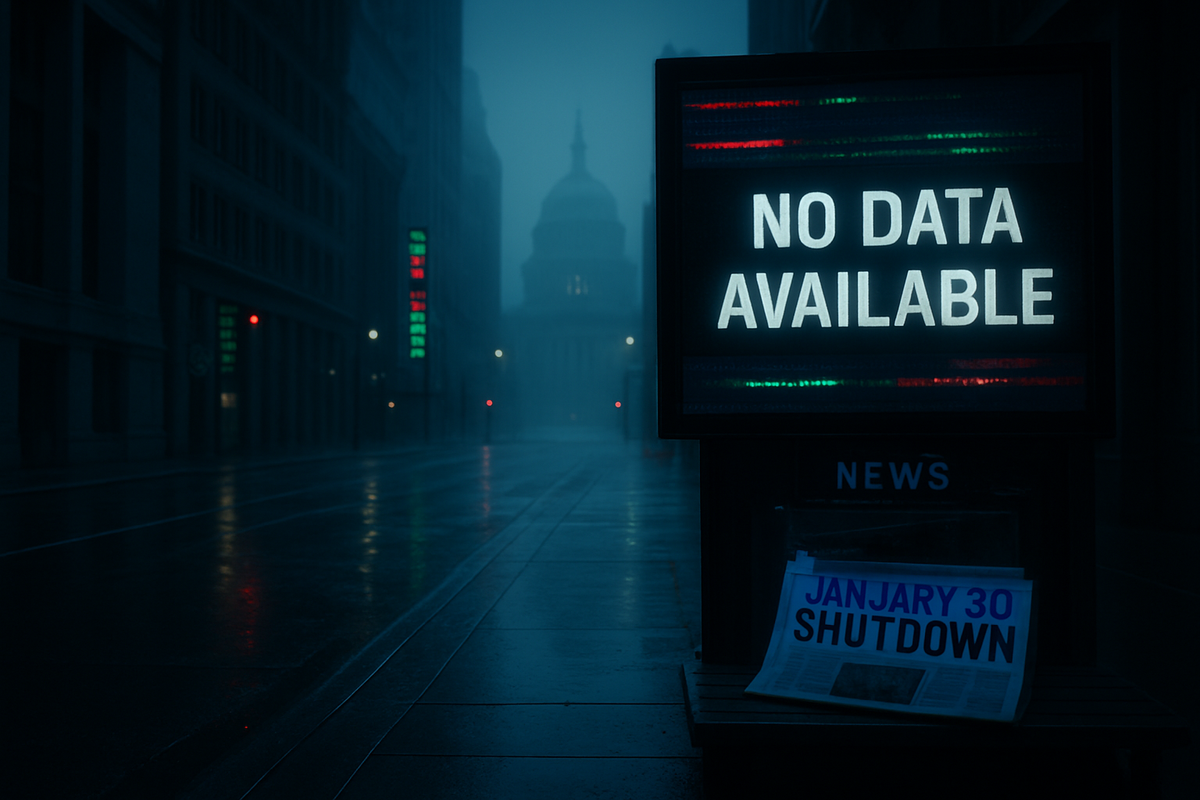
The four-day partial government shutdown that began at midnight on January 30, 2026, has officially come to a close, yet the ripples of the gridlock continue to disturb the waters of Wall Street. While the signing of a short-term funding bill on February 3 restored operations for the Department of Homeland Security (DHS) and other shuttered agencies, the financial world is now grappling with a significant "data blackout." The most glaring casualty of this hiatus is the February Jobs Report, originally scheduled for release today, February 6, which has been postponed indefinitely.
Despite the initial jitters, the S&P 500 and Dow Jones Industrial Average have remained remarkably resilient, treating the fiscal standoff as a temporary inconvenience rather than a structural threat. However, the absence of critical employment data is creating a vacuum of uncertainty. Investors are now left to navigate a cooling economy without the Bureau of Labor Statistics’ (BLS) gold-standard metrics, a situation that Federal Reserve officials warn could lead to policy errors as they weigh interest rate decisions for the upcoming March meeting.
The DHS Deadlock: A Crisis of Policy and Politics
The shutdown was not born from a typical total-budget collapse but rather a targeted impasse over Department of Homeland Security funding. The trigger was the January 24 "Alex Pretti incident" in Minneapolis, involving Customs and Border Protection (CBP) agents, which led Democratic lawmakers to withdraw support for the pending DHS appropriations bill. Demanding rigorous new oversight and restrictions on immigration enforcement, they faced a wall of opposition from Republican leadership, including House Speaker Mike Johnson, who prioritized border security enhancements.
The timeline accelerated rapidly toward the January 30 deadline. While six other major funding bills had already been signed by President Donald Trump, the DHS bill became a "poison pill." A failed Senate test vote on January 29, coupled with the House’s refusal to hold a vote over the weekend, ensured that funding expired at midnight on Friday. For four days, essential agencies operated on skeleton crews, and federal contractors faced "stop-work" orders, creating a localized freeze in government-dependent sectors.
The resolution arrived on the afternoon of February 3, after a narrow 217-214 vote in the House. The compromise provided a two-week funding extension for the DHS, buying time for further negotiations but doing little to solve the underlying ideological divide. Throughout the standoff, key figures like Senator Lindsey Graham and House Budget Chairman Jodey Arrington dominated the airwaves, reflecting a Washington that remains deeply polarized even in the face of fiscal instability.
Winners and Losers: From Defense Primes to Big Tech Safes
The market’s reaction to the shutdown was a textbook study in sector rotation. Defense contractors, long considered a proxy for federal spending, saw significant intraday swings. Lockheed Martin (NYSE: LMT) initially rose 1.88% as a hedge before the shutdown but saw its gains trimmed as the stalemate dragged into Monday. Conversely, Northrop Grumman (NYSE: NOC) experienced a 2.91% surge immediately following the resolution on February 3, as investors bet on a "catch-up" in contract obligations.
The "losers" in this brief skirmish were primarily found in the government services and IT sectors. Booz Allen Hamilton (NYSE: BAH) saw its stock dip from $88.42 to $83.00 during the window, weighed down by the prospect of delayed payments and halted projects. Leidos (NYSE: LDOS), however, managed to remain relatively flat, closing at $189.79, as its diversified healthcare and commercial divisions shielded it from the worst of the federal fallout. In the travel sector, United Airlines (NASDAQ: UAL) and Delta Air Lines (NYSE: DAL) both suffered early losses of over 1% on fears of air traffic control disruptions, only to rebound by nearly 5% once it became clear the shutdown would be short-lived.
Surprisingly, the mega-cap tech giants served as a "safe haven" during the four-day lapse. Apple (NASDAQ: AAPL) rose 4.06% during the shutdown window, largely decoupled from Washington’s woes and driven by optimism surrounding its latest AI software upgrades. While Amazon (NASDAQ: AMZN) saw modest gains of 1.5% during the gridlock, Microsoft (NASDAQ: MSFT) bucked the trend, continuing a slide toward $411.21 due to internal cloud guidance issues rather than political factors. For the broader market, the 2026 shutdown was a volatility event for those close to the government purse, but a non-event for the AI-driven tech rally.
The Significance of the "Data Void" and Fed Policy
While the government is back in business, the postponement of the February 6 Jobs Report has significant implications for the wider economy. Without the BLS data, the Federal Reserve is effectively "flying blind," a sentiment echoed by Fed Governor Michelle Bowman. The labor market had shown signs of cooling in late 2025, and without January’s benchmarks, the Fed may be forced to pause its planned rate-cutting cycle in March to avoid making a move based on incomplete or "noisy" data.
Historically, the S&P 500 has treated shutdowns as temporary noise, with a median return of +0.1% during such events since 1976. However, the 2026 event is unique in its proximity to a potential economic "soft landing." If the shutdown-induced delay hides a significant uptick in unemployment or a sudden drop in wage growth, the market could be mispricing the risk of a recession. The delay doesn't just stop the data; it creates a lag in the market's ability to price in reality.
Furthermore, this event highlights the ongoing friction surrounding the Prevent Government Shutdowns Act. Proponents of the bill argue that the 2026 lapse—like the record-breaking 43-day shutdown of late 2025—demonstrates that automatic continuing resolutions are necessary to protect the economy from political brinkmanship. For now, the "ripple effect" is most visible in the Treasury yields and the U.S. dollar, which saw sharp swings as investors weighed the shutdown against the concurrent nomination of Kevin Warsh to lead the Federal Reserve.
What Comes Next: Strategic Pivots and March Uncertainty
In the short term, the market will look for a "rebound" in sectors that were unfairly punished, such as regional travel and government IT. However, the long-term challenge remains the March 2026 Federal Reserve meeting. If the Bureau of Labor Statistics cannot provide a clean, adjusted report by mid-February, the "data-dependent" Fed may find itself stuck in a holding pattern. This could lead to a "wait-and-see" volatility where the market reacts violently to any secondary indicators, like private payroll data or jobless claims.
Strategic pivots are already underway among institutional investors. Many are moving away from firms with heavy "Civil Service" exposure and toward "Defense Primes" that have secured multi-year funding through previous minibus packages. There is also an emerging scenario where the DHS deadlock remains unresolved after the two-week extension, potentially leading to a second "mini-shutdown" in late February. Investors should prepare for a "W-shaped" recovery pattern rather than a straight line up.
Wrap-up: A Lesson in Resilience and Information Gaps
The January 30–February 3 shutdown serves as a stark reminder that while the U.S. economy has built a high tolerance for political theater, its reliance on timely data is an Achilles' heel. The key takeaway for investors is that the "noise" of the shutdown has been largely ignored, but the resulting "silence" from the BLS is the real risk. The market has moved past the gridlock, but it has not yet moved past the uncertainty of the labor market.
Moving forward, the S&P 500’s ability to stay near the 7,000 mark will depend less on what happens in the halls of Congress and more on the first set of post-shutdown economic data. The resilience of tech leaders like Apple and the quick bounce in airlines suggest that the fundamental appetite for risk remains strong. However, the "data blackout" is a wildcard. In the coming months, watch for the Fed’s tone—if they begin to prioritize "caution" over "cuts," the market's recent stride may quickly turn into a stumble.
This content is intended for informational purposes only and is not financial advice