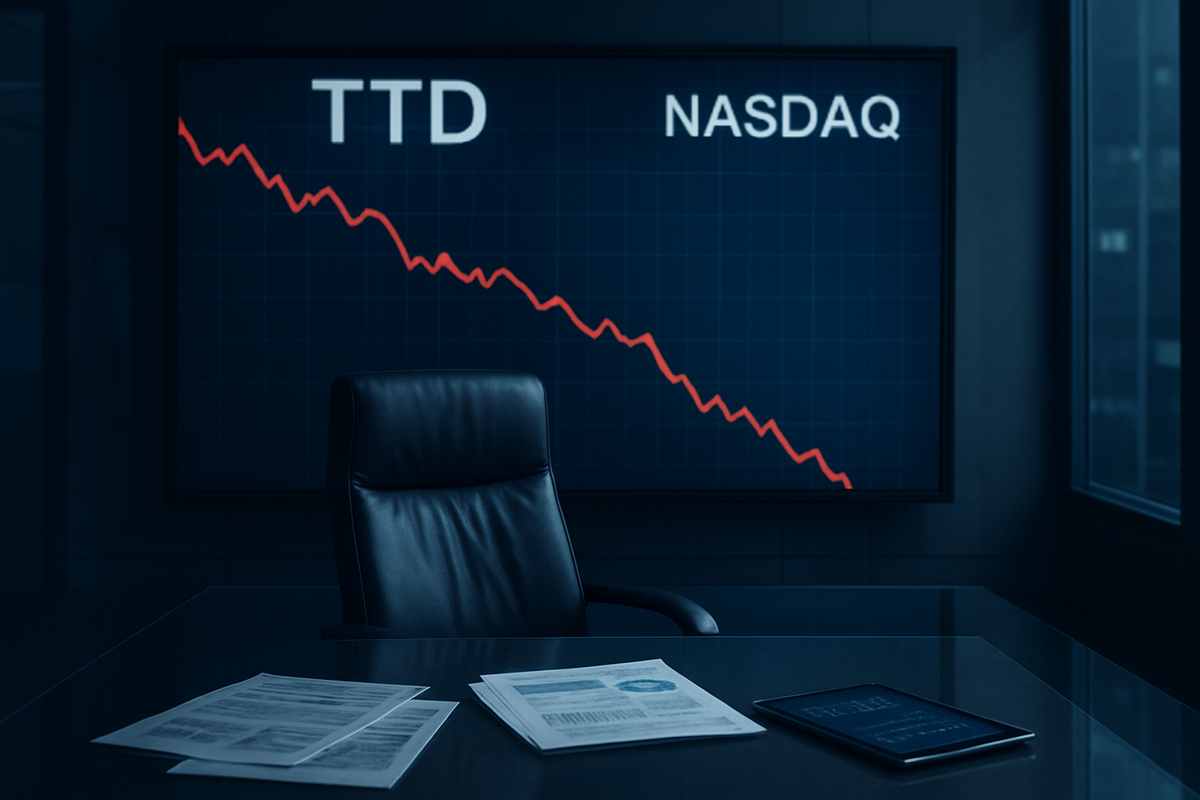
The Trade Desk (NASDAQ: TTD) finds itself in the crosshairs of a leadership crisis following the sudden and jarring termination of Chief Financial Officer Alexander Kayyal on January 26, 2026. The move, which comes just five months after Kayyal assumed the role, has rattled the nerves of institutional investors and sent the company’s stock price tumbling to levels not seen in years. By the close of trading on the week of the announcement, shares of the ad-tech giant had fallen more than 12%, marking a precipitous decline for a company that was once considered the untouchable "darling" of the programmatic advertising world.
The immediate fallout of Kayyal’s departure extends far beyond the C-suite. With the company appointing 11-year veteran Tahnil Davis as interim CFO, the market is now grappling with what analysts describe as "narrative volatility." The termination marks the second CFO exit for the company in less than six months—a red flag for a multi-billion-dollar enterprise during a period of intense industry disruption. As the company prepares for its upcoming quarterly earnings report, the primary concern for the market is no longer just revenue growth, but whether the executive leadership can stabilize a ship that appears to be listing under the pressure of a shifting digital landscape.
A "Terminated" Tenure: The Timeline of the Kayyal Exit
The dismissal of Alexander Kayyal was anything but a standard executive transition. According to an SEC 8-K filing released on Monday, January 26, 2026, Kayyal’s employment was "terminated" effective Saturday, January 24. The specific use of the word "terminated"—as opposed to the more common "resigned" or "stepped down"—is a rare and aggressive choice in corporate communications. It typically signals a forced departure or a breakdown in the relationship between the board and the executive, rather than a mutual separation.
The timeline leading up to this moment suggests a misalignment of strategic vision. Kayyal, a former General Partner at Lightspeed Venture Partners and a member of The Trade Desk’s board since early 2025, was initially seen as a high-profile hire capable of navigating the company through its next phase of global expansion. However, industry insiders suggest that his background in venture capital and board-level strategy may not have translated to the operational rigor required to manage the day-to-day finances of a public company facing decelerating growth.
The market reaction was swift and unforgiving. On the day of the disclosure, shares of The Trade Desk fell 8%, leading the decliners in the S&P 500. By Tuesday, the stock hit a fresh 52-week low, hovering near $32.00. This cumulative 12% drop erased billions in market capitalization, as major firms like Citigroup and Rosenblatt Securities immediately slashed their price targets. The "revolving door" at the CFO position has, in the eyes of many analysts, "eviscerated" the premium valuation that The Trade Desk long enjoyed compared to its peers.
Winners and Losers in the Ad-Tech Shakeup
The primary loser in this event is undeniably The Trade Desk (NASDAQ: TTD). The company’s inability to keep a finance chief in the seat for more than a few months has created a "show-me" story for investors who were already wary of slowing revenue. While the company reaffirmed its Q4 revenue guidance of "at least $840 million," the market viewed this as a disappointment. In a year where "beat and raise" was the expected cadence, merely hitting the floor of expectations suggests that the high-octane growth of the 2020-2024 era has stalled.
Conversely, the "Walled Gardens" such as Alphabet Inc. (NASDAQ: GOOGL) and Amazon.com, Inc. (NASDAQ: AMZN) stand to benefit from the uncertainty surrounding the independent leader. As The Trade Desk deals with internal friction, these giants are aggressively leveraging their first-party data ecosystems to lure advertisers back from the "Open Web." In 2026, Amazon has significantly expanded its retail media network, offering "close-to-zero" fees for programmatic guaranteed deals—a direct shot at TTD’s margin structure.
Independent Supply-Side Platforms (SSPs) like Magnite, Inc. (NASDAQ: MGNI) and PubMatic, Inc. (NASDAQ: PUBM) face a more complex situation. While they might see TTD’s instability as an opportunity to regain leverage in Supply Path Optimization (SPO) discussions, they are also wary of the broader industry malaise. If the leader of the independent web is struggling, the contagion could spread to smaller players. However, Magnite, currently holding a 25% share of the US SSP market, may find itself in a stronger negotiating position with agencies that are increasingly nervous about putting all their eggs in The Trade Desk's basket.
The "Great Integration" and the Crisis of the Open Web
The turmoil at The Trade Desk occurs against the backdrop of the "Great Integration" of 2026, where AI has fundamentally shifted how advertising is bought and sold. With the rise of "Agentic AI"—AI assistants that make purchasing decisions on behalf of consumers—the traditional funnel is being disrupted. Marketers are now optimizing for "AI buyers" rather than human eyeballs, and the complexity of this shift requires steady, experienced financial leadership to manage R&D investments.
Furthermore, the industry is navigating the post-"Cookie Apocalypse" reality. While Google officially pivoted to a "User Choice" model in late 2024, the majority of users have opted out of tracking, making identity solutions like Unified ID 2.0 (UID2) the new standard. The Trade Desk has staked its future on UID2, but the executive churn raises questions about the company's ability to execute the long-term roadmap for its AI platform, Kokai.
Historically, sudden CFO departures without a clear successor have often preceded larger strategic pivots or, in some cases, deeper financial restructuring. Comparisons are already being drawn to other high-growth tech firms that experienced similar management instability before being acquired or seeing their market caps permanently reset. The Trade Desk's current situation is a stark reminder that in the hyper-competitive ad-tech sector, technological dominance can be easily undermined by organizational instability.
Looking Ahead: The Search for Stability
In the short term, all eyes will be on the upcoming Q4 2025 earnings call, where CEO Jeff Green will be forced to address the termination of Kayyal and provide a clearer timeline for hiring a permanent CFO. The appointment of Tahnil Davis as interim CFO provides some operational continuity, given her long tenure as Chief Accounting Officer, but the market is unlikely to be satisfied until a heavyweight financial veteran is installed.
Investors should watch for any signs of a strategic pivot in the next six months. There is growing speculation that The Trade Desk may need to reconsider its fee structure to compete with Amazon and Google’s aggressive pricing models. If the company continues to see management churn, it may also become a target for activist investors who could push for a sale or more drastic cost-cutting measures. The "neutral" status of the platform is its greatest asset, but that neutrality is only as strong as the confidence investors have in its leadership.
Conclusion: A Turning Point for the Ad-Tech Giant
The termination of Alexander Kayyal is more than just a personnel change; it is a signal of a company at a crossroads. The Trade Desk has spent a decade defining the future of the Open Web, but it now faces a confluence of challenges: aggressive competition from trillion-dollar tech giants, a shifting technological landscape driven by Agentic AI, and a internal leadership vacuum that has spooked the market.
Moving forward, the narrative for The Trade Desk has shifted from "growth at any cost" to a rigorous assessment of executive execution. Investors should maintain a cautious stance, watching closely for the permanent CFO appointment and any revisions to the 2026 growth outlook. While the company's technological foundations, such as UID2 and OpenPath, remain robust, the "revolving door" in the C-suite has introduced a level of risk that will take more than one good earnings report to erase. The coming months will determine whether January 26 was a minor speed bump or the beginning of a larger decline for the ad-tech pioneer.
This content is intended for informational purposes only and is not financial advice.