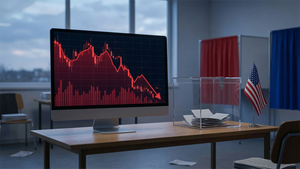
The tech-heavy Nasdaq Composite faced a stark reversal on January 8, 2026, as a wave of profit-taking in high-flying artificial intelligence stocks, led by Nvidia (NASDAQ: NVDA), dragged the index lower. After hitting a historic milestone just two days prior, Nvidia’s shares retreated as investors began to question the short-term sustainability of the AI hardware boom. The sell-off marks a significant shift in market sentiment, transitioning from the speculative euphoria seen at the start of the year to a more cautious, value-oriented approach.
This sudden cooling of the AI sector has immediate implications for the broader market. The Nasdaq's decline, driven by its most influential member, has triggered a "Great Rotation" into small-cap stocks and traditional value sectors like energy and financials. While the AI narrative remains fundamentally intact, the market is now demanding tangible evidence of "Return on AI Investment" (ROAI), moving away from the "build it and they will come" mentality that dominated 2024 and 2025.
The volatility began following the 2026 Consumer Electronics Show (CES) in Las Vegas, where Nvidia CEO Jensen Huang unveiled the "Vera Rubin" platform—the highly anticipated successor to the Blackwell architecture. The announcement initially sent Nvidia’s market capitalization soaring past the $5 trillion mark, a first for any public company, as the platform promised a staggering 15x leap in AI inference efficiency. However, the record-high Nasdaq Composite of 23,547.17 reached on January 6 proved to be a local ceiling.
By the morning of January 8, the tide had turned. A combination of "sell the news" behavior and fresh geopolitical headwinds from Asia sparked a rapid liquidation. Reports surfaced that Beijing had ordered Chinese domestic firms to halt orders of Nvidia’s H200 chips in favor of local alternatives, such as those from Huawei, creating a sudden revenue "drag" for the semiconductor giant. This news, coupled with a 10% correction in late 2025 known as the "Autumn Chill," reminded investors that the path to AI dominance is fraught with regulatory and geopolitical hurdles.
Initial market reactions were swift. As Nvidia’s stock price dipped, a ripple effect moved through the "Magnificent Seven," with major players like Apple (NASDAQ: AAPL) and Microsoft (NASDAQ: MSFT) also seeing their shares soften. Traders, many of whom were sitting on triple-digit gains from the previous 18 months, chose to lock in profits, leading to a 1.2% intraday drop for the Nasdaq 100. Meanwhile, the Russell 2000 index, representing small-cap companies, began to decouple from the tech giants, posting its second-best start to a year on record.
The primary losers in this shift are the concentrated AI infrastructure plays that have dominated portfolios for the last two years. Beyond Nvidia, Broadcom (NASDAQ: AVGO) and other high-end chipmakers faced selling pressure as the market re-evaluated the massive capital expenditure (CapEx) budgets of "hyperscalers." Analysts from firms like Capital Economics have warned that the $400 billion annual run rate for data center investment seen in late 2025 may be reaching a point of diminishing returns, at least in the eyes of impatient shareholders.
Conversely, the "winners" of this rotation are found in the long-neglected value and small-cap sectors. Energy companies have seen a resurgence, led by firms like Energy Services of America (NASDAQ: ESOA), which has benefited from renewed domestic infrastructure demand. Financial institutions are also gaining ground as the Federal Reserve’s pivot to a 3.50% interest rate environment begins to steepen the yield curve. Regional leaders like Huntington Bancshares (NASDAQ: HBAN) and Western Alliance Bancorporation (NYSE: WAL) have seen their stock prices climb as capital migrates out of the tech sector.
The healthcare and biotech sectors are also emerging as beneficiaries of the "AI fatigue." Companies like Arrowhead Pharmaceuticals (NASDAQ: ARWR) and obesity-treatment leaders Eli Lilly (NYSE: LLY) and Novo Nordisk (NYSE: NVO) are being viewed as more stable growth alternatives. Investors are increasingly looking for companies that use AI to improve their bottom lines—such as Pagaya Technologies (NASDAQ: PGY) in the fintech space—rather than just those selling the underlying "shovels" and "picks" of the AI gold rush.
This event fits into a broader historical trend of market "mean reversion." Just as the Dot-com bubble saw a massive rotation into value stocks in the early 2000s, the current market is experiencing a healthy, albeit painful, consolidation. The "Autumn Chill" of 2025 served as a precursor, signaling that the "speculative hype" phase of AI was ending and the "utility" phase was beginning. The wider significance lies in the shift from valuing companies on potential to valuing them on realized productivity gains.
The potential ripple effects on competitors are profound. With Nvidia facing new restrictions in China, the pressure on its domestic rivals and international partners is mounting. The regulatory landscape is also tightening, with the U.S. government balancing the need for technological leadership against national security concerns. This has created an opening for diversified tech firms and local champions in emerging markets to capture share in segments where Nvidia’s premium products are either too expensive or restricted.
Historically, periods of extreme concentration in a few mega-cap stocks, such as the Nifty Fifty in the 1970s or the tech giants in 2000, have ended with a broadening of market participation. The current rotation into the Russell 2000 suggests that the 2026 market may be more balanced than its predecessors. This transition is often viewed by economists as a sign of a maturing economic cycle where growth becomes more democratized across different industries.
In the short term, market participants should expect continued volatility as the "Vera Rubin" platform begins its full-scale rollout. While the initial profit-taking has been sharp, Nvidia's technological lead remains significant. Strategic pivots will likely involve Nvidia focusing more on software and integrated AI services to diversify its revenue streams away from pure hardware sales. For competitors, the challenge will be to prove they can offer comparable performance at a lower price point or within different regulatory frameworks.
Long-term, the focus will remain on the "Air Pocket" theory—a period where heavy investment continues but the resulting profit margins temporarily dip before widespread AI adoption takes hold. This could lead to a "Year of Risk Reboot," as suggested by Morgan Stanley, where the S&P 500 eventually finds a new floor and begins a more sustainable climb. Market opportunities will likely emerge in the "AI Efficiency" space, where software companies demonstrate how they are turning expensive chips into actual corporate earnings.
Potential scenarios include a "soft landing" for tech, where valuations gradually align with earnings growth, or a more disruptive "bursting" if the anticipated AI productivity gains fail to materialize by mid-2026. Investors will be closely watching the upcoming Q1 earnings reports for signs that the massive CapEx of 2025 is starting to pay off in the form of improved margins for the software and service-based companies that use Nvidia’s hardware.
The events of early January 2026 serve as a reminder that even the most revolutionary technologies are subject to the gravity of market cycles. Nvidia’s ascent to a $5 trillion valuation was a testament to the transformative power of AI, but the subsequent retreat highlights the importance of valuation discipline and the inevitability of profit-taking. The "Great Rotation" currently underway is not necessarily a rejection of AI, but rather a recalibration of how the market prizes growth versus value.
Moving forward, the market is likely to be characterized by a "show me" attitude. Investors should watch for the successful deployment of the Vera Rubin platform and any further shifts in U.S.-China trade relations. The performance of small-caps and value sectors will serve as a barometer for the health of the broader economy. While the Nasdaq may face headwinds from its heavy concentration in AI winners, the broadening of the market rally could provide a more stable foundation for long-term investors.
The key takeaway for the coming months is diversification. As the "Magnificent Seven" trade becomes more crowded and volatile, the opportunities in energy, financials, and specialized biotech are becoming too significant to ignore. The AI revolution is far from over, but the era of easy gains from simply owning the biggest chipmaker may be entering a more complex and selective phase.
This content is intended for informational purposes only and is not financial advice