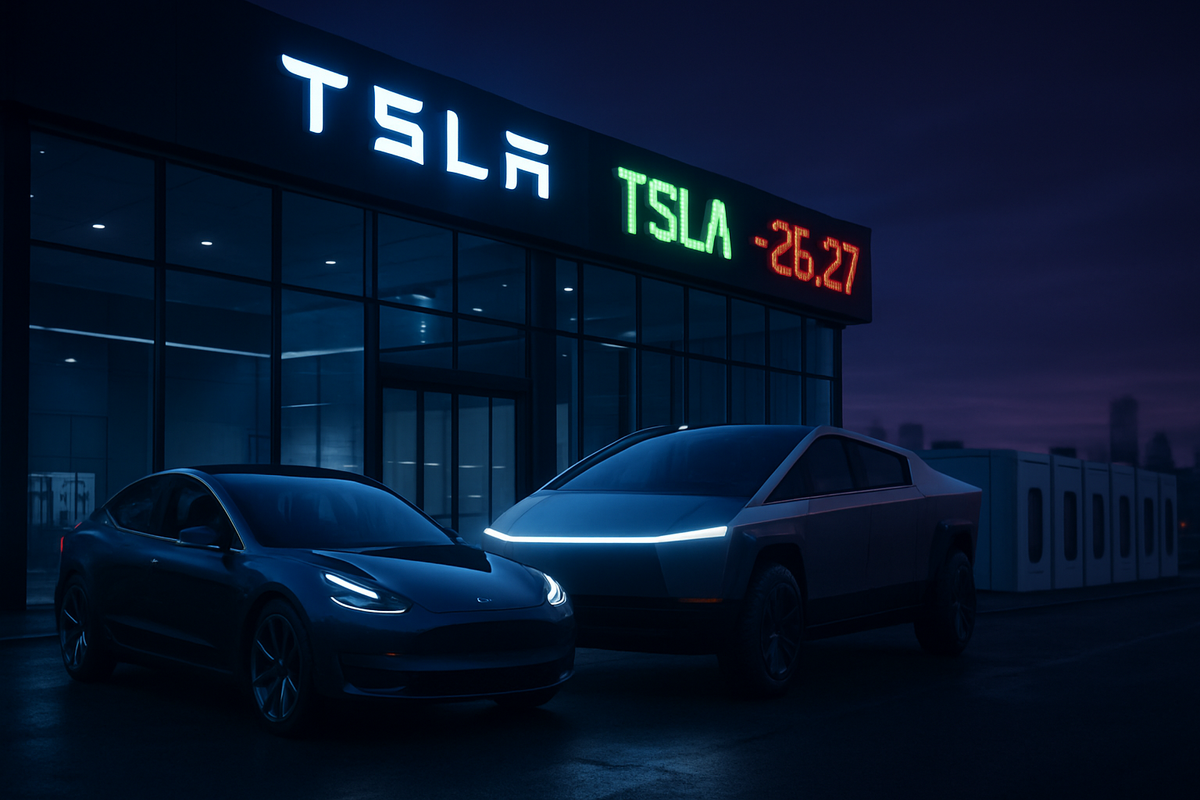
In a high-stakes start to the 2026 trading year, Tesla, Inc. (NASDAQ: TSLA) reported fourth-quarter vehicle delivery numbers that managed to narrowly beat the company’s own internal projections but failed to mask a broader slowdown in the electric vehicle (EV) sector. The report, released on the morning of January 2, 2026, revealed that the Austin-based automaker delivered 418,227 vehicles in the final quarter of 2025. While this figure was a "near-hit" against Tesla's lowered internal consensus of 420,399, it fell significantly short of independent Wall Street expectations, which had hovered near 441,000 units.
The market’s reaction was a textbook case of "sell the news." After an initial pre-market surge of 2.5%—fueled by record-breaking energy storage deployments and a charitable stock donation from CEO Elon Musk—investors quickly pivoted to the sobering reality of a second consecutive year of declining vehicle sales. By midday, Tesla’s stock had slashed its early gains, retreating from an intraday high of $457.83 to trade near the $450 level as analysts began slashing 2026 delivery forecasts.
The Numbers Behind the Narrative
Tesla’s fourth-quarter performance was defined by a stark divergence between its maturing automotive business and its surging energy division. Of the 418,227 vehicles delivered, the vast majority were the Model 3 and Model Y, which accounted for 406,585 units. The "Other Models" category, which includes the Model S, Model X, and the Cybertruck, contributed a modest 11,642 deliveries. Notably, production outpaced deliveries by roughly 16,000 units, leading to an inventory build that suggests demand continues to lag behind the company’s manufacturing capacity.
The timeline leading up to this report was fraught with headwinds. The third quarter of 2025 saw a massive "pull-forward" of sales as consumers rushed to take advantage of federal EV tax credits before they were largely repealed on September 30. This created a significant demand vacuum in the fourth quarter. Furthermore, the implementation of the One Big Beautiful Bill Act (OBBBA) in July 2025 shifted the incentive structure from direct credits to a tax deduction for auto loan interest, a move that favored domestic manufacturing but failed to ignite the same immediate consumer fervor as the previous $7,500 point-of-sale rebate.
Initial industry reactions have been mixed. While Tesla bulls pointed to the record 14.2 GWh of energy storage deployed in Q4 as evidence of a successful pivot to a broader "energy and AI" ecosystem, automotive purists expressed concern. For the full year 2025, Tesla delivered 1.636 million vehicles, an 8% decline from 2024 and a far cry from its 2023 peak of 1.81 million. This confirmation of a multi-year volume contraction has forced a re-evaluation of Tesla’s premium valuation relative to traditional and emerging peers.
Winners and Losers in a Shifting Landscape
The Q4 report solidified a historic shift in the global EV hierarchy. The clear winner of 2025 was BYD Company Limited (OTC: BYDDY), which officially seized the crown as the world’s top battery-electric vehicle (BEV) manufacturer. BYD reported 2.25 million BEV sales for the full year, a 28% increase that stood in sharp contrast to Tesla’s contraction. BYD’s vertical integration and aggressive expansion into Europe and Southeast Asia have allowed it to capture the mass-market share that Tesla has yet to address with a lower-cost model.
In the domestic market, Rivian Automotive, Inc. (NASDAQ: RIVN) emerged as a resilient player, meeting its annual production guidance of roughly 42,000 vehicles. While Rivian remains a niche player compared to Tesla, its ability to maintain steady growth amid a cooling market has bolstered investor confidence, particularly following a $6.6 billion Department of Energy loan for its Georgia manufacturing facility. Conversely, Lucid Group, Inc. (NASDAQ: LCID) is currently in a high-stakes ramp-up of its Gravity SUV, hoping the new model can reverse its history of high cash burn and low volume.
The "losers" in this environment appear to be pure-play EV startups without significant capital cushions and legacy automakers who overextended their EV transition plans. As U.S. consumer interest in pure BEVs dropped to just 11% in early 2026, companies heavily invested in Hybrid and Plug-in Hybrid (PHEV) technology, such as Toyota Motor Corporation (NYSE: TM), have seen a resurgence in demand, capturing the "EV-skeptic" demographic that is deterred by high interest rates and charging infrastructure gaps.
Wider Significance and Industry Trends
Tesla’s delivery miss is more than just a company-specific hurdle; it is a barometer for a cooling North American EV market. With average auto loan rates hovering at 7.01% as of January 2, 2026, the "restrictive" monetary environment has made big-ticket technology purchases a financial non-starter for many middle-class households. The broader industry trend is moving toward a "regional divergence," where China continues to see rapid adoption while the U.S. market grapples with policy uncertainty and a fleet of aging internal combustion vehicles that consumers are choosing to repair rather than replace.
The regulatory landscape has also become a battlefield. The repeal of the Inflation Reduction Act’s tax credits and the introduction of the OBBBA loan interest deductions represent a fundamental shift in how the U.S. government supports the transition to sustainable transport. This policy volatility, combined with the threat of new tariffs on Chinese battery materials, has left the industry in a state of "wait-and-see," stifling long-term capital investment.
Historically, Tesla has relied on a "growth at all costs" narrative to support its high price-to-earnings ratio. However, with two years of declining volumes, the company is now being forced to pivot its identity. The focus has shifted from being a "car company" to an "AI and robotics firm," with the market now placing an outsized emphasis on the upcoming "Cybercab" and the monetization of Full Self-Driving (FSD) software. This transition is reminiscent of other tech giants that had to reinvent themselves as their hardware businesses matured.
What Lies Ahead for Tesla
The immediate focus for investors will be the Q4 earnings call scheduled for January 28, 2026. This event will be critical for management to provide 2026 guidance and, more importantly, a roadmap for the "Model 2" or next-generation affordable platform. Without a sub-$30,000 vehicle to compete with BYD’s global onslaught, Tesla risks further volume erosion in its core automotive segment.
In the short term, the company must manage its growing inventory and navigate a U.S. market that is increasingly favoring hybrids. Strategic pivots toward FSD licensing and Robotaxi fleets are the "moonshot" opportunities that could decouple Tesla’s stock from its delivery numbers. However, these technologies face significant regulatory and technical hurdles that may not be resolved in the 2026 calendar year.
Long-term, Tesla’s dominance in the energy storage sector—highlighted by the 14.2 GWh record this quarter—provides a high-margin safety net that its competitors lack. If Tesla can successfully transition from a high-volume automaker to a diversified energy and AI infrastructure provider, the current delivery slump may be viewed in hindsight as a necessary period of consolidation.
Market Wrap-Up and Investor Outlook
The takeaway from the January 2 delivery report is clear: the era of "easy growth" for electric vehicles in the United States has ended. Tesla’s 418,227 deliveries represent a company fighting against macroeconomic gravity, policy shifts, and a formidable global competitor in BYD. While the stock’s early gains were erased by midday, the fact that it did not collapse entirely suggests that the "AI pivot" narrative still holds significant weight with the investor base.
Moving forward, the market will be looking for signs of stabilization in Tesla’s automotive margins and a concrete timeline for its Robotaxi ambitions. Investors should watch for the upcoming earnings call and any further updates on the OBBBA implementation, which will dictate the affordability of EVs in the coming months.
In conclusion, Tesla remains at a crossroads. The transition from a disruptive automaker to a mature technology conglomerate is proving to be a volatile journey. For investors, the coming months will require a careful balancing act between the sobering reality of declining car sales and the visionary potential of Tesla’s AI-driven future.
This content is intended for informational purposes only and is not financial advice.