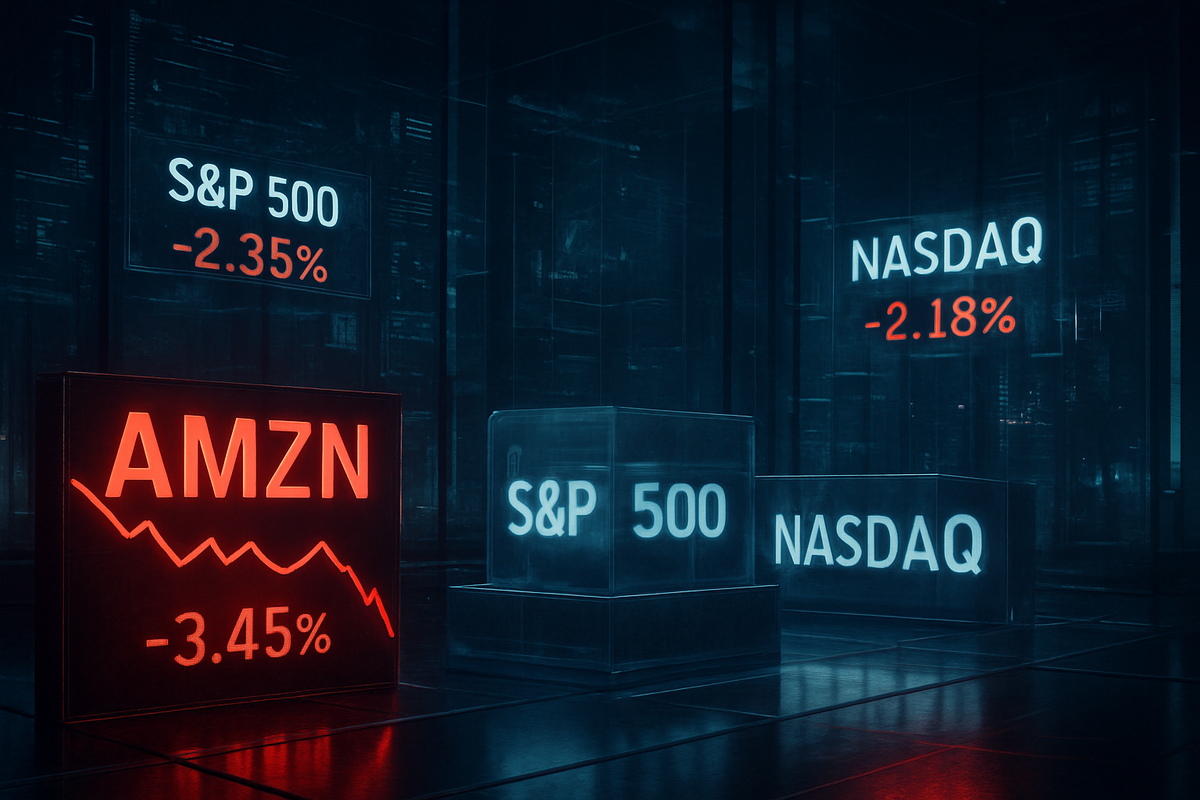
The first trading sessions of 2026 have delivered a sobering reality check to investors as two of the most influential components of the "Magnificent Seven" have hit significant turbulence. Shares of Amazon.com Inc. (NASDAQ: AMZN) and Tesla Inc. (NASDAQ: TSLA) fell sharply in the opening days of the year, exerting a heavy gravitational pull on the S&P 500 and the Nasdaq Composite. While the broader market entered the year with optimism fueled by a cooling Federal Reserve, the idiosyncratic struggles of these two giants have momentarily stalled the traditional "January Effect" rally.
The decline in these heavyweights is more than just a localized sell-off; it represents a test of the market’s concentration. With Amazon and Tesla collectively accounting for a substantial portion of the Nasdaq-100’s weighting, their simultaneous retreat has forced the index into a defensive posture, even as other sectors like semiconductors and financials show signs of resilience. This divergence highlights a shifting landscape where investors are becoming increasingly discerning, moving away from broad-based tech enthusiasm toward a more rigorous evaluation of individual company fundamentals and regulatory risks.
A New Year's Hangover for the Mega-Caps
The sell-off began in earnest during the first trading session of the year, following a series of data points that soured sentiment for the two retail and technology leaders. Tesla Inc. (NASDAQ: TSLA) saw its shares tumble after confirming that 2025 deliveries reached only 1.63 million vehicles, a notable decline from the 1.79 million reported in 2024. This marks the second consecutive year of annual sales contraction for the electric vehicle pioneer, a statistic that has rattled the "growth at any cost" narrative that previously supported its premium valuation. The decline was compounded by reports of significant market share erosion in Europe and China, where competitors like BYD Co. Ltd. (OTC: BYDDY) and Xiaomi Corp. (OTC: XIACY) have successfully undercut Tesla on price and technology features.
Simultaneously, Amazon.com Inc. (NASDAQ: AMZN) faced a wave of profit-taking as investors weighed the company’s massive $125 billion capital expenditure on artificial intelligence against the looming shadow of the Federal Trade Commission (FTC). While Amazon Web Services (AWS) showed signs of reacceleration toward the end of 2025, the market’s focus has shifted to the upcoming antitrust trial scheduled for October 2026. Analysts suggest that the "valuation ceiling" created by this legal overhang, combined with a slight miss in North American retail margins during the holiday quarter, prompted institutional investors to rotate capital out of the e-commerce giant and into more defensive or high-growth semiconductor plays.
The timeline leading to this moment was defined by a volatile 2025. Throughout the previous year, Tesla struggled with the "Elon Effect," as consumer sentiment toward the brand became increasingly polarized. Meanwhile, Amazon spent much of 2025 integrating its "Project Leo" satellite internet infrastructure and custom Trainium3 AI chips. As 2026 opens, the initial market reaction has been one of caution, with the Nasdaq-100 down 1.5% in the first 48 hours of trading, almost entirely due to the performance of these two outliers.
Winners and Losers in the Wake of the Slide
The primary "losers" in this scenario are the passive index funds and retail investors heavily concentrated in consumer discretionary ETFs. Because Tesla and Amazon are the dominant forces in the Consumer Discretionary Select Sector SPDR Fund (NYSEARCA: XLY), that sector has significantly underperformed the broader market. Retail traders who had bet on a year-end "Santa Claus" rally extending into January have found themselves underwater, particularly those holding leveraged long positions in Tesla.
Conversely, the "winners" are emerging in the semiconductor and traditional retail sectors. NVIDIA Corp. (NASDAQ: NVDA) and Advanced Micro Devices Inc. (NASDAQ: AMD) have seen a surge in interest as investors front-run the upcoming CES 2026 conference, where new AI architectures are expected to be unveiled. Furthermore, Walmart Inc. (NYSE: WMT) has benefited from the rotation, as its steady e-commerce growth and lack of regulatory baggage make it an attractive alternative to Amazon for those seeking exposure to the American consumer.
The broader banking sector, led by JPMorgan Chase & Co. (NYSE: JPM), has also seen a modest uptick. As investors pull back from high-beta tech names, the stability of financials—bolstered by the Federal Reserve's recent interest rate cuts to the 3.50%–3.75% range—has provided a safety net for the S&P 500, preventing a more catastrophic market-wide drawdown.
Index Concentration and the "Magnificent" Divergence
The current market action fits into a broader trend of "Magnificent Seven" divergence. For years, these seven stocks moved in lockstep, but 2026 is shaping up to be a year of separation. The fact that the S&P 500 is struggling despite strength in other sectors underscores the ongoing risk of index concentration. When two companies that represent nearly 6% of the S&P 500 and over 11% of the Nasdaq-100 falter, it creates a "math problem" for the indices that even a booming semiconductor sector can struggle to solve.
Historically, this mirrors the early 2000s or the 2022 tech correction, where high-valuation leaders were forced to undergo a period of "multiple compression" while the rest of the market caught up. The ripple effect is already being felt by partners and suppliers; battery manufacturers and logistics providers tied to Tesla and Amazon have seen their stock prices soften in sympathy. Regulatory scrutiny is also a major factor; the FTC’s aggressive stance toward Amazon is being watched closely by European regulators, potentially signaling a worldwide crackdown on big-tech ecosystems that could affect Alphabet Inc. (NASDAQ: GOOGL) and Apple Inc. (NASDAQ: AAPL) later in the year.
The Road Ahead: Catalysts and Pivots
In the short term, all eyes are on the upcoming economic data releases, specifically the Non-Farm Payrolls report on January 9, 2026. A "Goldilocks" employment number could provide the necessary sentiment boost to offset the tech slump. For Tesla, the next major pivot point is April 2026, when production for the dedicated "Cybercab" robotaxi is slated to begin. If Tesla can demonstrate a clear path to autonomous revenue, it may regain its status as a growth darling; otherwise, it risks being re-rated as a standard automotive manufacturer.
Amazon’s strategic pivot will likely involve a heavier emphasis on its advertising business and the commercial launch of its "Leo" satellite internet service in Q1 2026. These high-margin ventures are essential for offsetting the capital-intensive AI investments that have temporarily weighed on its stock. Investors should watch for a "broadening out" of the market, where small-cap stocks and mid-cap industrials begin to take the lead if the mega-cap tech giants remain in a period of consolidation.
Market Outlook and Summary
The early 2026 slump of Amazon and Tesla serves as a potent reminder that even the most dominant market leaders are not immune to fundamental challenges and regulatory gravity. The key takeaway for investors is the importance of diversification in an era of extreme index concentration. While the S&P 500 and Nasdaq remain near historic highs, the "engine" of the market is changing, with AI hardware and traditional value plays currently outperforming the consumer-facing tech titans.
Moving forward, the market is likely to remain volatile as it digests the transition of Federal Reserve leadership in May 2026 and the various legal challenges facing Big Tech. Investors should keep a close watch on the divergence between the "winners" of the AI infrastructure boom and the "strugglers" of the EV and e-commerce sectors. While the start of 2026 has been rocky for the indices, it also presents a potential entry point for those who believe in the long-term resilience of these tech giants once the current clouds of uncertainty clear.
This content is intended for informational purposes only and is not financial advice.