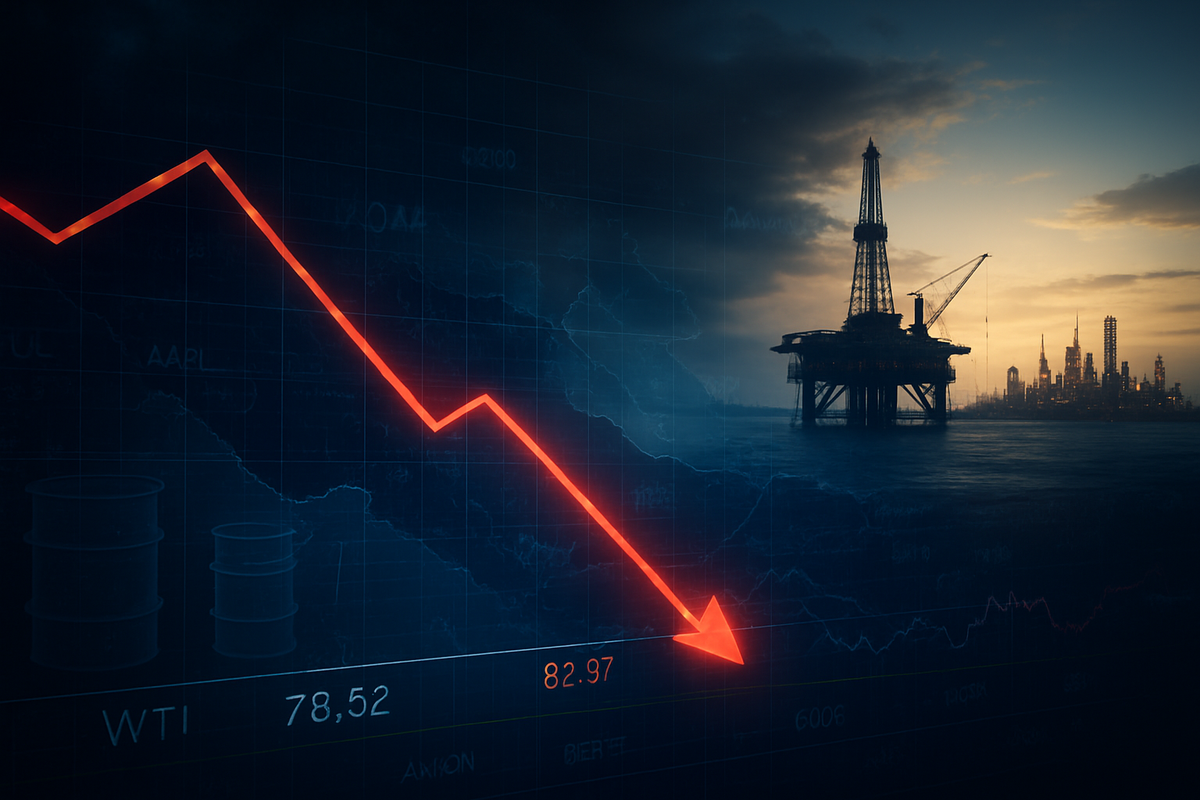
Energy markets experienced a dramatic correction on January 15, 2026, as the "geopolitical risk premium" that had propped up crude prices for weeks suddenly evaporated. Following signals from the White House that immediate military action against Tehran had been sidelined in favor of a "wait-and-see" approach, global benchmarks saw their steepest one-day declines of the new year.
The retreat in prices marks a significant turning point for a market that has been on edge since early January. As the threat of a kinetic conflict in the Persian Gulf receded, traders quickly shifted their focus back to lukewarm global demand and ballooning U.S. inventories. For the first time in 2026, the prospect of a supply glut has outweighed the fear of a supply shock, sending ripples across the energy, aviation, and logistics sectors.
De-Escalation and the "Tariffs over Tomahawks" Strategy
The primary catalyst for the January 15 price tumble was a strategic shift by the Trump administration. After two weeks of escalating rhetoric following nationwide unrest in Iran, President Donald Trump announced in an Oval Office statement that the U.S. would hold off on retaliatory strikes. The decision was reportedly triggered by intelligence suggesting that the Iranian regime had halted a series of high-profile executions of protesters—a condition the White House had set as a red line for military intervention. "The killing in Iran is stopping," the President remarked, signaling a preference for "economic suffocation" over missiles, a move analysts are already dubbing the "Tariffs over Tomahawks" strategy.
This diplomatic pivot was not reached in a vacuum. Behind the scenes, a coalition of Arab allies—including Saudi Arabia, Qatar, Oman, and Egypt—engaged in 48 hours of frantic "back-channel" diplomacy. These nations warned Washington that a U.S. strike could lead to uncontrollable "blowback" on regional military facilities and permanently damage the global economy. By the time the U.S. Ambassador to the UN, Mike Waltz, spoke at an emergency Security Council meeting on the 15th, the tone had shifted from imminent threat to firm observation.
The market reaction was swift and decisive. West Texas Intermediate (WTI) futures plummeted by 4.5%, breaking below the psychologically critical $60 mark to settle at $59.19 per barrel. Brent crude, the international benchmark, followed suit with a 4.1% decline, falling to $63.76 per barrel. This erased nearly all the gains accrued in the first half of the month, as traders liquidated "war hedges" originally placed to protect against a potential closure of the Strait of Hormuz.
Winners and Losers: A Tale of Two Sectors
The sudden drop in crude created a stark divide on Wall Street. The aviation sector emerged as the clear winner, as lower oil prices translate directly into reduced jet fuel expenses—the largest variable cost for carriers. Delta Air Lines (NYSE: DAL) saw its stock surge by 4.16%, rebounding from a slump earlier in the week. United Airlines Holdings (NASDAQ: UAL) and American Airlines Group (NASDAQ: AAL) also posted gains of 4.16% and 3.76% respectively, as investors cheered the prospect of improved operating margins for the first quarter of 2026.
Conversely, the energy sector faced a wave of repositioning. While diversified "Big Oil" majors showed some defensive resilience, the impact was still felt. Exxon Mobil Corp. (NYSE: XOM) saw its shares dip 0.82%, acting as a relative safe haven compared to the commodity itself. Chevron Corp. (NYSE: CVX) followed a similar path, closing down 0.70%. However, pure-play upstream producers were hit much harder. Occidental Petroleum Corp. (NYSE: OXY) fell 2.59%, reflecting its higher sensitivity to domestic price fluctuations. Analysts at UBS noted that if WTI remains below the $60 threshold, many shale producers may be forced to reconsider their 2026 capital expenditure plans.
Shifting Focus to Supply Fundamentals
While geopolitics grabbed the headlines, a bearish report from the U.S. Energy Information Administration (EIA) provided the fundamental "one-two punch" that cemented the day’s losses. The EIA reported a 3.4-million-barrel build in crude inventories and a massive 9-million-barrel increase in gasoline stockpiles. This data suggested that even without the easing of Middle Eastern tensions, the market was already facing a surplus.
This event fits into a broader 2026 trend where the "geopolitical risk premium" is increasingly volatile but ultimately temporary. Naeem Aslam of Zaye Capital Markets observed that the market is "continuously repricing" this premium against a backdrop of increasing U.S. production and the gradual return of sanctioned oil. Specifically, reports that Venezuela is beginning to reverse production cuts as exports resume under a shifting U.S. policy framework have added further downward pressure on prices, suggesting that the era of supply-side scarcity may be drawing to a close.
The Road Ahead: Volatility and Strategic Pivots
In the short term, oil prices are likely to remain in a "holding pattern" as markets monitor the situation in Tehran. If the Iranian regime resumes its crackdown, the military option could return to the table, potentially re-inflating prices overnight. However, the long-term outlook appears increasingly bearish. Traders are now forced to reckon with a global economy that is growing more efficient and a U.S. energy sector that continues to pump at record levels regardless of the political climate.
Strategic pivots will be required for both producers and consumers. Energy companies may shift their focus toward dividend stability and debt reduction rather than aggressive drilling in a sub-$60 WTI environment. Meanwhile, industrial companies and transportation fleets may use this price dip to lock in long-term fuel hedges, capitalizing on the temporary relief from 2025’s higher averages. The "market opportunity" here lies in the volatility itself; 2026 is shaping up to be a year where algorithmic trading and headline sensitivity dictate daily moves more than seasonal demand patterns.
Summary and Market Outlook
The events of January 15, 2026, serve as a potent reminder of how quickly geopolitical narratives can be upended. The 4% tumble in oil prices has effectively recalibrated the market’s expectations, stripping away the "war premium" and exposing the underlying reality of a well-supplied global market. Key takeaways for investors include the resilience of major integrated oil firms like ExxonMobil and the significant margin expansion potential for the airline industry.
Moving forward, the market will likely be defined by a tug-of-war between the Trump administration's "Maximum Pressure 2.0" economic policies and the fundamental reality of a global oil surplus. Investors should keep a close watch on weekly EIA inventory reports and any official rhetoric regarding the Strait of Hormuz. While the immediate threat of fire in the Gulf has been extinguished, the embers of regional instability remain, ensuring that volatility will be a constant companion for energy traders throughout the coming months.
This content is intended for informational purposes only and is not financial advice.