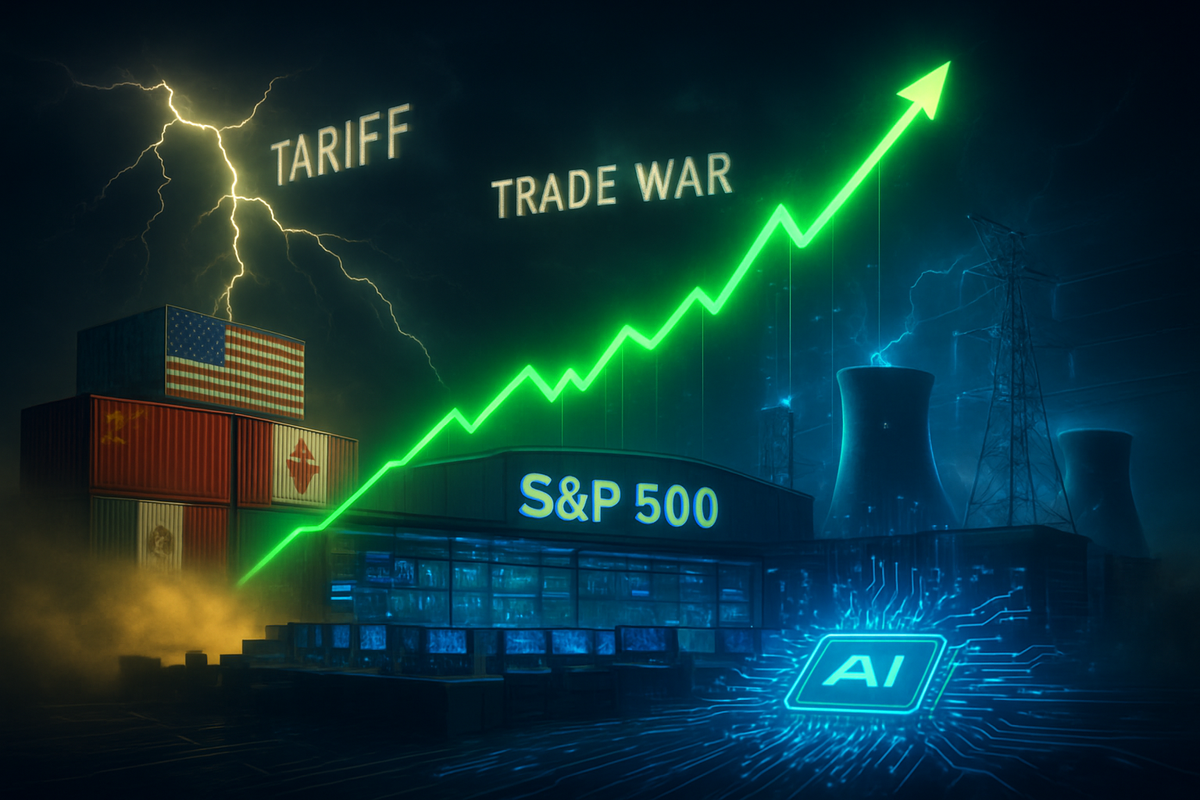
As the final bells ring on the trading floor this December 31, 2025, the American equity markets have achieved what many analysts deemed impossible just twelve months ago. Despite a year defined by aggressive protectionism, "on-again, off-again" trade wars, and a global reconfiguration of supply chains, the U.S. stock market has closed at historic all-time highs. The resilience of the S&P 500 (NYSE: SPY), which gained 17.7% over the course of the year, serves as a stark reminder that the "Wall of Worry" is often built of the very bricks that pave the way for a bull market.
The immediate implications of this year’s performance are profound. Investors have effectively decoupled the "geopolitical noise" of 2025 from the "technological signal" of the artificial intelligence (AI) monetization cycle. While the "April Tariff Storm" briefly sent shockwaves through the global economy, the year-end rally suggests that the market has priced in a new era of American industrial policy, fueled by domestic energy production and a relentless drive toward AI-driven productivity.
A Year of "Tariff Shocks" and Market Defiance
The narrative of 2025 was written in the ink of executive orders. The year began with a series of aggressive trade maneuvers, starting on February 1, when the administration signed orders imposing 25% tariffs on imports from Mexico and Canada, alongside a 10% levy on Chinese goods. While these moves initially triggered a "shock" sell-off in futures markets, the volatility proved to be short-lived as the Federal Reserve successfully navigated a "soft landing," keeping inflation expectations anchored despite the rising cost of imported goods.
The most significant test for the market arrived on April 4, a day now known in financial circles as "Liberation Day." The White House announced a global 10% tariff on nearly all imports, leading to a 10.5% correction in the S&P 500—the sharpest of the year. However, the panic subsided just five days later when a 90-day pause was announced for certain critical components. This "Liberation Day Recovery" saw markets rally 9.5% in a single week, setting the stage for a summer of record-breaking climbs. By the time the Dow Jones Industrial Average (INDEXDJX: .DJI) reached its all-time high of 48,731.16 on Christmas Eve, the market had endured three separate "tariff shocks," including an August hike on Canadian energy to 35%.
Key stakeholders in this drama included not just trade negotiators, but the titans of Silicon Valley and the American energy patch. The "DeepSeek Shock" in January—a moment where a highly efficient Chinese AI model threatened U.S. dominance—actually served as a catalyst for U.S. firms to accelerate their own development. This competitive pressure, combined with the administration's "Supply Chain 2.0" initiative, forced companies to reshore manufacturing at a pace never before seen in the post-globalization era.
The Winners and Losers of the New Protectionism
In this climate of trade volatility, the divide between the "haves" and the "have-nots" became a chasm. The undisputed champion of 2025 was the semiconductor and AI infrastructure sector. Nvidia (NASDAQ: NVDA) achieved a historic $5 trillion market cap in October, finishing the year up approximately 42%. The demand for AI "plumbing"—memory, storage, and chips—was so insatiable that Western Digital (NASDAQ: WDC) gained 292%, while its recently spun-off entity, SanDisk (NASDAQ: SNDK), surged a staggering 580% as the world scrambled for NAND flash memory.
The energy sector also emerged as a primary winner, driven by the "AI Power" trade. NextEra Energy (NYSE: NEE) became a darling of the markets as it positioned itself as the lead provider for the massive electricity requirements of new AI data centers. Similarly, ExxonMobil (NYSE: XOM) benefited from the tariff regime; as duties on Canadian and Mexican crude made domestic production more attractive for U.S. refiners, domestic oil giants saw their margins expand. Palantir (NASDAQ: PLTR) also thrived, with its stock rising 139% as government and enterprise AI contracts surged in an increasingly fractured geopolitical landscape.
Conversely, the losers of 2025 were those tied most closely to global consumer discretionary spending and long-tail supply chains. Nike (NYSE: NKE) and Adidas struggled as the "April Tariff Storm" hit the sportswear sector particularly hard, with Nike facing significant margin compression. Consumer staples giant Procter & Gamble (NYSE: PG) saw its stock drop over 13% as rising input costs forced price hikes that pushed consumers toward private labels. Furthermore, the U.S. auto industry faced a brutal second half of the year as USMCA exemptions ended in July, causing duties on parts to surge and impacting the bottom lines of major manufacturers.
AI Monetization and the "Supply Chain 2.0" Trend
The wider significance of 2025 lies in the successful transition of AI from a speculative "hype" cycle to a "tangible utility" cycle. The market's ability to ignore trade tensions was largely due to the fact that AI-driven productivity gains began to show up in corporate earnings. Companies across all sectors began using AI to optimize logistics, reduce labor costs, and manage the very tariff-related complexities that would have crippled them a decade ago. This technological buffer has created a "new normal" where geopolitical risk is secondary to technological advancement.
This year also marked the definitive end of the old globalization model. The "Supply Chain 2.0" trend—characterized by nearshoring and "friend-shoring"—is no longer a theoretical strategy but a market necessity. The resilience of the Nasdaq Composite (INDEXNASDAQ: .IXIC), which gained 21.7% this year, reflects a belief that the U.S. is winning the race to build a self-contained, high-tech industrial base. This shift mirrors historical precedents like the post-WWII industrial boom, where domestic manufacturing and new technology (then electronics, now AI) drove a multi-decade expansion.
Furthermore, the regulatory environment has shifted toward "reciprocal tariffs," a policy that heavily impacted emerging markets. Stocks in India and Brazil struggled under 50% U.S. reciprocal levies, signaling a move toward a more fragmented global economy. This has forced a rotation of capital out of "risky" emerging markets and back into the perceived safety of the U.S. dollar and American equities, further fueling the record highs seen on Wall Street.
Looking Toward 2026: Pivots and Scenarios
As we look toward 2026, the primary question is whether this resilience can be sustained. In the short term, legal challenges to the "Liberation Day" tariffs are expected to reach the Supreme Court. A ruling against the administration could provide a massive "relief rally," while a confirmation of the executive branch's broad tariff powers might lead to a period of consolidation as the market digests the permanent nature of these costs.
Strategic pivots will be required for companies in the consumer and automotive sectors. We are likely to see an "Automation Arms Race" as these firms attempt to offset tariff-induced labor and part costs with AI-driven manufacturing. Market opportunities may emerge in the nuclear energy sector and grid modernization, as the "AI needs power" narrative remains a core investment theme. Potential scenarios for 2026 range from a "Golden Age of Domestic Industry" if reshoring continues successfully, to a "Stagflationary Trap" if the cost of protectionism finally outpaces the gains from AI productivity.
Final Reflections on a Record-Breaking Year
The year 2025 has proven that the American market is more than just a collection of companies; it is a dynamic ecosystem capable of evolving in real-time. The key takeaway for investors is that while tariffs create localized pain, the broader market's direction is currently dictated by the transformative power of AI and energy independence. The S&P 500’s finish at 6,945.77 is not just a number—it is a testament to the fact that innovation can outpace regulation and protectionism.
Moving forward, the market remains in a state of "cautious exuberance." Investors should keep a close eye on the "AI Power" trade and the ongoing legal battles over trade policy. While the 2025 rally was historic, the lasting impact will be determined by how well American companies can maintain their productivity lead in a world of rising borders. For now, the bulls have won the day, proving that even a storm of tariffs cannot dampen the fire of a technological revolution.
This content is intended for informational purposes only and is not financial advice