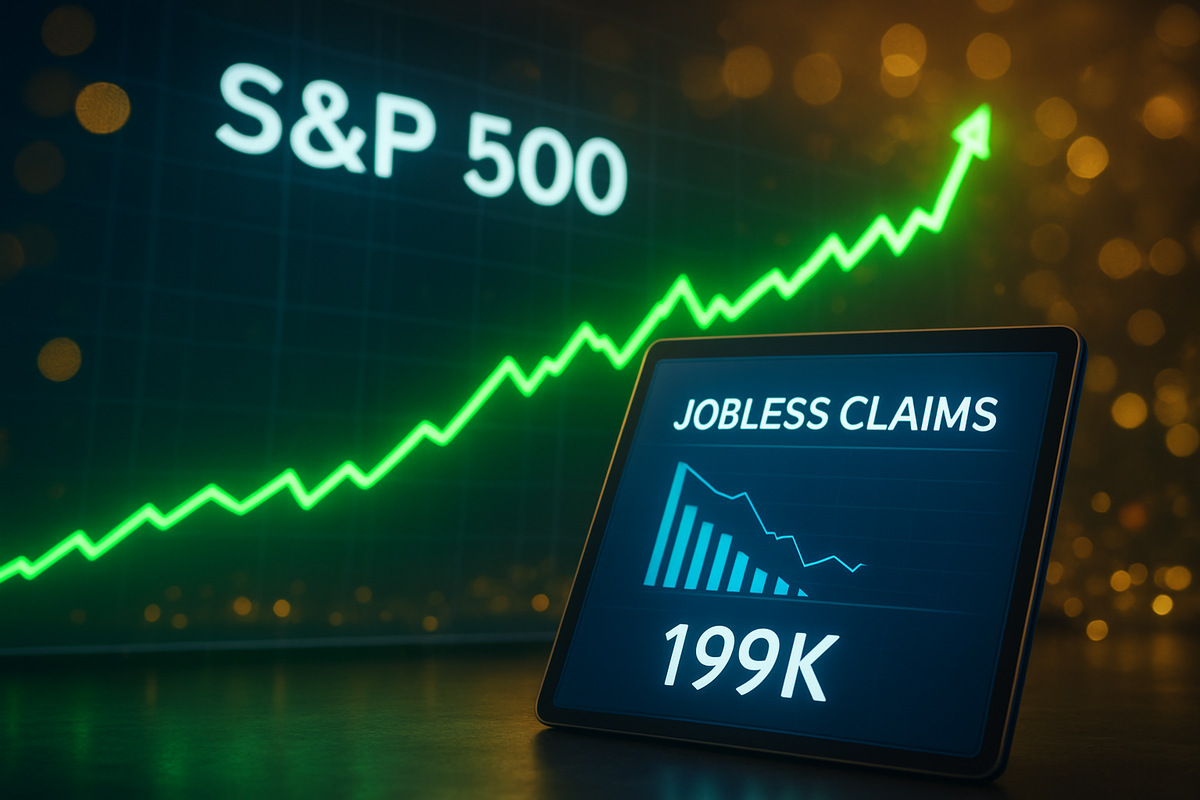
The final trading day of 2025 concluded on a high note for Wall Street, as the U.S. Department of Labor released initial jobless claims that defied the year’s cooling trend. For the week ending December 27, 2025, initial claims for unemployment benefits fell to 199,000, sliding back below the psychologically significant 200,000 mark and beating analyst expectations of 215,000. This unexpected show of resilience in the labor market provided the necessary fuel for a final "Santa Rally," pushing the S&P 500 (NYSE: SPY) to a record close of nearly 6,900.
The "decent" labor data served as a crucial relief valve for investors who had spent much of the fourth quarter fretting over a rising national unemployment rate, which currently sits at a four-year high of 4.6%. While the broader hiring environment has slowed, the low level of new layoffs suggests that corporate America is entering 2026 in a "no hire, no fire" equilibrium. This stability, coupled with the Federal Reserve’s third consecutive interest rate cut earlier this month, has solidified market sentiment that a "soft landing" remains the most likely trajectory for the U.S. economy.
Resilience Amidst a Cooling Climate
The 199,000 print for jobless claims was the highlight of a relatively quiet holiday trading session. Throughout 2025, the labor market has been characterized by a paradoxical "fragile resilience." While the headline number of layoffs remains historically low, the pace of job creation has decelerated significantly compared to the post-pandemic boom. The year began with the Federal Reserve maintaining a "higher-for-longer" interest rate stance, but as the unemployment rate crept from 4.1% in January to 4.6% by December, the central bank pivoted toward an easing cycle.
The timeline leading to this year-end boost was marked by strategic shifts in both fiscal and monetary policy. Following a pivotal 25-basis-point cut in September, the Fed followed up with additional cuts in October and December, bringing the federal funds rate down to a range of 3.50%–3.75%. These moves were designed to proactively protect the labor market from the "sluggishness" observed in the manufacturing and retail sectors. The December 31st data confirmed that these efforts have, so far, prevented a more severe spike in unemployment.
Tech Titans and Retail Giants: The Winners and Losers of 2025
The technology sector remained the primary engine of market growth in 2025, with companies like Nvidia (NASDAQ: NVDA) and Apple (NASDAQ: AAPL) leading the S&P 500's 18% annual gain. For Nvidia, the year-end labor data reinforces the narrative that enterprise spending on AI remains robust, as companies continue to prioritize automation over traditional headcount. Microsoft (NASDAQ: MSFT) and Amazon (NASDAQ: AMZN) also saw their valuations bolstered by the news, despite both companies having undergone significant internal restructuring throughout the year to shift resources toward generative AI development.
However, the "K-shaped" nature of the 2025 economy means not all sectors shared in the year-end joy. Retail bellwether Walmart (NYSE: WMT) has faced a more complex environment as consumer sentiment hit multi-year lows due to persistent price pressures and the cooling job market. While the low jobless claims are a positive sign for future spending, the rising unemployment rate has already begun to weigh on discretionary sectors. Luxury and hospitality brands like Marriott (NASDAQ: MAR) have reported a "stress test" on their margins as middle-income households pull back on non-essential travel.
In the financial sector, the impact was equally nuanced. BlackRock (NYSE: BLK) ended the year strong, benefiting from the surge in asset valuations and a successful pivot toward AI-driven portfolio management. Conversely, Ally Financial (NYSE: ALLY) has faced headwinds as the 4.6% unemployment rate led to a slight uptick in auto loan and credit card delinquency rates. For these firms, the "decent" jobless claims are a sign that the credit environment may stabilize, but the margin for error remains thin heading into the new year.
Analyzing the Broader Significance
The final jobless claims report of 2025 fits into a broader industrial trend of "workforce rebalancing." Across the S&P 500, the focus has shifted from aggressive expansion to operational efficiency. This is most evident in the tech and finance sectors, where AI is no longer just a buzzword but a primary driver of headcount decisions. The "no hire, no fire" mode identified by economists suggests that while companies are reluctant to let go of skilled talent, they are equally hesitant to expand their payrolls in the face of geopolitical and trade uncertainties.
Historically, an unemployment rate of 4.6% would have been cause for alarm, but in the context of 2025, it is viewed as a controlled cooling. The year was also marked by significant disruption in the public sector, with the Department of Government Efficiency (DOGE) initiatives leading to over 280,000 federal job cuts. This massive reduction in the government workforce placed additional pressure on the private sector to absorb displaced workers, a feat that the December 31st data suggests is happening, albeit slowly.
Looking Ahead to 2026: Pivots and Possibilities
As we move into 2026, the primary question for investors is whether the Federal Reserve's easing cycle will be enough to counteract the potential inflationary impact of new trade tariffs. The "Santa Rally" provided a pleasant end to 2025, but the market remains wary of a potential "hard landing" if the unemployment rate continues its upward climb toward 5%. Short-term, the focus will remain on the January jobs report to see if the holiday hiring season provided a sustainable lift.
Strategic pivots will be required for companies in the consumer staples and discretionary sectors. If the labor market remains in its current "sluggish" state, we may see a further shift toward value-oriented business models. For tech companies, the challenge will be to prove that AI investments can translate into bottom-line growth without further massive layoffs, which could eventually sap the consumer demand that fuels their ecosystems.
Final Wrap-up and Investor Takeaways
The final trading day of 2025 provided a microcosm of the year’s economic narrative: a labor market that is cooling but not collapsing, a Federal Reserve that is responsive to data, and a stock market that remains hungry for growth. The 199,000 jobless claims were the "just right" number for a market looking for a reason to buy, allowing the S&P 500 to cap off a stellar year with a record-breaking performance.
Moving forward, investors should keep a close watch on the intersection of labor data and consumer credit. While the S&P 500 is at all-time highs, the underlying health of the American consumer is increasingly tied to the stability of the 4.6% unemployment rate. If jobless claims begin to trend back toward the 230,000–250,000 range in early 2026, the "soft landing" narrative could quickly be called into question. For now, however, Wall Street is celebrating a year of resilience and a final boost that sent 2025 out on a high note.
This content is intended for informational purposes only and is not financial advice.