The retrenchment of Nvidia in late 2025 serves as a stark reminder of the "double-edged sword" of market concentration. While Nvidia’s meteoric rise propelled the S&P 500 and the Dow to record highs earlier this year, its current volatility is now the primary source of market instability. The key takeaway for investors is that the "AI trade" is no longer a monolithic upward move; it has become a nuanced landscape where hardware providers face margin pressure and software adopters must prove their monetization capabilities.
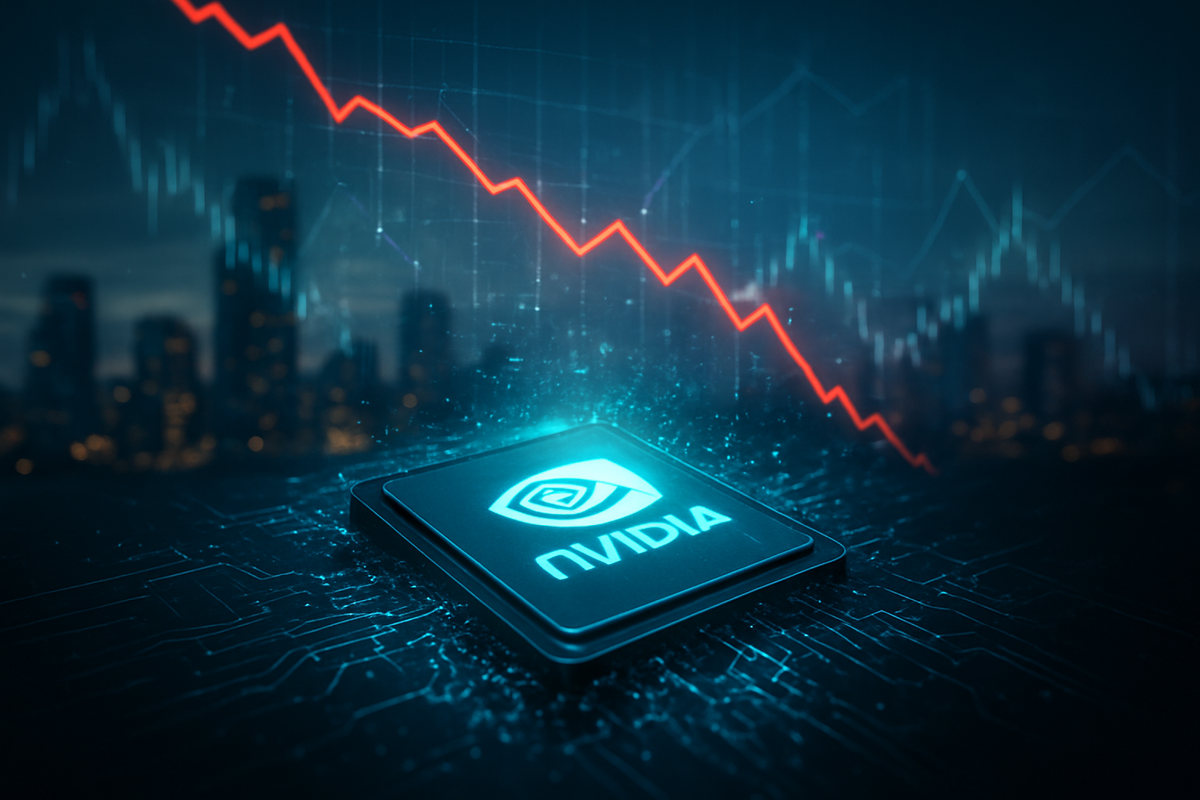
As 2025 draws to a close, the "Nvidia Era" of the stock market is facing its most significant test yet. NVIDIA (NASDAQ: NVDA), the semiconductor juggernaut that became the first company to eclipse a $5 trillion market capitalization just two months ago, has seen its shares retreat sharply in the final weeks of December. This downturn in the world’s most influential stock is not merely a tech-sector correction; it has become the primary anchor dragging down the S&P 500 and the Dow Jones Industrial Average, illustrating the systemic risk inherent in a market so heavily concentrated in a single name.
The decline, which has seen Nvidia shares fall from an October peak of $212 to a current range of $187–$190, was exacerbated this week by a combination of institutional year-end rebalancing and new geopolitical headwinds. As fund managers lock in profits from a year that saw Nvidia gain nearly 50%, the resulting "mechanical de-risking" has triggered a broader market retreat. With Nvidia now accounting for over 7% of the S&P 500, its 1.5% to 2% daily swings are frequently the difference between a green or red day for the entire U.S. equities market.
The Catalyst: From Peak Valuation to "Institutional De-risking"
The current market malaise can be traced back to a series of events that began in late October 2025, when Nvidia’s valuation reached its historic $5 trillion zenith. While the company’s Q3 fiscal 2026 earnings, reported in November, were stellar—boasting $57 billion in revenue and $31.9 billion in net income—the market’s reaction signaled a shift in sentiment. Investors began to look past the "blistering" growth of the Blackwell chip architecture toward a future of stabilizing, albeit high, growth rates. The Q4 guidance of $65 billion, while exceeding expectations, confirmed that the era of triple-digit year-over-year percentage gains was finally decelerating.
The situation worsened in early December when the Trump administration introduced a "25% federal fee" on advanced H200 chip exports to China. While the policy allowed Nvidia to resume sales to the region, the high "tax" acted as a governor on profit margins, cooling the "China recovery" narrative that had buoyed the stock in the fall. Simultaneously, reports surfaced that Meta Platforms (NASDAQ: META) had begun shifting a significant portion of its internal AI training orders away from Nvidia GPUs toward Alphabet (NASDAQ: GOOGL) custom Tensor Processing Units (TPUs). This news sparked fears that the "hyperscaler" customers—Nvidia's largest source of revenue—were finally succeeding in their long-term goal of diversifying away from the Nvidia ecosystem.
Winners and Losers in the Wake of Volatility
The "Nvidia fatigue" of late 2025 has created a stark bifurcation in the market. The primary beneficiaries have been companies seen as viable alternatives or defensive havens. Advanced Micro Devices (NASDAQ: AMD) has emerged as a major winner, with its stock surging over 110% year-to-date as it captures data center share with its MI350 series. Alphabet has also outperformed the broader "Magnificent Seven," gaining 64% this year as its Gemini 3 model and custom silicon strategy provide a buffer against Nvidia’s hardware pricing power. Outside of tech, the rotation has favored "stodgy" sectors; the Utilities Select Sector SPDR (NYSE: XLU) and financial giants like JPMorgan Chase (NYSE: JPM) have seen massive inflows as investors seek refuge in yield and domestic stability.
Conversely, the "losers" list is headlined by those most closely tied to the Nvidia supply chain or those struggling with the high costs of the AI transition. Super Micro Computer (NASDAQ: SMCI) has suffered outsized losses, often plunging double digits on days when Nvidia faces selling pressure. Microsoft (NASDAQ: MSFT) has also lagged the broader market, as investors grow weary of the massive capital expenditures required to sustain its Azure AI infrastructure without a corresponding explosion in Copilot software revenue. Meanwhile, the legacy chipmaker Intel (NASDAQ: INTC), which was replaced by Nvidia in the Dow Jones Industrial Average in late 2024, continues to struggle with its manufacturing transitions, even as Nvidia attempted to stabilize the firm with a $5 billion stock purchase agreement earlier this month.
A Shift in the AI Narrative: From Hardware to Utility
The current downturn marks a pivotal shift in the broader industry trend: the transition from the "AI Hype" phase to the "AI ROI" (Return on Investment) phase. For the past two years, the market treated AI hardware as a speculative gold mine; in late 2025, it is increasingly being viewed as a high-cost utility. This shift has significant regulatory and policy implications, as governments begin to eye the massive energy consumption and concentrated market power of AI leaders. The "Trump Fee" on exports is a prime example of how geopolitical strategy is now being funded directly by the margins of high-tech leaders.
Historically, this event mirrors the "dot-com" maturation of the early 2000s, where infrastructure providers like Cisco eventually ceded their market-leading momentum to the software and service providers that utilized that infrastructure. The "Nvidia Effect" on the Dow Jones—where a single stock’s price movement can swing the 30-stock index by hundreds of points—has also led to renewed calls for index reform. Regulators are increasingly concerned that the S&P 500’s heavy concentration in a handful of tech names creates a "systemic risk" where a single company’s guidance can impact the retirement accounts of millions of Americans.
The Road Ahead: Blackwell, Rubin, and Edge AI
Looking into early 2026, Nvidia’s path to recovery lies in its ability to execute the transition to its next-generation "Rubin" architecture and its expansion into "Edge AI." While the data center remains the crown jewel, the company’s recent $20 billion acquisition of assets from the startup Groq suggests a strategic pivot toward high-speed inference—the process of running AI models rather than just training them. If Nvidia can prove that its software ecosystem, CUDA, remains the indispensable "operating system" for AI inference, it may regain its footing.
In the short term, the market faces a "Santa Claus rally" that is entirely dependent on Nvidia’s ability to stabilize. A potential easing of trade tensions or a surprise partnership in the automotive or robotics sectors could provide the necessary spark. However, the long-term challenge remains the "AI Hangover." As companies like Oracle (NYSE: ORCL) face scrutiny over their massive debt-funded data center expansions, the entire sector must prove that AI is generating real-world efficiency gains that justify the trillions of dollars in market value created since 2023.
Summary and Investor Outlook
The retrenchment of Nvidia in late 2025 serves as a stark reminder of the "double-edged sword" of market concentration. While Nvidia’s meteoric rise propelled the S&P 500 and the Dow to record highs earlier this year, its current volatility is now the primary source of market instability. The key takeaway for investors is that the "AI trade" is no longer a monolithic upward move; it has become a nuanced landscape where hardware providers face margin pressure and software adopters must prove their monetization capabilities.
Moving forward, the market will likely remain in a state of "Nvidia-watching" through the first quarter of 2026. Investors should keep a close eye on capital expenditure reports from the "Big Four" (Microsoft, Alphabet, Meta, and Amazon) to see if they continue to order Blackwell chips at the same record-breaking pace. Furthermore, the performance of defensive sectors like Energy—led by Exxon Mobil (NYSE: XOM) and Chevron (NYSE: CVX)—will indicate whether the rotation out of tech is a temporary year-end phenomenon or a long-term structural shift in the market.
This content is intended for informational purposes only and is not financial advice.