The final trading week of 2025 opened on a somber note for Wall Street as a sharp retreat in high-flying technology stocks pulled major indices into the red. On Monday, December 29, 2025, the market’s usual "Santa Claus rally" was notably absent, replaced instead by a wave of profit-taking and growing skepticism over the sustainability of the artificial intelligence boom. The Dow Jones Industrial Average, the S&P 500, and the Nasdaq Composite all posted losses, ending a year of record-breaking gains with a sudden, localized tremor in the tech sector.
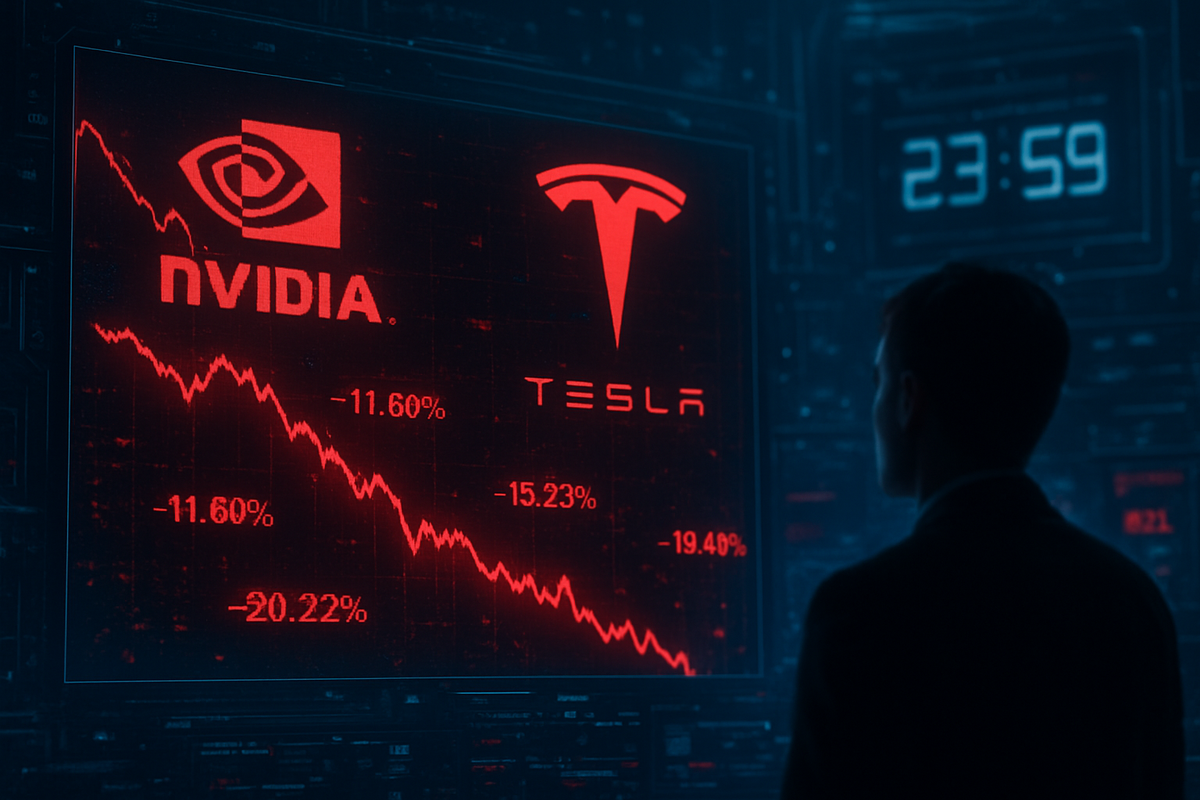
Leading the downward charge were the market’s most influential heavyweights: Nvidia and Tesla. As the two companies faced unique internal headwinds and broader valuation fatigue, their collective decline sent ripples through the exchange-traded funds (ETFs) and mutual funds that track the major benchmarks. While the broader market remains on track for double-digit annual gains, today’s slide serves as a stark reminder of the volatility inherent in the megacap growth names that have dominated the 2025 narrative.
A Perfect Storm for Growth Leaders
The market's performance on December 29 was defined by a significant pullback in Nvidia (NASDAQ: NVDA), which fell approximately 1.8% to close near $190.53. This decline follows a historic year where the chipmaker briefly surpassed a $5 trillion market capitalization in October. However, the holiday week brought "capital-allocation concerns" to the forefront. Investors spent the day digesting the finalization of Nvidia’s $5 billion private stock purchase of Intel (NASDAQ: INTC) and a massive $20 billion licensing agreement with the AI inference startup Groq. Analysts are now questioning whether Nvidia is overextending its reach or attempting to prop up struggling legacy competitors at the expense of its own balance sheet.
Tesla (NASDAQ: TSLA) experienced an even more dramatic reversal, with shares sliding 4.5% in early trading before settling at a 2.2% loss, closing at $475.19. The catalysts for the drop were multi-faceted, ranging from fundamental sales data to regulatory headaches. The primary driver was the "tax credit cliff"—the fallout from the legislative repeal of the $7,500 federal electric vehicle (EV) tax credit earlier in September. This policy shift caused a massive "pull-forward" of sales into the third quarter, leaving the final months of 2025 looking exceptionally lean.
The timeline of this slide began in mid-December as institutional investors started rebalancing portfolios to lock in the year’s significant gains. By the time markets opened on the 29th, the thin trading volumes typical of the holiday season exacerbated the downward pressure. Key stakeholders, including major hedge funds and retail investors who had ridden the AI wave all year, appeared to be moving toward the exits simultaneously, triggered by a combination of high valuations and a lack of fresh positive catalysts to drive the market higher in the year's final days.
Assessing the Winners and Losers in a Shifting Market
While the tech sector bled, the "losers" list was dominated by the very names that had carried the market for most of 2025. Beyond Nvidia and Tesla, other AI-exposed firms like Microsoft (NASDAQ: MSFT) and Amazon (NASDAQ: AMZN) saw modest declines of 0.5% to 1.0%, as investors questioned the immediate return on investment for the massive capital expenditures these "hyperscalers" have funneled into data centers. The Nasdaq Composite (INDEXNASDAQ: .IXIC), heavily weighted toward these names, bore the brunt of the damage, dropping 0.6% on the day.
However, the day was not a total loss for all sectors. Defensive and value-oriented stocks emerged as the relative "winners." Exxon Mobil (NYSE: XOM) and Chevron (NYSE: CVX) both outperformed the broader market, gaining roughly 1.2% as oil prices climbed due to supply concerns and geopolitical instability. This rotation suggests that while growth is taking a breather, capital is not necessarily leaving the market entirely; rather, it is seeking refuge in tangible assets and companies with steady cash flows.
The S&P 500 (INDEXSP:.INX), which fell about 0.3% to 6,929.94, illustrated this internal tug-of-war. While the tech-heavy components dragged the index down, the energy and industrial sectors provided a necessary floor. For investors, the day highlighted the danger of "concentration risk." Those heavily overweight in the "Magnificent Seven" or AI-adjacent stocks saw their portfolios take a disproportionate hit compared to those with more diversified holdings in traditional value sectors.
Broader Significance and the Maturing AI Cycle
The current market slide is more than just a seasonal blip; it reflects a broader shift in the "AI investment cycle." Throughout 2024 and 2025, the market operated on a "build it and they will come" mentality regarding AI infrastructure. As 2025 closes, the narrative is shifting toward "show me the money." The skepticism surrounding Nvidia’s licensing deals and Intel investment suggests that the market is becoming more discerning about how AI leaders spend their cash. This mirrors historical precedents like the post-2000 dot-com era, where the initial infrastructure build-out eventually gave way to a period of consolidation and rigorous valuation testing.
Furthermore, the struggles of Tesla highlight a maturing and increasingly competitive EV landscape. With the rise of international rivals like BYD (OTC:BYDDF) and a shift in consumer focus toward autonomous software over hardware manufacturing, Tesla’s high-multiple valuation is under intense scrutiny. The expiration of US tax credits has also brought the reality of "organic demand" back to the forefront, forcing investors to grapple with the possibility of Tesla’s first significant year-over-year delivery contraction in 2026.
Geopolitical tensions also played a silent but significant role in today’s market sentiment. Rising frictions in Asia, particularly regarding the semiconductor supply chain between China and Taiwan, have added a "risk premium" to companies like Nvidia that rely on global manufacturing hubs. These macro-level concerns, combined with the Federal Reserve’s upcoming December meeting minutes, have created an environment where investors prefer caution over exuberance as they head into the new year.
Looking Ahead: Strategic Pivots and 2026 Outlook
As we move into 2026, the primary question for the market is whether this year-end slide is a healthy correction or the start of a deeper cyclical downturn. For Nvidia, the coming months will be a test of its strategic pivots. The success of its licensing deals and its ability to integrate its new investments will determine if it can maintain its lead in the AI space. Investors will be looking for signs that the AI "inference" market can provide the same explosive growth that the "training" market did in 2023 and 2024.
Tesla, meanwhile, faces a potential identity crisis. With EV hardware margins under pressure, the company must prove that its "Full Self-Driving" (FSD) and robotics initiatives can generate meaningful revenue to offset slowing vehicle sales. The market will be hyper-focused on the Q4 delivery report and any guidance regarding a "lower-cost" model that could reinvigorate demand in a post-subsidy environment. A failure to show a clear path to volume growth could lead to a further re-rating of the stock toward traditional automotive multiples.
Wrap-Up: A Reality Check for the New Year
The market action on December 29, 2025, serves as a vital "reality check" for an investment landscape that has been characterized by relentless optimism. The slide led by Nvidia and Tesla underscores the fact that even the most dominant companies are not immune to the laws of valuation and the shifts in government policy. While the indices remain near all-time highs, the day's events suggest that the "easy money" phase of the AI and EV rallies may be drawing to a close.
Moving forward, investors should watch for the Federal Reserve's tone in early January and the upcoming earnings season, which will provide the first concrete data on how companies are navigating the post-tax-credit world and the maturing AI cycle. The key takeaway from the final week of 2025 is that diversification and a focus on fundamental earnings quality will likely be the winning strategies for 2026. As the clock ticks down on a historic year, the market is signaling that the next chapter will require more than just a "buy the dip" mentality—it will require a discerning eye for value and a readiness for increased volatility.
This content is intended for informational purposes only and is not financial advice.