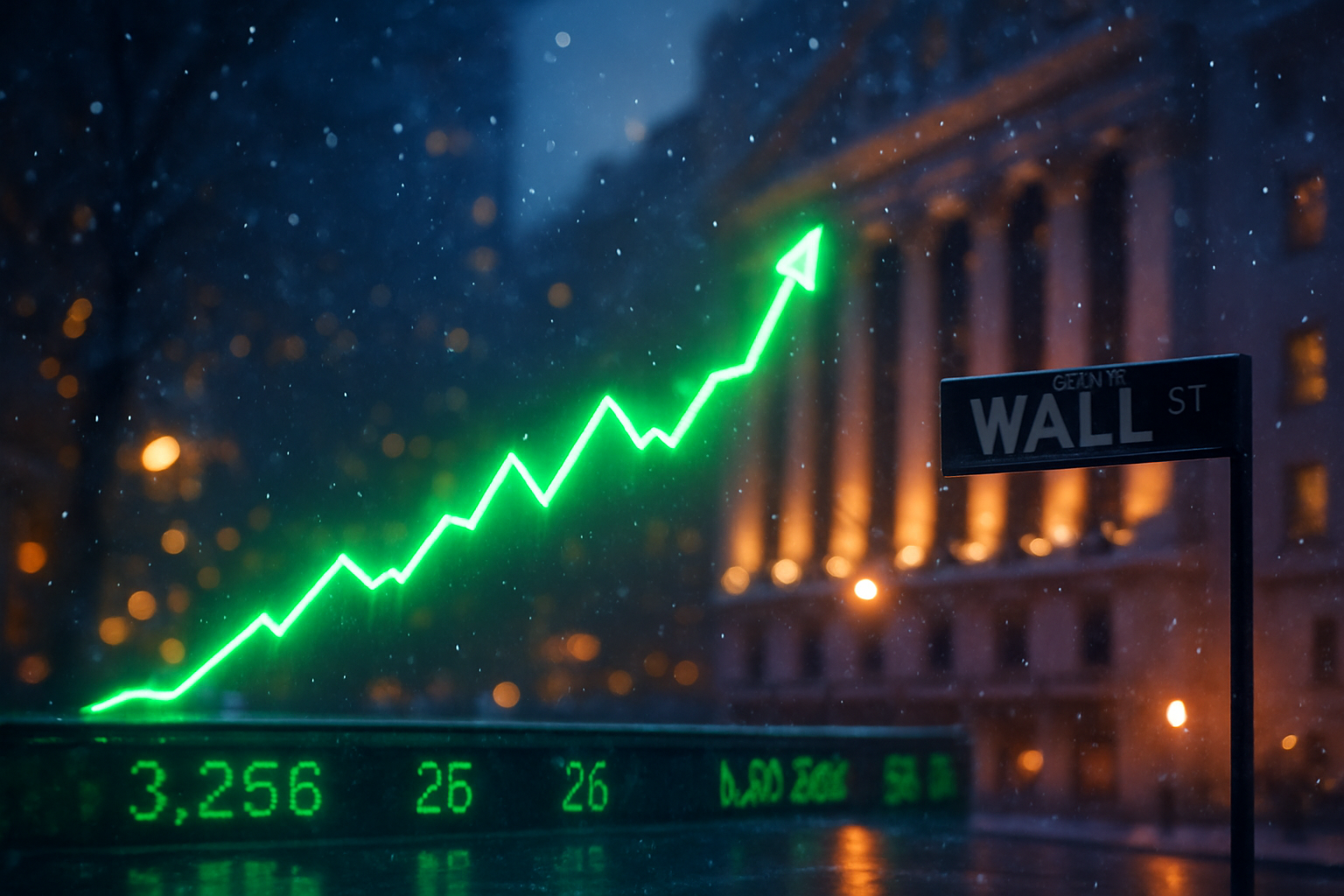
As the calendar turns to December 26, 2025, Wall Street is unwrapping a familiar gift: the "Santa Claus Rally." With the S&P 500 (NYSE: SPY) flirting with the psychological milestone of 7,000 points and hitting a record close of 6,920 just before the holiday break, investor optimism is at a fever pitch. However, seasoned analysts warn that while the year-end "melt-up" provides a festive boost to portfolios, it should be viewed as a seasonal signal of market health rather than a standalone long-term investment strategy.
The current rally is being fueled by a "Goldilocks" economic environment—cooling inflation paired with a resilient labor market. Following a 25-basis point rate cut by the Federal Reserve on December 10, which brought the target range down to 3.50%–3.75%, liquidity has flooded back into the equity markets. This surge is not merely a holiday fluke; it is the culmination of a year that saw three rate cuts and a surprisingly robust Q3 GDP growth rate of 4.3%, signaling that the "soft landing" many doubted in early 2025 has finally been achieved.
The Mechanics of the "Melt-Up"
The Santa Claus Rally, a phenomenon first identified by Yale Hirsch in 1972, specifically tracks the market's performance during the last five trading days of December and the first two of January. Historically, this seven-day window has seen the S&P 500 gain an average of 1.3%, with a success rate of nearly 80% since 1950. In 2025, the timeline was set in motion by the resolution of a 43-day government shutdown earlier in the quarter, which released a backlog of economic data and approximately $1 trillion in liquidity through the Treasury General Account.
Key players in this year's rally include major institutional fund managers engaging in "window dressing." This practice involves selling off underperforming "laggards" and loading up on high-profile "winners" to ensure their year-end reports look favorable to clients. This has created a concentrated push into the year’s top performers, such as Nvidia (NASDAQ: NVDA), which cleared a major technical resistance level of $194.17 on December 24. The rally is further supported by the exhaustion of tax-loss harvesting—a process where investors sell losing positions to offset capital gains—which typically concludes by mid-December, leaving a "selling vacuum" that buyers are now eagerly filling.
Winners, Losers, and the "Hidden Hands"
The primary beneficiaries of this seasonal surge are the heavyweights of the Invesco QQQ Trust (NASDAQ: QQQ). Nvidia (NASDAQ: NVDA) continues to act as the market's "North Star," driven by the volume ramp-up of its Blackwell Ultra chips. Similarly, Amazon (NASDAQ: AMZN) has seen a late-December boost, with analysts citing a 21.4% year-over-year surge in inventory efficiency during the peak holiday shopping season. Even Tesla (NASDAQ: TSLA) has become a focal point for retail and institutional traders alike, with aggressive options activity targeting a "gamma squeeze" as the stock approaches the $500 mark.
On the other side of the ledger, smaller caps and debt-heavy firms are finding mixed results. While the iShares Russell 2000 ETF (NYSE: IWM) has benefited from the Fed's easing cycle, it remains sensitive to the "January Effect," where small-caps often outperform after being beaten down by year-end tax selling. Meanwhile, companies like Oracle (NYSE: ORCL) have faced a more volatile path; despite a surge in cloud infrastructure revenue, concerns over data center delays have led to tactical "dip buying" rather than a straight-line ascent. Investors who chased these laggards early in December may find themselves underwater if they mistook a tax-relief bounce for a fundamental turnaround.
Wider Significance: The "Naughty or Nice" Barometer
The Santa Claus Rally is often considered a leading indicator for the year ahead, summarized by the market adage: "If Santa Claus should fail to call, bears may come to Broad and Wall." Historically, when the rally is positive, the S&P 500 has gained an average of 10.4% in the following full year. Conversely, a "naughty" list finish—where the market fails to gain during this window—has historically preceded periods of stagnation or decline, as seen in 1999 and 2007.
In the broader context of 2025, this rally fits into a trend of "Sovereign AI" investment and a shift toward a more balanced, multi-sector growth model. The surge in commodities, with Gold hitting record highs above $4,500/oz, suggests that while equities are booming, investors are still hedging against potential currency debasement and geopolitical shifts, such as the high-profile sale of TikTok’s U.S. operations to a consortium involving Oracle (NYSE: ORCL). This dual-track movement—stocks hitting highs while gold surges—indicates a market that is flush with cash but remains wary of the long-term structural debt issues that may resurface in 2026.
What Comes Next: The 2026 Transition
As we look toward the first week of January 2026, the market faces several immediate hurdles. The most significant is the 7,000-point resistance level for the S&P 500. A successful breach could trigger a fresh wave of FOMO (fear of missing out) buying, but a failure to hold these levels once the "Santa" liquidity dries up could lead to a sharp mean-reversion. Investors should also prepare for the "January Effect," where the capital gains realized during this rally are often reallocated into different sectors, potentially causing a rotation out of Big Tech and into undervalued industrials or healthcare.
Short-term opportunities exist in the "relief bounce" of stocks that were heavily sold for tax reasons in November. However, the long-term challenge for 2026 will be the Federal Reserve's next move. With a 75% probability of another rate cut in January, the market is pricing in a continuation of the easy-money era. Any hawkish surprise from the Fed or a sudden spike in energy prices could quickly turn the holiday cheer into a January hangover. Strategic pivots toward "equal-weight" strategies, such as the Invesco S&P 500 Equal Weight ETF (NYSE: RSP), may be required if the current tech-heavy concentration begins to wobble.
Wrap-Up: A Gift to Be Handled with Care
The 2025 Santa Claus Rally has provided a spectacular finish to a year defined by AI breakthroughs and economic resilience. The key takeaway for investors is that while the rally is a statistically significant signal of bullish sentiment, it is not a guarantee of future performance. The "Nice" list finish to 2025 suggests a positive outlook for the first half of 2026, but the artificial nature of "window dressing" and tax-loss harvesting means that much of the current buying pressure is mechanical rather than fundamental.
Moving forward, the market will likely be defined by how it handles the 7,000-point milestone and the transition into a post-holiday economic reality. Investors should watch for the sustainability of the AI trade and the impact of the Fed's January meeting. While Santa has certainly delivered this year, the most successful investors will be those who use this rally to rebalance their portfolios rather than those who chase the "melt-up" into an uncertain new year.
This content is intended for informational purposes only and is not financial advice.