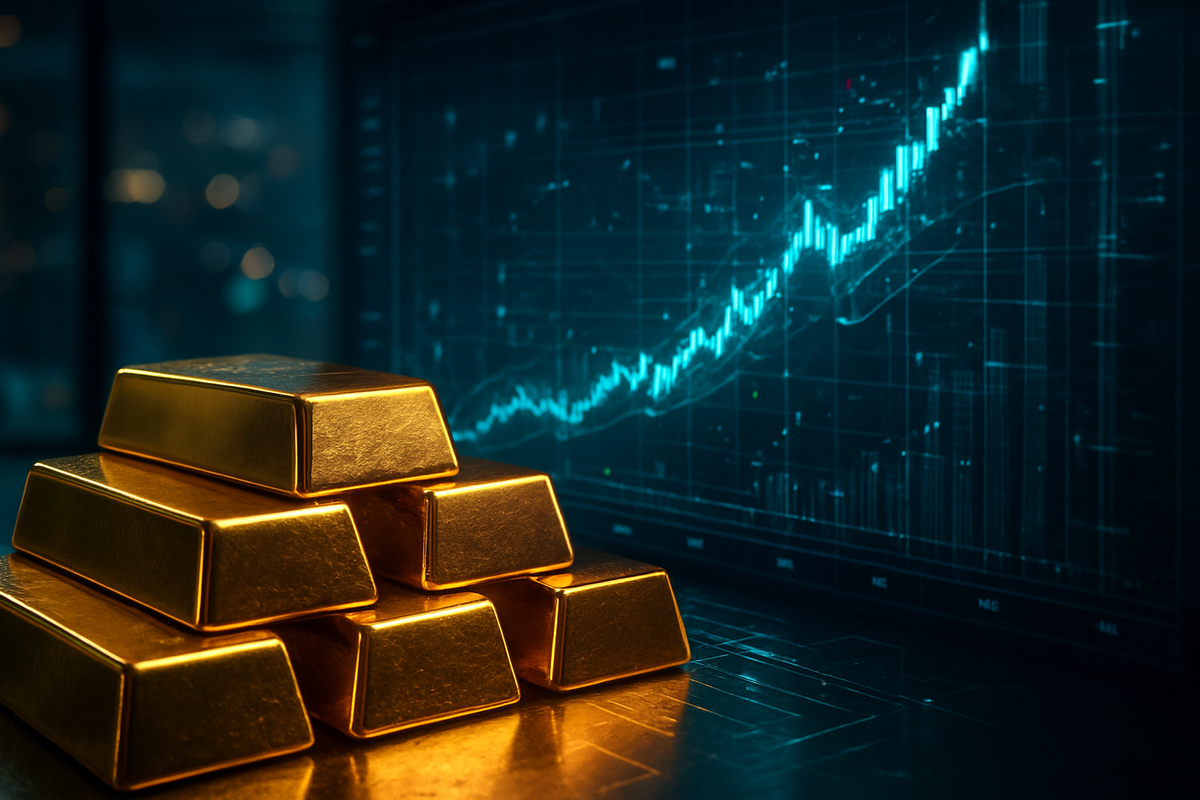
NEW YORK — In a financial landscape that has defied traditional economic gravity, gold prices have surged to a breathtaking new all-time high, closing at $4,530 per ounce on December 26, 2025. This historic milestone comes as the global economy grapples with a unique "Everything Rally," where safe-haven assets and high-risk technology stocks are simultaneously reaching record peaks. While the S&P 500 (INDEXSP:.INX) hovers near the psychological 7,000 barrier and the Nasdaq Composite (INDEXNASDAQ: .IXIC) sits above 23,000, investors are increasingly treating precious metals not just as a hedge against disaster, but as a mandatory "debasement insurance" in an era of unprecedented fiscal expansion.
The surge in gold—which has gained over 70% in 2025 alone—reflects a profound shift in market psychology. For the first time in decades, the traditional inverse correlation between equities and bullion has decoupled. Investors are no longer choosing between growth and safety; they are using the massive profits generated by the "Third Wave of AI" to fund aggressive positions in hard assets. This dual-track momentum has pushed the gold-to-S&P 500 ratio to levels not seen since the 2020 pandemic, signaling a deep-seated anxiety about the long-term stability of fiat currencies despite the current stock market euphoria.
The Perfect Storm: Geopolitics, Central Banks, and the Fed
The road to $4,500 gold was paved by a "perfect storm" of geopolitical and monetary triggers that accelerated throughout the final quarter of 2025. The immediate catalyst for the December spike was a sudden U.S. naval blockade of Venezuelan oil tankers on December 16, which reignited fears of a broader energy crisis and a "fear trade" in the commodities market. This followed a year of persistent instability, including drone strikes in Eastern Europe and escalating tensions in the Middle East, which kept the "risk premium" on gold at historically elevated levels.
Beyond the headlines, the structural foundation of the rally was built by central banks. Throughout 2025, institutions in China, India, and Poland continued a massive "de-dollarization" campaign, collectively purchasing over 1,000 metric tons of gold. This institutional demand provided a solid floor for prices, even as the Federal Reserve continued its easing cycle. With three consecutive rate cuts in 2025 and more projected for 2026, the "opportunity cost" of holding non-yielding gold vanished, while the U.S. Dollar Index (DXY) weakened under the weight of projected record-level public debt.
The timeline of this ascent is remarkable. Gold began the year near $2,700/oz, buoyed by the Fed's initial pivot in late 2024. By October 2025, it had breached the $4,000 mark. The final leg of the rally was characterized by a "Santa Claus Rally" in both metals and stocks, as the market priced in a "soft landing" that somehow requires both maximum liquidity and maximum safety.
Winners and Losers: From Mining Giants to Tech Margins
The meteoric rise of gold has created a clear divide between those who extract the metal and those who must consume it. The primary beneficiaries have been the major mining corporations, which have seen their profit margins explode as the price of gold far outpaced their all-in sustaining costs (AISC).
Newmont Corporation (NYSE: NEM) emerged as a standout performer, reporting record quarterly free cash flow of $1.7 billion and net income margins expanding to 33%. While the company maintained a disciplined $0.25 quarterly dividend, its stock price nearly doubled in 2025, supported by a massive $3 billion share buyback program. Similarly, Barrick Gold (NYSE: GOLD) leveraged its $1,538/oz AISC to achieve a 42% operating margin, rewarding shareholders with a 25% dividend hike. Agnico Eagle Mines (NYSE: AEM) also capitalized on the trend, transitioning to a net cash position of nearly $2.2 billion as it realized average gold prices well above $3,400/oz throughout the year.
Conversely, the "cost-push" pressure of $4,500 gold has begun to squeeze industrial and retail players. Signet Jewelers (NYSE: SIG) has had to engage in "value-engineering," redesigning jewelry to use less metal and pivoting aggressively toward lab-grown diamonds to protect margins. In the technology sector, the impact is even more acute. Apple (NASDAQ: AAPL) reported a slight dip in product gross margins to 35.9% in late 2025, with analysts pointing to the rising cost of conductive gold components in the iPhone 17 and high-end AI servers. Even semiconductor giants like Intel (NASDAQ: INTC) and Taiwan Semiconductor Manufacturing Company (NYSE: TSM) have cited "growing materials expenses" as a reason for mid-single-digit price hikes on their latest chip architectures.
A Historical Shift in Market Sentiment
The 2025 gold rally is more than just a price spike; it is a historical anomaly that mirrors the stagflationary era of 1979-1980, yet occurs within a high-growth AI boom. Experts point to the "Gold-to-S&P 500 ratio," which fell to approximately 1.66 in late December. Historically, when this ratio drops below 1.7 while both assets are at record highs, it signals a "profound transformation" in how the market perceives risk.
The broader significance lies in the "Debasement Trade." Investors are increasingly skeptical of the long-term purchasing power of the U.S. dollar as national debt projections continue to climb. This has led to a surge in precious metal ETFs, with SPDR Gold Shares (NYSEARCA:GLD) reaching a record $150 billion in assets under management (AUM). Even more striking was the performance of iShares Silver Trust (NYSEARCA:SLV), as silver hit an all-time high of $75.84/oz, outperforming gold on a percentage basis as retail "FOMO" (fear of missing out) took hold.
The 2026 Outlook: Bubble or New Base?
As we head into 2026, the primary question for investors is whether gold has established a new permanent floor or if it is currently in the terminal phase of a speculative bubble. In the short term, the momentum appears tilted toward the upside, especially if geopolitical tensions in South America and Eastern Europe remain unresolved. Strategic pivots are already underway, with hedge funds increasing their allocations to "hard assets" as a core portfolio component rather than a tactical hedge.
However, challenges emerge if the Federal Reserve is forced to pause its rate-cutting cycle due to "sticky" inflation—ironically fueled by the very commodity rally we are seeing now. A sharp reversal in equity volatility could also lead to a "liquidity grab," where investors sell their gold winners to cover losses in a potential tech correction. The most likely scenario is a period of high-level consolidation, where $4,000 becomes the new "support" level for gold, much as $2,000 was in the early 2020s.
Final Reflections for the Modern Investor
The events of 2025 have rewritten the playbook for diversified portfolios. The "Everything Rally" has proven that in an era of massive fiscal dominance and rapid technological change, traditional correlations can and will break. The key takeaway for the coming months is to watch the "Gold/Silver Ratio," which has compressed significantly, indicating that industrial demand is now competing directly with safe-haven demand.
Moving forward, investors should keep a close eye on central bank reserve statements and U.S. Treasury auction results. If the appetite for sovereign debt continues to wane while the appetite for bullion remains insatiable, the "Golden Paradox" of 2025 may just be the beginning of a much larger structural realignment in the global financial system. For now, gold remains the undisputed king of the 2025 market, a glittering reminder that even in a world of digital agents and silicon chips, the oldest form of money still holds the ultimate veto.
This content is intended for informational purposes only and is not financial advice.