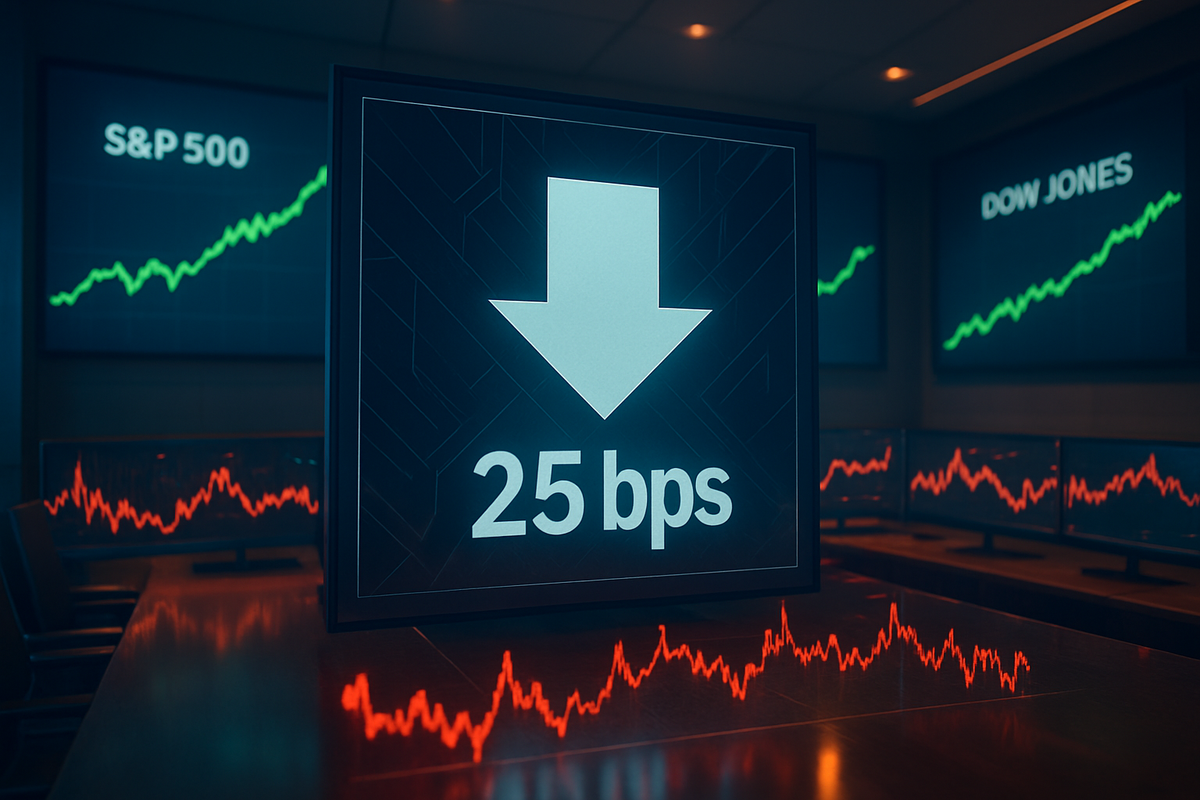
The Federal Reserve concluded its final meeting of 2025 on December 10 with a decision that left Wall Street both relieved and on edge. By implementing a 25-basis-point reduction, bringing the federal funds rate to a target range of 3.5%–3.75%, the central bank delivered its third consecutive quarter-point cut of the year. However, the move was far from a simple victory for "doves." Chair Jerome Powell accompanied the cut with a surprisingly "hawkish" message, signaling that the era of aggressive easing may be nearing its conclusion just as the S&P 500 (INDEXSP:.INX) and Dow Jones Industrial Average (INDEXDJX:.DJI) hover at historic peaks.
The immediate reaction was a flurry of volatility. While equity futures initially dipped as traders digested Powell’s cautious rhetoric, the broader markets eventually rallied, driven by the sheer momentum of year-end liquidity and a resilience in corporate earnings. As of December 25, 2025, the S&P 500 remains within striking distance of its all-time high of 6,912, while the Dow has solidified its position above the 48,000 mark. Yet, the "hawkish cut" has introduced a new layer of complexity for 2026, as investors grapple with a Federal Reserve that appears increasingly divided over the path of inflation and a cooling labor market.
The December FOMC meeting was defined by a level of internal friction not seen in over half a decade. The 9–3 vote represented the most dissents in a single meeting since 2019, reflecting a committee torn between two competing economic threats. On one side, Stephen Miran dissented in favor of a larger 50-basis-point cut, citing a labor market that he believes is softer than official data suggests. On the other, Austan Goolsbee and Jeffrey Schmid voted to hold rates steady, pointing to a Consumer Price Index (CPI) that remains stubborn at 2.7% and a Personal Consumption Expenditures (PCE) projection of 2.9% for the end of the year.
Chair Jerome Powell’s press conference was the primary source of the "hawkish" friction. Powell described the decision to cut as a "close call" and notably shifted his terminology regarding the "neutral rate"—the theoretical interest rate that neither stimulates nor restrains the economy. For the first time, Powell stated that current rates are within a "range of plausible estimates of neutral," a stark departure from earlier in the year when he suggested rates were still significantly restrictive. This linguistic pivot suggests that the Fed believes it has already done the heavy lifting and may pause its cutting cycle sooner than the market expects.
The backdrop for this decision was further complicated by a 43-day government shutdown that occurred earlier in the quarter, creating a "data void" for policymakers. With several key government reports delayed or unavailable, the Fed was forced to rely heavily on private-sector indicators and anecdotal evidence. This lack of clarity likely contributed to the "wait and see" approach emphasized by Powell, who explicitly ruled out a "preset schedule" for future cuts, effectively tempering expectations for a January 2026 follow-up.
The Fed’s cautious stance and the extension of corporate tax cuts via the "One Big Beautiful Bill Act" (OBBBA) have created a bifurcated landscape for public companies. Large-cap technology firms, which have driven much of the S&P 500’s 17% gain in 2025, remain the primary beneficiaries of the current environment. Companies like Microsoft Corp. (NASDAQ: MSFT) and Nvidia Corp. (NASDAQ: NVDA) continue to thrive on the back of sustained AI infrastructure spending, with the slightly lower interest rates providing a marginal boost to their long-term valuation models. However, the hawkish tone suggests that the "easy money" rally for high-growth, pre-revenue tech firms may be hitting a ceiling.
The banking sector saw a more nuanced reaction. While lower rates typically squeeze net interest margins, the Fed’s signal that it is nearing the end of its easing cycle provided a boost to major lenders like JPMorgan Chase & Co. (NYSE: JPM) and Goldman Sachs Group Inc. (NYSE: GS). These institutions benefit from a steepening yield curve and the broader market rally, which fuels their investment banking and wealth management divisions. Conversely, regional banks may struggle if the "hawkish" pause leads to higher-for-longer short-term borrowing costs while the labor market continues to soften, potentially increasing loan default risks.
Industrial and manufacturing giants, such as Caterpillar Inc. (NYSE: CAT), have found support in the Fed’s upgraded GDP growth forecast for 2026, which was revised upward to 2.3%. The combination of fiscal stimulus from the OBBBA and a Fed that is willing to defend growth has kept industrial sentiment high. However, companies highly sensitive to consumer discretionary spending, such as Nike Inc. (NYSE: NKE), face a more precarious path. With unemployment edging up toward 4.6% and inflation still above the 2% target, the "squeezed consumer" remains a central theme for the coming year.
The December meeting fits into a broader global trend of "recalibration" rather than "rescue." Central banks around the world are navigating a post-pandemic landscape where inflation remains more structural than previously thought, driven by deglobalization and energy transitions. The Fed’s hawkish cut mirrors recent moves by the European Central Bank, which has also adopted a data-dependent, meeting-by-meeting approach. This shift marks the end of the "forward guidance" era, where central banks would telegraph their moves months in advance to provide market certainty.
Historically, a "hawkish cut" is a rare maneuver, often used when the Fed wants to provide a liquidity cushion while simultaneously signaling to the bond market that it will not tolerate a resurgence of inflation. Comparisons are being drawn to the mid-cycle adjustments of the 1990s, where the Fed successfully engineered a "soft landing" by fine-tuning rates without triggering a recession. However, the current scenario is unique due to the massive fiscal tailwinds from the OBBBA, which are essentially working in the opposite direction of the Fed’s remaining restrictive stance.
The ripple effects of this policy divergence are being felt in the currency markets. The U.S. Dollar Index (DXY) fell to 98.64 following the announcement, its lowest level since October, as the 25-basis-point cut outweighed the hawkish rhetoric in the eyes of currency traders. A weaker dollar provides a tailwind for U.S. multinationals but complicates the inflation fight by making imports more expensive. This "policy tug-of-war" between fiscal expansion and monetary caution is likely to be the defining theme of the 2026 economic landscape.
Looking ahead to the first quarter of 2026, the market faces a "show me" period. Investors will be hyper-focused on whether the labor market stabilizes or if the recent uptick in unemployment to 4.6% is the start of a more ominous trend. If payroll gains continue to underwhelm, the Fed may be forced to abandon its hawkish rhetoric and return to a more aggressive easing posture, regardless of where inflation sits. This would represent a significant strategic pivot and could lead to increased market volatility as the "soft landing" narrative is put to the test.
Short-term opportunities may emerge in defensive sectors and high-quality dividend payers if the market rally pauses to digest the Fed's new stance. However, the long-term challenge remains the "neutral rate" debate. If the Fed truly believes the neutral rate is higher than it was pre-pandemic, the days of 0% interest rates are gone for good. This requires a fundamental shift in how investors value assets, moving away from liquidity-driven speculation and toward a focus on fundamental cash flow and balance sheet strength.
Potential scenarios for 2026 range from a "Goldilocks" outcome—where inflation drifts toward 2% while growth remains steady—to a "stagflationary" trap where the Fed is forced to keep rates high despite a weakening economy. The latter would be the ultimate test for the S&P 500's record valuations. Strategic adaptations for corporations will likely include a renewed focus on debt refinancing and cost-cutting to preserve margins in an environment where the "Fed put" is no longer a guaranteed safety net.
The Federal Reserve's December 2025 decision was a masterclass in atmospheric management. By cutting rates, they acknowledged the cooling labor market; by speaking hawkishly, they kept inflation expectations anchored. The key takeaway for investors is that the "easy" phase of the rate-cutting cycle is over. The Fed is no longer on a mission to lower rates at any cost; it is now in a delicate balancing act, attempting to find the "neutral" sweet spot while navigating a data-poor environment and a divided committee.
As we move into 2026, the market's record-high status will be tested by the reality of a 3.5% interest rate floor and a labor market that is no longer "red hot." The S&P 500 and Dow may be celebrating today, but the Fed has made it clear that the path forward will be measured in inches, not miles. Investors should watch for the January employment report and the next round of PCE data as the first true tests of Powell's "close call" philosophy.
The lasting impact of this meeting may not be the 25-basis-point cut itself, but the realization that the Federal Reserve has regained its optionality. For a market that has grown accustomed to predictable support, this new era of "plausible neutral" and data-driven uncertainty represents a return to a more traditional, and perhaps more volatile, financial reality.
This content is intended for informational purposes only and is not financial advice.