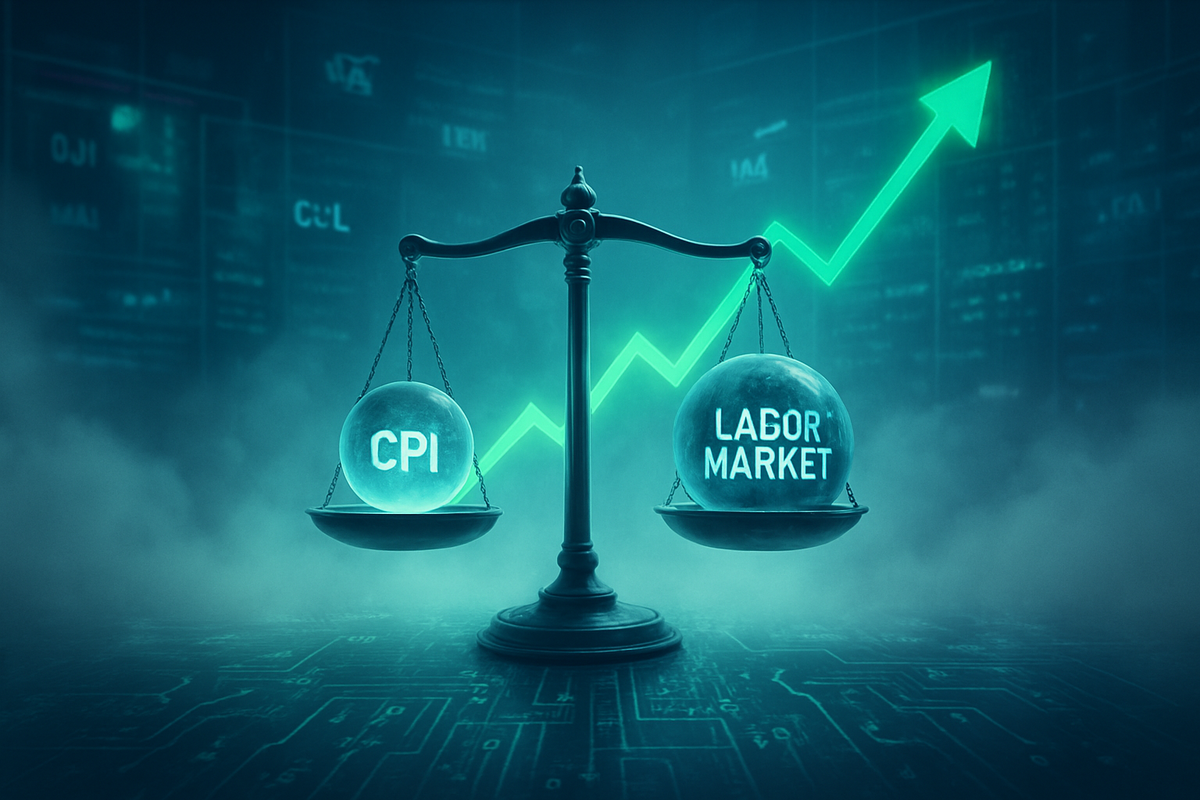
Wall Street breathed a collective sigh of relief this week as fresh economic data suggested that the "Great Data Gap" of 2025 might finally be closing with a soft landing in sight. Following a record-breaking 43-day federal government shutdown that ended in mid-November, the first comprehensive look at inflation and employment has sparked a late-December "risk-on" rally. The benchmark S&P 500 and Nasdaq Composite surged after the Consumer Price Index (CPI) came in cooler than expected, momentarily silencing fears that the recent period of fiscal and administrative upheaval would reignite price pressures.
The immediate implications are profound for the Federal Reserve, which has been forced to navigate a "data vacuum" for much of the fourth quarter. With the headline inflation rate cooling to 2.7% and the unemployment rate ticking up to a four-year high of 4.6%, the central bank’s recent 25-basis-point rate cut appears, in hindsight, to be a calculated preemptive strike against a slowing labor market. Investors are now recalibrating their portfolios, pivoting away from government-dependent sectors and toward high-execution technology and resilient consumer brands as they look toward a more stable 2026.
The Data Vacuum: Deciphering a Distorted Economic Landscape
The economic reports released between December 16 and December 18, 2025, were arguably the most anticipated in a generation. The 43-day federal shutdown, which paralyzed the Bureau of Labor Statistics (BLS) from October 1 to November 12, created a massive hole in the nation's economic record. When the November CPI report finally crossed the wires on December 18, it showed an annual increase of 2.7%, well below the 3.1% consensus forecast. Core CPI, which excludes volatile food and energy costs, slowed to 2.6%—its lowest level since the post-pandemic era began.
The jobs data was equally complex. The November Non-Farm Payrolls (NFP) report showed an addition of 64,000 jobs, a modest figure that nevertheless beat the whisper number of 50,000. However, this followed a revised loss of 105,000 jobs in October, a month dominated by the shutdown and the first wave of aggressive workforce reductions from the Department of Government Efficiency (DOGE). The unemployment rate rose to 4.6%, up from 4.4% in September, signaling that while the private sector remains resilient, the public sector is undergoing a historic contraction.
The Federal Reserve’s Federal Open Market Committee (FOMC) had already anticipated some of this weakness during its December 10 meeting. In a divided vote, the Fed lowered the federal funds rate to a range of 3.50%–3.75%. Chair Jerome Powell noted that the committee was operating with a "skeptical eye" toward the shutdown-distorted data, emphasizing that the Fed would rather lean toward supporting the labor market now than risk a deeper recession later. Market reaction was swift: the 10-year Treasury yield drifted down to 4.12%, while the tech-heavy Nasdaq jumped 1.38% on the heels of the inflation miss.
Winners and Losers in the Post-Shutdown Economy
The market's reaction has created a stark divide between companies that thrive on private-sector innovation and those tethered to federal spending. The clear winners of the December rally have been the "AI Titans" and high-growth tech firms. Micron Technology (NASDAQ: MU) saw its shares skyrocket by over 10% after the company signaled that AI demand remains decoupled from broader macroeconomic headwinds. Similarly, NVIDIA (NASDAQ: NVDA) and Alphabet (NASDAQ: GOOGL) continued their 2025 dominance, with Alphabet benefiting from the successful integration of Gemini AI into its core revenue streams.
In the consumer space, Carvana (NYSE: CVNA) emerged as a standout performer, gaining ground on the expectation that lower interest rates in 2026 will revive the used-car market. Retailers like Lululemon (NASDAQ: LULU) also saw a boost, as cooling inflation suggests that consumers may have more disposable income for the final stretch of the holiday season. Even speculative plays like Rocket Lab (NASDAQ: RKLB) found favor, as investors looked past government volatility toward the company's private-sector launch pipeline.
Conversely, the "losers" of this cycle are concentrated in sectors reliant on federal contracts and steady government operations. Telecommunications firm Clearfield Inc. (NASDAQ: CLFD) struggled as delays in federal broadband funding took a toll on its 2026 outlook. The medical diagnostics sector also felt the sting; Spectral AI (NASDAQ: MDAI) and Qiagen NV (NYSE: QGEN) both reported revenue headwinds due to the halt in federal research grants and contract "rejustifications" led by DOGE. Small-cap stocks, represented by the Russell 2000, have also lagged behind their larger counterparts, as the 4.6% unemployment rate weighs more heavily on domestic-focused, credit-sensitive smaller enterprises.
A New Era of Fiscal and Monetary Policy
This event marks a significant shift in the broader industry trend of "fiscal-monetary tension." For the first time in decades, the Federal Reserve is managing a cooling economy while the executive branch actively pursues a policy of radical administrative downsizing. The DOGE initiatives, led by Elon Musk, have resulted in the loss of over 271,000 federal jobs in 2025 alone. This massive reduction in the public workforce is acting as a "shadow" tightening of the economy, effectively doing some of the Fed's work for it by cooling wage growth and aggregate demand.
Historically, federal shutdowns have been temporary blips, such as the 35-day shutdown in 2018-2019. However, the 2025 event was different due to its length and the subsequent permanent structural changes to the federal government. The "Great Data Gap" forced Wall Street to turn to alternative data providers like Goldman Sachs (NYSE: GS) and JPMorgan (NYSE: JPM) to gauge economic health, a trend that may permanently change how analysts value official government statistics.
The regulatory implications are also shifting. With the Department of Government Efficiency reviewing every major federal contract, the "moat" traditionally enjoyed by major defense and IT contractors is thinning. Policy experts suggest that the "higher for longer" interest rate mantra of 2024 has been replaced by a "lower for longer" growth expectation for the public sector, forcing a massive reallocation of capital toward the private AI and energy sectors.
The Road to 2026: Scenarios and Strategic Pivots
Looking ahead, the market faces a "data-dependent pause" in early 2026. While the December rate cut provided a temporary cushion, the Fed’s updated "dot plot" suggests only one additional 25-basis-point cut may be on the table for the entirety of 2026. The central bank is aiming for a "neutral" rate of roughly 3.0% by 2027, but that path depends entirely on whether the current cooling of inflation is permanent or merely a side effect of the shutdown’s disruption to consumer spending.
Short-term, investors should expect continued volatility in government-heavy sectors as DOGE continues its audit of federal agencies. Strategic pivots are already underway; many government contractors are attempting to diversify into commercial aerospace and private cybersecurity to mitigate the risk of contract terminations. Meanwhile, the "AI arms race" is expected to enter an "execution phase," where companies like Micron and NVIDIA must prove that their massive valuations are supported by tangible earnings growth in a slower-growth macro environment.
Potential scenarios range from a "Goldilocks" recovery—where private sector growth fully offsets public sector losses—to a "stagflationary" drag if the recent tariffs and energy price stickiness prevent inflation from reaching the Fed's 2% target. Most analysts currently lean toward the former, citing the resilience of the American consumer and the transformative potential of AI productivity gains.
Conclusion: Navigating the Narrow Path
The events of late 2025 have proven that the U.S. economy is more resilient than a 43-day shutdown might suggest, but the scars of the "Great Data Gap" will remain for some time. The key takeaway for investors is that the Federal Reserve is walking an increasingly narrow path: it must provide enough liquidity to prevent a labor market collapse while remaining vigilant against any resurgence of inflation fueled by administrative shifts or global trade tensions.
Moving forward, the market is likely to reward "quality" and "execution." The era of "easy money" is gone, replaced by a regime where fundamental earnings and private-sector demand are the primary drivers of stock performance. Investors should keep a close watch on the March 2026 FOMC meeting and the ongoing DOGE reports, as these will provide the next set of clues for the economy's long-term trajectory. For now, the "relief rally" of December 19, 2025, suggests that Wall Street is willing to bet on a brighter, albeit leaner, future.
This content is intended for informational purposes only and is not financial advice.