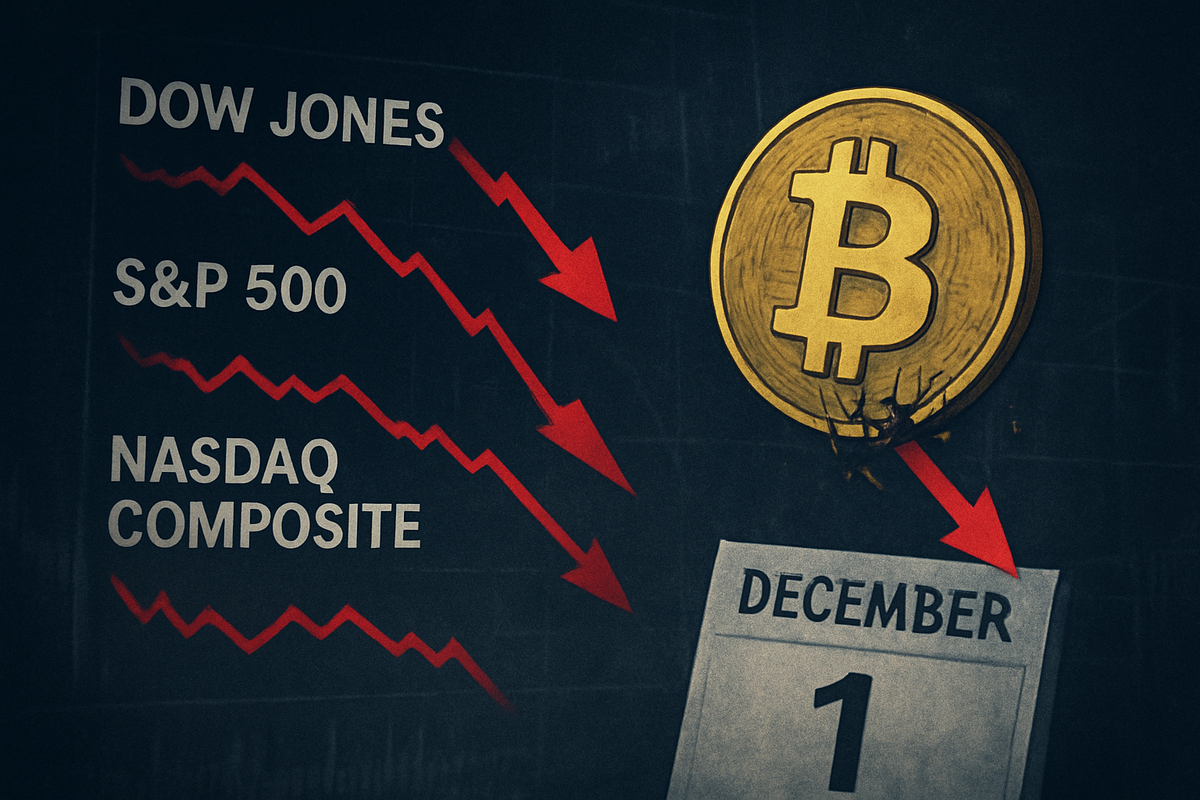
December 1, 2025, has dawned with a distinct chill across global financial markets, as major indices including the Dow Jones Industrial Average (NYSE: ^DJI), S&P 500 (NYSE: ^GSPC), and Nasdaq Composite (NASDAQ: ^IXIC) experienced significant declines, signaling a somber commencement to the final month of the year. Adding to the widespread apprehension, Bitcoin, the world's leading cryptocurrency, also saw a substantial plummet, marking a broad-based retreat from risk assets. This synchronized downturn has investors and analysts scrambling to understand the underlying causes and potential implications for the holiday season and beyond, raising concerns about economic stability and future market trajectories.
The abrupt market correction has cast a shadow over recent optimism, with market participants now bracing for increased volatility. The synchronized fall across traditional equities and the cryptocurrency market suggests a systemic shift in investor sentiment, possibly driven by macroeconomic concerns that transcend individual asset classes. As the year-end approaches, this downbeat start to December could significantly influence portfolio strategies and investment decisions, prompting a re-evaluation of risk exposure and asset allocation in a rapidly evolving financial landscape.
A December Plunge: Unpacking the Market's Sudden Retreat
The first trading day of December 2025 witnessed a sharp reversal in market fortunes, with all three major U.S. stock indices registering notable losses. The Dow Jones Industrial Average, often seen as a barometer for the broader industrial economy, led the decline, while the technology-heavy Nasdaq Composite also suffered considerably, indicating a pullback from growth-oriented stocks. The S&P 500, representing a broader cross-section of the U.S. economy, mirrored these losses, reflecting widespread selling pressure across various sectors. Concurrently, Bitcoin (CRYPTO: BTC), which often acts as a bellwether for speculative appetite, experienced a significant drop, breaking through key support levels and amplifying the sense of market distress.
While specific, immediate triggers for this downturn are still being fully assessed, preliminary analyses point to a confluence of factors contributing to the market's sudden weakness. Concerns over persistent inflation, potentially prompting more aggressive monetary policy tightening from central banks globally, appear to be a primary driver. Geopolitical tensions, coupled with renewed anxieties about global economic growth prospects, are also weighing heavily on investor confidence. The timeline leading up to this moment includes a period of sustained market gains in recent weeks, making this sharp correction feel particularly jarring and potentially signaling an exhaustion of upward momentum. Key players involved in this unfolding scenario include global central banks, whose upcoming policy statements are eagerly anticipated, and major institutional investors whose shifts in sentiment can significantly sway market directions. Initial market reactions have been characterized by heightened caution and a flight to safety, with traditional safe-haven assets potentially seeing increased demand.
This broad-based sell-off suggests that investors are re-evaluating their risk exposure in light of emerging macroeconomic headwinds. The tech sector, which has often been a leader in market rallies, appears particularly vulnerable to higher interest rate expectations, as future earnings are discounted more heavily. Similarly, the cryptocurrency market, known for its volatility, tends to react sharply to shifts in global liquidity and risk appetite. The synchronized nature of these declines across disparate asset classes underscores a pervasive shift in market psychology, moving from a "buy the dip" mentality to a more cautious, risk-off approach as the year draws to a close.
Market Movers: Identifying Potential Winners and Losers
A significant market downturn, particularly one that includes a broad equity sell-off and a cryptocurrency plummet, inevitably creates a distinct landscape of winners and losers. Companies with strong balance sheets, stable cash flows, and those operating in defensive sectors are typically better positioned to weather such storms. Conversely, highly leveraged companies, growth stocks reliant on future earnings potential, and firms with significant exposure to volatile assets like cryptocurrencies are likely to face considerable headwinds.
In this environment, traditional defensive sectors such as utilities, consumer staples, and healthcare might see increased investor interest. Companies like Johnson & Johnson (NYSE: JNJ), Procter & Gamble (NYSE: PG), and Duke Energy (NYSE: DUK) could be viewed as relative safe havens due to their consistent demand and less cyclical business models. Furthermore, companies providing essential services or those with robust dividend policies often attract capital during periods of uncertainty. On the flip side, technology giants and high-growth companies that thrived in a low-interest-rate environment, such as many constituents of the Nasdaq Composite, could experience continued pressure. Companies like Tesla (NASDAQ: TSLA) or Nvidia (NASDAQ: NVDA), while fundamentally strong, might see their valuations re-rated downwards as investors become more risk-averse and the cost of capital potentially rises.
The plummet in Bitcoin and the broader crypto market will undoubtedly impact companies with direct or indirect exposure to digital assets. Publicly traded companies that hold Bitcoin on their balance sheets, such as MicroStrategy (NASDAQ: MSTR), or those heavily invested in cryptocurrency mining operations, could see their stock prices suffer significantly. Additionally, financial technology (FinTech) firms that have built substantial business models around cryptocurrency trading or services might face reduced transaction volumes and profitability. Conversely, companies specializing in cybersecurity or traditional financial institutions that have maintained a more conservative stance on crypto exposure might be seen as more stable during this period of digital asset volatility. The ripple effects could also extend to companies whose revenue streams are tied to consumer discretionary spending, as economic uncertainty often leads to reduced consumer confidence and tighter budgets.
Wider Significance: A Shift in the Economic Tides?
The downbeat start to December 2025, characterized by a broad market sell-off and a significant cryptocurrency plummet, carries wider significance that extends beyond immediate portfolio adjustments. This event could signal a pivotal shift in broader industry trends, potentially marking the end of a prolonged period of easy money and exuberant risk-taking. It fits into a narrative of increasing economic uncertainty, where concerns over persistent inflation, rising interest rates, and decelerating global growth are converging to challenge market stability. The synchronized nature of the decline across traditional equities and digital assets suggests a systemic repricing of risk, rather than an isolated sector-specific event.
Potential ripple effects on competitors and partners are substantial. In the technology sector, a sustained downturn could lead to reduced investment in research and development, slower innovation cycles, and increased pressure on profitability, impacting the entire ecosystem of suppliers and service providers. For financial institutions, increased market volatility and a potential flight to safety could alter lending practices and investment strategies. Regulatory bodies worldwide will be closely watching these developments, particularly in the cryptocurrency space, where calls for stricter oversight often intensify during periods of significant price corrections. This event could accelerate discussions around comprehensive regulatory frameworks for digital assets, impacting how these markets operate in the future.
Historically, sharp market corrections often precede periods of economic re-evaluation. Comparisons could be drawn to previous periods of monetary policy tightening or significant geopolitical shocks, where markets initially react with fear before finding a new equilibrium. While not directly comparable, the dot-com bubble burst or the initial phases of the 2008 financial crisis offer precedents for how sustained market anxiety can reshape investor behavior and industry landscapes. This current downturn may represent a necessary recalibration, forcing companies and investors to adapt to a potentially higher-interest-rate, lower-growth environment, moving away from the liquidity-driven rallies of the past.
What Comes Next: Navigating the Uncertainty Ahead
The immediate aftermath of this downbeat December start will likely be characterized by heightened market volatility and a period of consolidation as investors digest the implications. In the short term, markets will be keenly watching for any policy responses from central banks, particularly statements regarding future interest rate paths and quantitative tightening measures. Any signs of easing inflationary pressures or more dovish stances from monetary authorities could provide a reprieve, while continued hawkishness might prolong the market's struggles. Companies, especially those in growth sectors, may need to implement strategic pivots, focusing more on profitability and cash flow generation rather than purely top-line growth. This could mean a slowdown in hiring, a reduction in expansion plans, and a greater emphasis on operational efficiency.
Looking further ahead, the long-term possibilities are more varied. A sustained period of market weakness could present significant market opportunities for long-term investors willing to buy into fundamentally strong companies at discounted valuations. Conversely, a prolonged downturn, potentially exacerbated by unforeseen economic shocks, could lead to a recessionary environment, posing severe challenges for businesses and consumers alike. Emerging market economies, often more sensitive to global capital flows and commodity prices, could face particular difficulties if risk aversion persists. The cryptocurrency market, in particular, will face a critical test of its resilience; a prolonged bear market could lead to a shakeout of less robust projects and a renewed focus on utility and regulatory compliance.
Potential scenarios range from a relatively quick rebound, driven by signs of economic stabilization and controlled inflation, to a more protracted bear market influenced by persistent macroeconomic headwinds. Strategic adaptations required across the board will include a renewed focus on risk management, diversification, and a disciplined investment approach. Companies may need to reassess their supply chains, manage debt levels more cautiously, and innovate to maintain competitiveness in a potentially tighter economic climate. Investors will need to remain agile, carefully monitoring economic data, corporate earnings, and geopolitical developments to navigate the evolving market landscape effectively.
Wrap-Up: A Call for Caution and Strategic Foresight
The downbeat start to December 2025, marked by significant declines in the Dow, S&P 500, Nasdaq, and a plummet in Bitcoin, serves as a potent reminder of the inherent volatility and interconnectedness of global financial markets. The key takeaway from this event is the clear shift in investor sentiment, moving towards a more risk-averse stance driven by a confluence of macroeconomic concerns, including inflation, interest rates, and global growth prospects. This synchronized downturn across traditional equities and digital assets underscores a broad recalibration of risk and valuation expectations.
Moving forward, the market is likely to remain sensitive to incoming economic data and central bank communications. The assessment of the market's trajectory will hinge on whether current pressures are transient or indicative of a more fundamental shift in the economic cycle. While corrections are a natural part of market cycles, the broad nature of this particular downturn suggests a period of significant re-evaluation. The lasting impact could be a more disciplined market environment, where fundamental strength and prudent financial management are rewarded over speculative growth.
Investors should watch closely for signs of stabilization in inflation, clarity on central bank monetary policies, and any developments in geopolitical tensions. Corporate earnings reports in the coming months will also provide crucial insights into the health of various sectors and the resilience of individual companies. A diversified portfolio, a long-term perspective, and a willingness to adapt to changing market conditions will be paramount. This event underscores the importance of robust risk management and strategic foresight in navigating what promises to be an interesting and potentially challenging period for global finance.
This content is intended for informational purposes only and is not financial advice