March 9, 2025 - Ninghai, China - As silver prices continue to trend upward, metallization cost has once again moved to the center of PV cost-structure discussions. For high-efficiency module such as HJT, every milligram of silver directly affects manufacturing economics and long-term product competitiveness.
While recent industry dialogue has intensified around silver paste cost reduction and alternative metallization materials, this is not new territory for Risen Energy. In August 2023, Risen Energy released a dedicated technical study titled “White Paper of HJT Hyper-ion Products of Risen Energy: Development and Application of Low-Silver Metallization Paste“. Today, revisiting this work is not a matter of republishing archived material but rather an opportunity to reflect on the strategy within a new industry context — and to share insights derived from practical experience rather than theoretical positioning.
White paper of HJT Hyper-ion products of Risen Energy Development and application of Low-silver metallization paste
I. Foresight and Layout: Beyond "Substitution," Focused on "System Engineering"
In the white paper, Risen Energy systematically elaborated on the 'why' and 'how' of transitioning to low-silver content. The decision was never framed as a short-term hedge against silver price fluctuations, but rooted in first-principles cost analysis and long-cycle industrial planning.
In HJT cell architecture, metallization paste represents the second-largest cost component after silicon wafers. Silver’s limited resource base and inherent price volatility introduce structural risk into long-term scaling. History provides a clear parallel: the semiconductor industry’s transition from gold bonding wires to copper interconnects was not optional — it was economically inevitable. For PV, the underlying logic is similar.
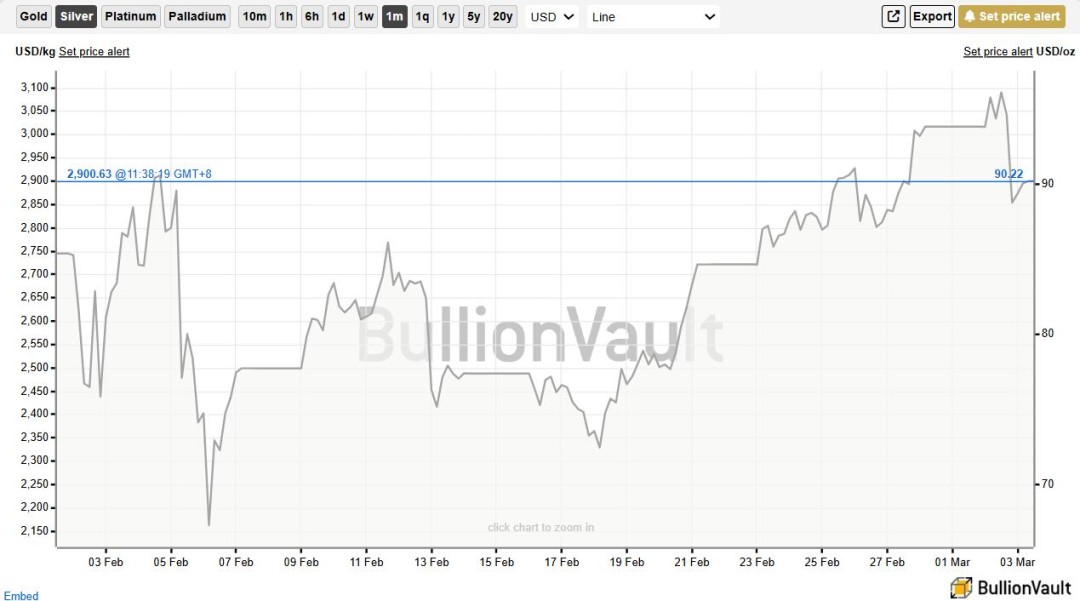
Silver price trend chart
Risen Energy’s research did not stop at the conceptual stage but delved into mass-production:
- Candidate Material Screening:Three key dimensions were comprehensively evaluated: electrical conductivity, global reserves, and market prices, identifying copper, aluminum, zinc, and nickel as feasible base metals for further development.
- Technical Path Selection: Between the two main paths of "Electroplated metallization" and "low-silver-content paste," Risen Energy prioritized the latter. From a mass-production standpoint, the encapsulated paste offered decisive advantages including compatibility with existing production lines, lower capital expenditure, faster scalability and more predictable process control. This approach is compatible with existing production lines, enabling rapid cost reduction. The selected architecture employs a silver shell encapsulating a low-cost metal core — balancing conductivity, reliability, and manufacturability.
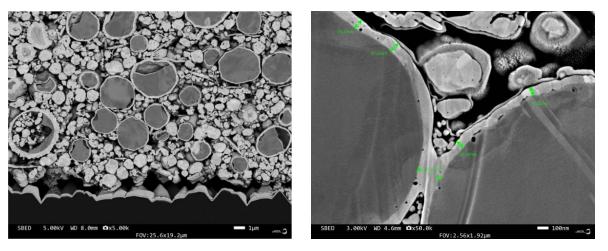
(a) (b) Photo of FIB-SEM of paste with low-silver content
- Reliability Validation: Any innovation is meaningless without reliability validation. Through extensive testing, the excellent structural integrity of the silver encapsulation is confirmed. Even under rigorous accelerated aging tests involving light, heat, and electrical stress, the low-cost metal particles remain securely locked within the silver shell, without precipitating or affecting cell performance. Industry's concern about copper diffusion is also addressed by conducting limit tests, which provides counter-evidence that its application is safe and reliable under HJT's low-temperature processes and specific structure.
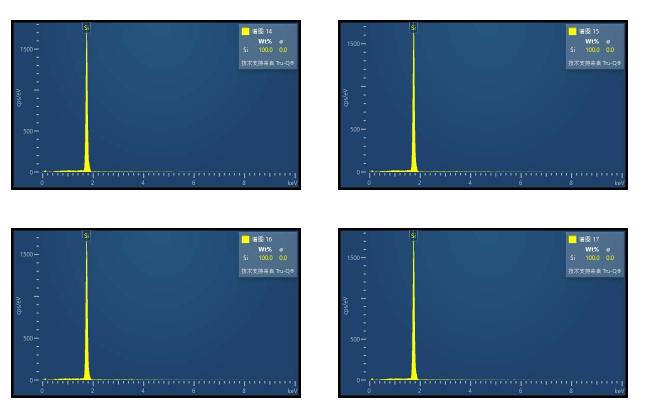
EDS (Detection of low-cost metal deep inside the cell)
- Module-Level Empirical Evidence: Cell-level feasibility does not automatically translate into module-level bankability. The white paper also showed the performance of modules incorporating low-silver paste after intensified DH (Damp Heat) and TC (Thermal Cycling) tests. Results demonstrated degradation performance equivalent to — and in some scenarios marginally better than — conventional full-silver paste modules. Months of field energy yield data parity in real operating environments.
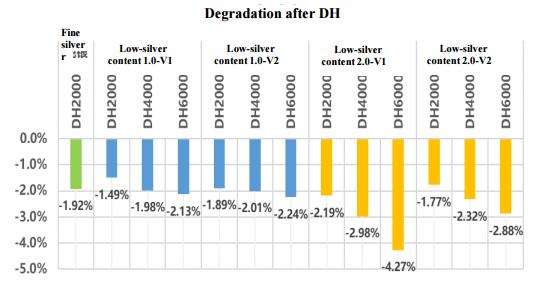
Degradation after DH tests
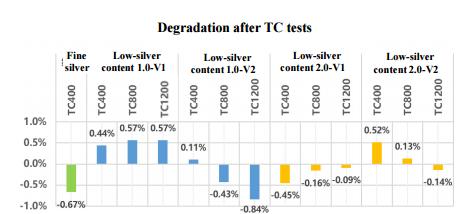
Degradation after TC tests
All these works clearly aimed at a single goal: developing an HJT product that is not lower in cost but without efficiency sacrifice, reliability compromise, or yield uncertainty.
II. Leadership and Execution: From "Technical Blueprint" to "Mass-Production"
The 2023 white paper addressed "feasibility" and "methodology" of low-silver metallization. What distinguishes the present stage is execution, the "practical results" behind this publication.
Risen Energy personnel are pleased to see that low-silver metallization has become an industry consensus, with various technological routes being actively explored. However, the journey from laboratory breakthroughs to stable mass production on the line remains long. Material adaptation, process window stability, and long-term reliability consistency confirmation requires cumulative manufacturing experience.
At Risen Energy, low-silver metallization technology for HJT products is not pilot initiative. It has been implemented in sustained, high-volumen mass production for multiple years. The focus has evolved from “can it work?” to “how well can it perform at scale?”
More specifically, the cost-reduction plan Risen Energy initially established is steadily becoming reality. Currently, the pure silver consumption of Risen Energy's HJT cells has been reduced to 3.9 mg/W, placing it among the leading levels globally. More importantly, the company continues to follow the established technology roadmap to persistently drive down silver content. Risen Energy firmly believes that only by translating technological foresight into solid manufacturing capability and quality control can truly create value for customers.
III. Reflection and Outlook: Driven by "Value," Proven by "Execution"
Revisiting this earlier publication is not to compare technical routes or position one pathway against another. Rather, as early movers and long-term practitioners, Risen Energy aims to share perspectives that have been validated through time and scaled manufacturing experience.
1.Inherent Compatibility of HJT Technology and Low-Silver Paste: HJT's full low-temperature process, compatibility with ultra-thin wafers, and unique cell structure provide a more favorable platform and a wider safety window for the application of low-silver or even silver-free metallization technologies.
2.The Ultimate Goal of Cost Reduction is to Enhance Product Competitiveness: The move to low-silver content must not come at the expense of efficiency, reliability, or power generation. Risen Energy's practice demonstrates that through systematic material development, process optimization, and rigorous validation, it is entirely possible to significantly reduce silver consumption while maintaining or even enhancing the overall performance of the product.
3.The Industry's Future is Inextricably Linked to Material Innovation: If elevated silver prices becomes structurally persistent, the transition to low-silver and silver-free solutions will inevitably accelerate. This is not merely a cost game but a core technological innovation deeply rooted in material systems.
Pioneering the path means undertaking greater exploration risks and more sustained R&D allocation. Yet for a genuinely technology-driven enterprise, Risen Energy believes this is not discretionary — it is foundational. Risen Energy appreciated the continued trust placed in our HJT technology by customers and partners worldwide. Meanwhile, Risen Energy remains committed to advancing across multiple strategic fronts including low-silver metallization, ultra-thin wafers, and equipment localization, translating technological foresight into scalable industrial capability. With more practical technologies and superior products, Risen Energy will advance the industrialization of HJT technology and contribute solidly to the global energy transition.
About Risen Energy
Risen Energy integrates photovoltaics, inverter, energy storage, power station development, and smart energy management. Through strategic investments across the entire energy value chain—from production, conversion, and storage to consumption, operation, and management—Risen Energy accelerates the fusion of solar and storage.
For more information, please contact:
Risen Energy Co., Ltd.
Info@risenenergy.com
Media Contact
Company Name: Risen Energy CO. LTD.
Contact Person: Min Xiao
Email: Send Email
Country: China
Website: https://en.risenenergy.com/