The Spanish-speaking artificial intelligence education market has expanded at a pace that few industries match. Enrollment figures across the sector's leading platforms suggest that hundreds of thousands of entrepreneurs in Spain, Mexico, Argentina, Colombia, and the broader Latin American market have completed some form of AI training in the past two years. They can build automation workflows. They can deploy language model applications. They can architect systems that, in the right hands, genuinely transform how a business operates.
But a structural problem has surfaced consistently enough that practitioners and educators across the sector are now talking about it openly: most of these entrepreneurs cannot reliably get clients.
This is the monetization gap — and it is increasingly the central tension in the Spanish-language AI training industry.
The Problem the Curriculum Is Not Solving
The gap between technical training and commercial execution is not unique to AI. It appeared in digital marketing, in web development, in social media management. Every time a technical discipline emerges and generates a mass education response, the same failure mode follows: training institutions optimize for skill development because that is what they know how to teach. Business development — specifically, how to build a repeatable, scalable system for acquiring clients — requires a different type of expertise and, typically, a different type of instructor.
In the AI agency space, this gap has a specific shape.
An entrepreneur who exits an AI training program with genuine technical skills faces three immediate commercial challenges that the curriculum almost never addresses. The first is positioning: AI is a term that now covers hundreds of possible applications, and a solo founder or small team attempting to sell "AI services" to business owners without a precise, differentiated value proposition is invisible in a market that has grown crowded quickly.
The second challenge is outreach infrastructure. The default commercial strategy for most newly trained AI entrepreneurs is referrals and personal network activation. This works until it doesn't — typically within the first three to six months. Referrals are unpredictable. They do not scale. And they disappear entirely when the founder's personal bandwidth runs out.
The third challenge is follow-through. B2B sales data across service industries consistently shows that the majority of deals are closed after five or more touchpoints, yet most solo founders abandon outreach after one or two attempts. This is not a motivation problem. It is a systems problem. Without automated, structured follow-up infrastructure, qualified leads that expressed genuine interest simply fall out of the pipeline.
"The problem is never the lack of talent," says Alex Torre, founder of Scaling Systems, a consultancy specializing in client acquisition systems and commercial automation for service-based businesses. "Technically, many of these entrepreneurs are excellent. What they're missing is the architecture — the system that brings clients in consistently, whether or not the founder is actively working that day."
A Collaboration That Exposed the Scale of the Problem
The clearest illustration of how significant this gap has become emerged from a partnership between Torre and IA Winners, one of the most recognized AI training academies in the Hispanic market.
IA Winners had built a rigorous technical curriculum for entrepreneurs looking to launch their own AI agency from scratch. The program attracted serious students — not hobbyists, but people who had identified AI services as a viable business model and invested accordingly in developing the skills to deliver them. But feedback from the program pointed consistently to a bottleneck that the technical training alone could not resolve: graduates knew how to build; they did not know how to sell.
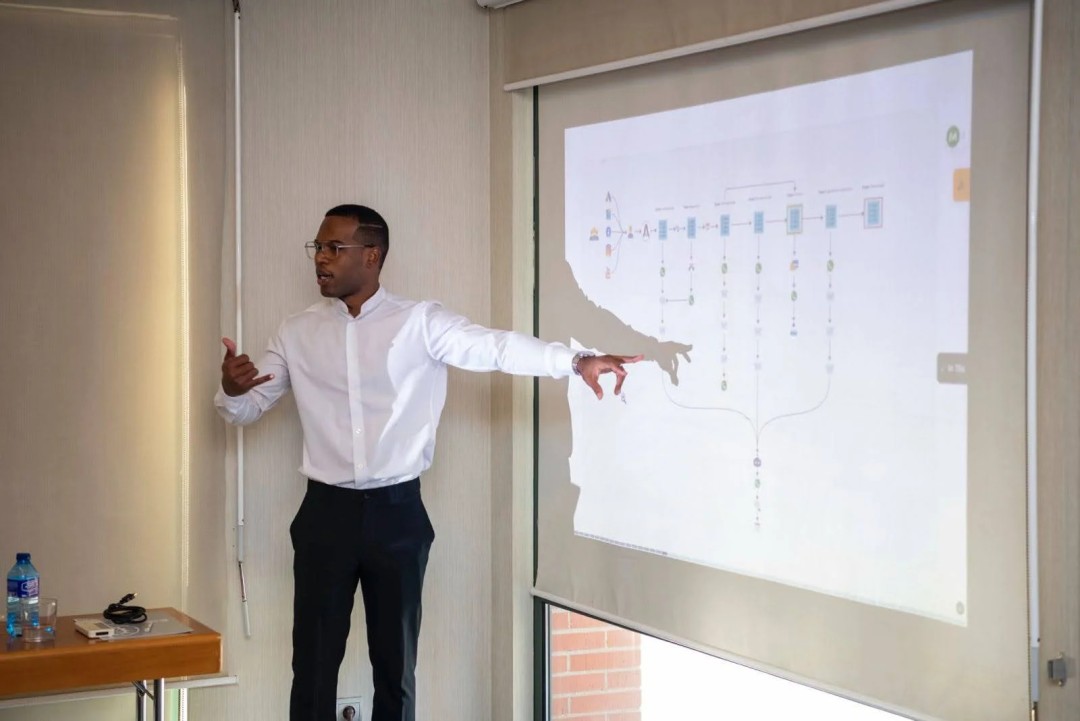
The collaboration brought Torre and Scaling Systems into the program to deliver what amounted to a parallel commercial curriculum alongside the technical one. Over 700 entrepreneurs went through the combined program. The scope was not a one-session overview. It covered the full commercial architecture of an AI agency: how to define a positioning that differentiates in a saturated market, how to build an outreach system that generates qualified conversations without constant manual intervention, how to design a sales process appropriate for the SME market, and how to implement the follow-up automation that keeps a pipeline active over months rather than days.
The model was, in effect, a recognition that technical training and business training serve different functions — and that delivering one without the other produces incomplete entrepreneurs.
What Scaling Systems Identified That Most Trainers Miss
Alex Torre's methodology, developed through Scaling Systems across years of building and advising service businesses, starts from a diagnostic observation that contradicts the dominant narrative in AI entrepreneurship education.
Most educators frame the AI agency opportunity primarily as a technology problem: learn the tools, build the skills, and clients will follow. Torre's position, grounded in operational experience rather than theory, is that this framing is backwards. Technology is not the constraint. Commercial infrastructure is.
"Everyone wants to automate their business with AI," he observes. "Almost nobody has clean enough processes to automate. And almost nobody asking how to build an AI agency has a functioning client acquisition system in place before they start. You can't automate something that doesn't exist yet."
The Scaling Systems framework approaches this by separating the problem into distinct layers. Before any AI tool is relevant, there needs to be a clear answer to a simpler set of questions: Who is the client? What specific business outcome does the agency deliver for them? How does a prospective client first enter the pipeline? What happens to them over the following 30, 60, and 90 days if they don't immediately convert?
These are not AI questions. They are business design questions. And they are, systematically, what is missing from the majority of AI training programs in the Hispanic market — not because program designers are negligent, but because they are optimized for a different objective.
Torre scaled his own agency to over €400,000 per month in recurring revenue and has taken multiple businesses through the €100,000 monthly threshold using the same systems-first methodology that Scaling Systems now teaches. The numbers are relevant not as marketing credentials but as proof of concept: the approach works at the scale that AI agency founders are attempting to reach.
Why This Matters Now, in 2026
The timing of this conversation is not coincidental. The first generation of Spanish-speaking AI entrepreneurs trained in 2023 and 2024 are now two to three years into their attempts to build sustainable businesses around these skills. Some have succeeded. Many have not. The ones who have not failed for lack of technical ability — the tools available to them are more powerful than ever. They failed because of the commercial infrastructure gap that nobody adequately prepared them for.
At the same time, the AI services market for SMEs in Spain and Latin America is genuinely growing. Business owners are more receptive to AI implementation proposals than they were two years ago. The market conditions for an AI agency with a strong positioning and a functioning client acquisition system have arguably never been better.
This creates an unusual situation: a market with significant real demand, a large population of technically capable providers, and a persistent mismatch between the two that is almost entirely explained by the absence of commercial systems on the supply side.
The consultancies and educators who are addressing this mismatch directly — not by teaching more AI, but by teaching the business architecture that makes AI skills commercially viable — are emerging as a distinct and necessary category in the Hispanic entrepreneurship ecosystem.
Scaling Systems, through its own client work and through collaborations like the one with IA Winners, represents one of the clearest examples of that category taking shape in the Spanish-speaking market.
The Broader Implication for AI Education
The conversation that the IA Winners collaboration helped catalyze points toward a structural shift in how serious AI training programs will need to be designed going forward.
Technical skills are a prerequisite. They are not a sufficient condition for building a viable AI agency. The entrepreneurs who are building sustainable, scalable AI businesses in the Hispanic market are not necessarily the most technically sophisticated. They are the ones who paired technical capability with commercial infrastructure — a functioning positioning, a systematic approach to client acquisition, and the automation to sustain follow-up and conversion over time without constant founder involvement.
For training programs, this suggests a curriculum design question that is becoming harder to ignore: is the goal to produce technically skilled individuals, or to produce viable business owners? The answer shapes everything from faculty selection to program structure to what success metrics are actually measured at graduation.
For entrepreneurs currently in or considering AI training, the practical implication is more direct. The investment in technical skills is only as valuable as the commercial infrastructure built to deploy them. Without a system that brings clients in reliably — without a repeatable, scalable approach to outreach, conversion, and follow-up — technical excellence remains potential rather than revenue.
That distinction, between potential and revenue, is precisely the gap that practitioners like Alex Torre and firms like Scaling Systems have positioned themselves to close.
Alex Torre is the founder of Scaling Systems, a consultancy focused on client acquisition systems, sales automation, and business scaling for coaches, consultants, and agency owners. He has scaled a digital agency to over €400,000 in monthly revenue and has trained over 700 Spanish-speaking entrepreneurs in commercial business architecture through collaborations including IA Winners. More information at https://alextorre.com/.
Video Link: https://www.youtube.com/embed/xMscCnXgcGk
Media Contact
Company Name: Scalix Systems LLC
Contact Person: Media Relations
Email: Send Email
Country: Spain
Website: https://alextorre.com/