Today’s Date: January 16, 2026
Introduction
Tesla, Inc. (NASDAQ: TSLA) enters 2026 at a critical crossroads. Long the poster child for the electric vehicle (EV) revolution, the company is now aggressively rebranding itself as an artificial intelligence and robotics powerhouse. This transition comes at a time of significant stock volatility and a fundamental shift in its core automotive business. While 2025 was marked by slowing delivery growth and increased competition from Chinese rivals like BYD, Tesla’s narrative is increasingly dominated by the "trinity" of its future: the fully autonomous Cybercab, the Optimus humanoid robot, and the long-awaited volume production of the Tesla Semi. As of mid-January 2026, Tesla remains one of the most polarizing and heavily traded stocks in the world, valued not just on the cars it sells today, but on the autonomous future it promises for tomorrow.
Historical Background
Founded in 2003 by Martin Eberhard and Marc Tarpenning—and famously led to global prominence by Elon Musk—Tesla's journey is a saga of near-bankruptcies and industry-disrupting triumphs. The 2008 Roadster proved EVs could be desirable; the Model S in 2012 proved they could be luxury leaders; and the Model 3 in 2017 brought EVs to the mass market. The company’s "Production Hell" period between 2017 and 2019 eventually gave way to a massive scaling phase, leading to the establishment of Gigafactories in Shanghai, Berlin, and Texas. By 2021, Tesla joined the exclusive trillion-dollar market cap club, forever altering the trajectory of the global automotive industry and forcing every major legacy manufacturer to pivot toward electrification.
Business Model
Tesla’s business model is a vertically integrated ecosystem that spans three primary segments:
- Automotive: The core revenue driver, encompassing the sale and leasing of the Model 3, Y, S, X, Cybertruck, and the newly ramping Semi. This also includes the growing "Automotive Services" segment, which features the Supercharger network—now the de facto charging standard in North America.
- Energy Generation and Storage: A high-growth segment focusing on Powerwall (residential), Megapack (utility-scale), and solar deployments. In 2025, this segment saw record margins as grid-scale storage demand surged globally.
- AI and Software (The "High-Margin" Future): This includes Full Self-Driving (FSD) subscriptions, which recently pivoted to a $99/month recurring model, and the projected licensing of FSD software to other automakers. This segment also houses the development of Optimus and Tesla’s Dojo supercomputer.
Stock Performance Overview
Tesla’s stock performance continues to be a "tale of two timelines." Over a 10-year horizon, TSLA has been a generational wealth creator, up over 1,500%. Over the last 5 years, it has outperformed the S&P 500 significantly, though with massive drawdowns. However, the last 12 months (2025–early 2026) have been a rollercoaster. After hitting a local bottom in early 2025, the stock rallied toward the $450 level as excitement for the Cybercab launch grew. Yet, volatility remains high; in just the first two weeks of 2026, the stock has swung between $430 and $447, sensitive to macro news regarding interest rates and Nvidia’s competitive AI announcements.
Financial Performance
In its most recent reporting cycles of late 2025, Tesla revealed a more mature, albeit pressured, financial profile. Total deliveries for 2025 reached approximately 1.64 million units—an 8.5% decline from 2024—marking a rare period of cooling demand. Consequently, automotive gross margins have stabilized around 16%–17%, down from the 25%+ peaks of 2021. Despite this, the company’s "fortress balance sheet" remains intact, with cash reserves exceeding $35 billion. Investors are currently focused on the Q4 2025 earnings call (slated for late January 2026), looking for signs that the higher-margin Energy and Software segments are beginning to offset the narrower margins on vehicle hardware.
Leadership and Management
Elon Musk remains the central figure of Tesla’s leadership, serving as CEO and "Technoking." However, his attention is famously divided between X (formerly Twitter), SpaceX, xAI, and Neuralink. This "key person risk" remains a primary concern for institutional investors. Supporting Musk is a lean executive team, including Tom Zhu (Automotive) and Vaibhav Taneja (CFO), who have been credited with maintaining operational discipline during the 2025 downturn. The board of directors continues to face scrutiny regarding governance, particularly following the high-profile legal battles over Musk’s compensation package, which remains a focal point for activist shareholders.
Products, Services, and Innovations
Innovation at Tesla is currently focused on three pillars:
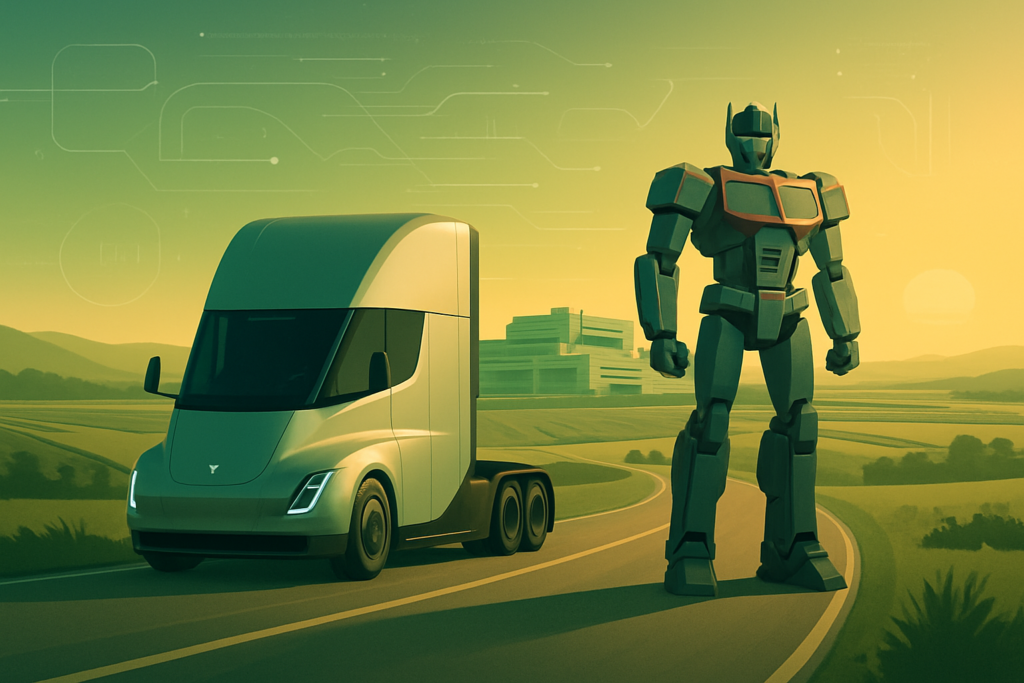
- The Semi Truck: Production at the Nevada Gigafactory expansion is finally hitting its stride in early 2026. The production-intent Semi is achieving efficiency rates of 1.72 kWh per mile, a figure that currently leads the industry for heavy-duty electric transport.
- Optimus (Humanoid Robot): Now in its third generation, Optimus is being deployed within Tesla’s own factories for simple logistics tasks, serving as a live testbed for what Musk believes will eventually be Tesla’s most valuable product.
- Cybercab: Revealed in late 2025 and slated for an April 2026 operational pilot, the Cybercab is Tesla’s purpose-built robotaxi, devoid of steering wheels or pedals, representing the ultimate goal of the company’s AI efforts.
Competitive Landscape
Tesla no longer operates in a vacuum. In the EV space, BYD Company Limited (OTC: BYDDY) surpassed Tesla in total volume in 2025, leveraging a massive cost advantage in battery production. In the luxury and truck segments, Rivian Automotive (NASDAQ: RIVN) and Hyundai Motor Company (OTC: HYMTF) have carved out significant niches. More critically, the competitive threat has shifted to AI. Nvidia Corporation (NASDAQ: NVDA) recently unveiled a "turn-key" autonomous driving platform at CES 2026, threatening to commoditize the very software advantage Tesla has spent a decade building.
Industry and Market Trends
The "EV Winter" of 2024–2025 has transitioned into a "Pragmatic Era." Global demand for pure EVs has plateaued in some markets as consumers wait for cheaper models and better infrastructure. Conversely, the AI boom has created a secondary market for Tesla’s expertise. We are seeing a massive trend toward "Software-Defined Vehicles" (SDV), where the car's value is determined by its digital capabilities rather than its horsepower. Additionally, the industrial sector is rapidly shifting toward autonomous logistics, creating a tailwind for the Tesla Semi.
Risks and Challenges
- Regulatory Scrutiny: Tesla’s FSD remains under intense investigation by the NHTSA and international regulators following several high-profile incidents in late 2025.
- Product Delays: Tesla has a history of missing timelines; any delay in the April 2026 Cybercab launch or the rumored $25,000 "Model 2" could lead to a sharp valuation correction.
- Margin Erosion: Ongoing price wars in China continue to eat into the profitability of Giga Shanghai, Tesla’s most productive plant.
- FSD Commoditization: If Nvidia or Waymo successfully license their tech broadly, Tesla’s "moat" could evaporate.
Opportunities and Catalysts
- Semi Volume Ramp: The transition of the Semi from "pilot" to "volume" in Nevada could unlock a massive new revenue stream in the $700 billion trucking industry.
- FSD Licensing: Rumors persist that a major legacy automaker (potentially Ford or VW) may finally sign a deal to license Tesla’s FSD software in 2026.
- The "Model 2": A sub-$25,000 vehicle expected to be teased in Q2 2026 could reignite the mass-market growth story.
- Optimus Commercialization: Any update on the external sale of Optimus units would likely trigger a massive shift in how the stock is valued by Wall Street.
Investor Sentiment and Analyst Coverage
Investor sentiment on Tesla is highly fragmented. "AI Bulls" like Dan Ives of Wedbush see a path to a $3 trillion market cap, viewing Tesla as the only AI company that also owns a massive physical manufacturing footprint. Conversely, "Valuation Bears" at firms like JPMorgan point to a P/E ratio that remains disconnected from current automotive earnings. Retail sentiment remains fiercely loyal, often viewing Tesla as a tech conglomerate rather than a car company. Institutional ownership has stabilized, but many funds have reduced their weightings due to the volatility seen in late 2025.
Regulatory, Policy, and Geopolitical Factors
Geopolitics play a massive role in Tesla’s 2026 outlook. The expiration of the $7,500 federal EV tax credit in the U.S. at the end of 2025 has created a temporary "delivery hangover" in early 2026. Furthermore, escalating trade tensions between the EU and China have forced Tesla to re-strategize its exports from Giga Shanghai to Europe. Domestically, the regulatory path for Level 4 autonomy (no driver required) remains a patchwork of state-by-state approvals, which could slow the nationwide rollout of the Cybercab.
Conclusion
As of January 16, 2026, Tesla is a company in the midst of its most daring transformation yet. The traditional business of selling cars has slowed, but the seeds of its AI and autonomous future are beginning to sprout. The success of the Tesla Semi production ramp in Nevada and the upcoming Cybercab launch will likely determine if 2026 is the year Tesla reclaims its undisputed crown or if it becomes a victim of its own lofty ambitions. For investors, Tesla remains a high-beta bet on the future of robotics and autonomy—one that requires a high tolerance for volatility and a long-term belief in Elon Musk’s overarching vision.
This content is intended for informational purposes only and is not financial advice.