(BPT) - For the 11 million Americans living with angina, chronic chest pain caused by a lack of blood flow to the heart muscle can touch every aspect of daily life.1 From relationships to careers and mental wellbeing, angina's impact extends far beyond its physical symptoms.2 For many, medicines and/or a procedure to clear blocked arteries makes a difference. But for others, symptoms persist. If you or someone you love is experiencing chronic, recurring angina symptoms, understanding your options - including those being explored as part of clinical research - can help you take an active role in addressing this debilitating condition for yourself or for a loved one.
Understanding Angina: More Than Just Chest Pain
Angina pain is often a symptom of coronary artery disease (CAD), when plaque buildup occurs in the arteries supplying the oxygen-rich blood to the heart, forcing it to work harder than it should.1 Angina may feel like pressure or squeezing in the chest, pain in the shoulders, arms, neck, jaw or back, or shortness of breath.3
Beyond physical symptoms, people with recurring, severe angina face more frequent hospital visits and healthcare costs that can double compared to those without the condition.4 Nearly half (45%) of people experiencing angina report episodes as extremely or moderately debilitating, with many expressing concerns about their future health.2 These issues underscore the urgent need for new treatment options.
When Standard Options Aren't Enough
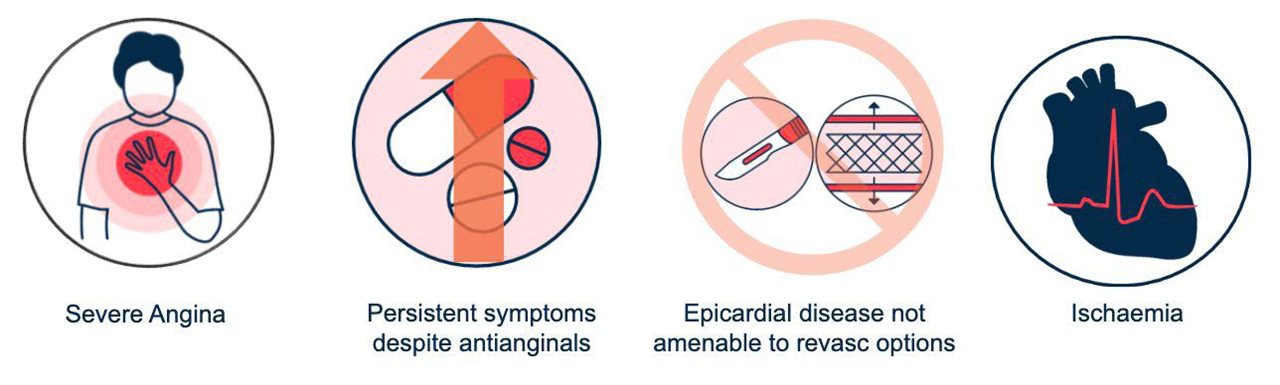
While medicines and a procedure to clear blocked arteries can successfully ease symptoms, 20-40% of patients continue to experience angina after revascularization, and roughly 50% continue their symptoms after medical therapy.5,6
Clinical Research Study is Evaluating a Potential New Option
For those with recurring, chronic angina, the COSIRA II trial is currently enrolling participants in sites across the U.S.
The trial is designed to evaluate the safety and effectiveness of an investigational device for treatment of recurring, chronic angina in adults who continue to have symptoms, such as chest pain, chest pressure, or tightness, despite taking at least three medicines at the maximum doses they can tolerate.
"For people living with chronic, recurring angina who continue to experience symptoms despite medications or procedures to clear blocked arteries, clinical trials like COSIRA II can provide an important opportunity to explore innovative therapies that could help ease symptoms and improve patient outcomes," said Dr. Timothy Henry, Co-Principal Investigator of the COSIRA II Clinical Trial and Medical Director of the Carl and Edyth Lindner Center For Research And Education, Christ Hospital, Cincinnati. "If you or someone you love continues to struggle with angina symptoms, I encourage you to talk to your doctor about all available treatment options, including whether a clinical trial might be right for you."
The COSIRA II Trial is Currently Enrolling
Living with chronic, recurrent angina can feel overwhelming, but expert support can help guide your health journey. If you are interested in learning whether the COSIRA II trial might be right for you or a loved one, you can talk to your doctor or visit the COSIRA II Clinical Trial Website (Shockwave Medical, part of Johnson & Johnson MedTech) to see trial locations and get more information.
CAUTION-Investigational Device. Limited by US Law to Investigational Use.
- Agho, A. V., Disu, F., Figueroa, A. S., Wiredu, B., Okorigba, E. M., Olanite, M., Okobi, O. E., & Noman, T. (2025). Prevalence of angina pectoris: An analysis of the National Health Interview Survey (NHIS) database. https://www.ncbi.nlm.nih.gov/pmc/articles/PMC12116826/.
- BJCardio editorial team. (2008, July). New data highlight burden of sub-optimal management of angina. The British Journal of Cardiology, 15(3), 191-194.
- Mayo Clinic. Angina. https://www.mayoclinic.org/diseases-conditions/angina/symptoms-causes/syc-20369373. Accessed October 2025.
- Kempf, J., et al. (2011). Health resource utilization and direct costs associated with angina for patients with coronary artery disease in a US managed care setting. American Health & Drug Benefits, 4(6).
- Crea, F., et al. (2019). Mechanisms and diagnostic evaluation of persistent or recurrent angina following percutaneous coronary revascularization. European Heart Journal, 40(29), 2455-2462.
- Singh A. (2024 Oct). European Heart Journal, 28; 45 (Supplement_1): ehae666.1457
SPL-78928 Rev. A.