Analyzing 2020–2025 market activity, the first-of-its-kind dataset provides businesses and consumers with insights into where and how problematic peptides appear online
LegitScript, the leader in merchant and product certification and monitoring, today released primary research findings on peptide activity across the commercial internet, detailing how unapproved and problematic peptides have surged in visibility and availability from 2020–2025. Drawing on its multi-channel monitoring of online advertisements, e-commerce listings, and social media content, LegitScript’s data illustrates how these products are increasingly presented in ways that obscure their regulatory status.
This press release features multimedia. View the full release here: https://www.businesswire.com/news/home/20251209572056/en/
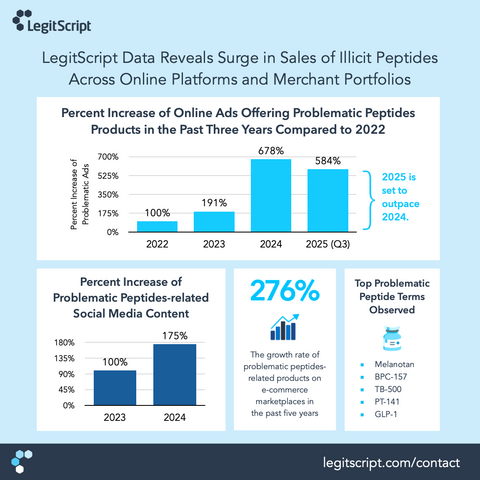
LegitScript’s analysis provides platforms, e-commerce operators, payment providers, and the broader public with new clarity into where high-risk peptides proliferate online and the conditions that are enabling their growth.
- Significant Growth in Online Advertising: In 2024, LegitScript observed 308% more ads related to problematic peptides than in 2023, and 678% more compared to 2022. And 2025 is set to surpass 2024.
- Marketplace Expansion: In the past five years, e-commerce marketplaces have seen a 276% growth rate of problematic peptides-related products being sold.
- Rising Social Media Presence: In 2024, LegitScript observed 75% more social media content related to problematic peptides sales than in 2023.
- Most Frequently Observed Problematic Products: Among hundreds of unauthorized product names and terms LegitScript has observed, the most common products include Melanotan, BPC-157, TB-500, PT-141, and GLP-1.
“Peptides have quickly moved from a niche category into mainstream awareness, and that rise in popularity has been accompanied by a rise in unapproved products entering digital channels,” said Gerard Olson, Director of Research at LegitScript. “Our findings confirm this sharp growth across advertising, e-commerce, and social media, making it increasingly important to educate consumers and aid businesses in catching these problematic listings early. Clear visibility into these trends supports business integrity and protects patient safety.”
Understanding Growth Conditions
As public interest in peptides has exploded, many merchants engaged in unauthorized sales are attempting to appear legitimate by employing professional-looking websites that claim to offer high-purity, lab-tested products. Many new entrants build catalogs around compounds with strong consumer appeal: those associated with aesthetic, performance, or recovery outcomes, and then pair them with marketing cues designed to position these offerings alongside more familiar health-related items. This blend of recognizable language and targeted product selection helps sellers build a false sense of safety to tap into rising demand.
Some listings use terminology or positioning that blurs the line between legitimate research materials and items intended for unauthorized private consumption. Product catalogs often highlight compounds tied to fitness, performance, or aesthetic goals, and are often framed as safe and legal despite their unapproved status. Even professionals in the healthcare and wellness spaces are often unaware that many peptides are being used in ways that are improper and potentially dangerous.
“The business models used to market peptides, as well as the peptides themselves, are so varied that both consumers and businesses are easily confused by what is legitimate and what is not,” said Olson. “We see everything from ‘Research Use Only’ language to supplement‑style marketing used to position unapproved treatments as routine. Together, these patterns help explain how certain products surface quickly and how tactics adapt across different parts of the online ecosystem.”
Common Red Flags Associated with High-Risk Peptide Listings
As peptide-related offerings appear across a range of online environments, there are several indicators that may signal when a product warrants closer scrutiny. These include:
- “Not for Human Consumption” labeling, which can be used in ways that obscure a product’s intended use.
- Minimal or missing buyer-qualification steps, especially when purchases can be completed without any direct interaction or screening.
- Catalogs dominated by compounds frequently associated with misuse, such as Melanotan/Melanotan II, BPC-157, TB-500 or AOD-9604.
- Marketing cues that resemble supplement or lifestyle-product positioning, despite the product’s unapproved status.
“We’re observing peptides follow a pattern we’ve seen in past online drug booms: rapid consumer interest, uneven product quality, and sellers moving faster than the safeguards meant to protect people,” said Scott Roth, CEO of LegitScript. “Our role is to provide our customers with the visibility and insight they need to protect their ecosystems and support patient well-being. By combining advanced technology with expert human review, LegitScript empowers organizations to make confident decisions today and stay ahead of tomorrow’s emerging threats.”
Learn More
For a fuller understanding of how peptide products are categorized, the risks they pose, and the steps businesses can take to identify higher-risk offerings, LegitScript offers a comprehensive Q&A guide with expanded explanations, red-flag examples, and practical considerations for evaluating peptide-related activity.
Learn more about the complex peptides industry by watching LegitScript’s recent webinar “Peptides Everywhere,” which explores how payment service providers and online platforms can better mitigate their risk. You can watch the webinar now on demand.
About LegitScript
LegitScript, the global leader in Enterprise Risk Management Solutions, is trusted by the world’s largest search engines, e-commerce marketplaces, payment service providers, and social media platforms. By combining advanced, AI-driven technology with deep domain expertise and curated market intelligence, LegitScript empowers businesses to stay ahead of emerging threats and seize new growth opportunities with precision and speed. Our global team of regulatory experts and analysts is skilled at understanding global regulatory changes and assessing risk across products, websites, merchants, and platforms, providing clients with unmatched accuracy, actionable insights, and exceptional support.
View source version on businesswire.com: https://www.businesswire.com/news/home/20251209572056/en/
“We’re observing peptides follow a pattern we’ve seen in past online drug booms: rapid consumer interest, uneven product quality, and sellers moving faster than the safeguards meant to protect people,” said Scott Roth, CEO of LegitScript.
Contacts
Media Contact
Julian Byrne
anthonyBarnum Public Relations
julian.byrne@anthonybarnum.com
(512) 665-9258