Berkshire Hathaway (BRK.A) (BRK.B) is once again doing what it historically does only when management believes the opportunity is compelling: buying back its own stock. After a prolonged pause in repurchases, even as its cash pile swelled to record levels, the conglomerate has resumed share buybacks under new CEO Greg Abel. On the surface, that might seem like a routine capital allocation move. In reality, it carries a much more profound message for investors.
For decades, Berkshire’s buyback policy has been straightforward and disciplined. The company repurchases shares only when they trade below a conservatively determined estimate of intrinsic value. Unlike many corporations that use buybacks mechanically or opportunistically to manage earnings per share, Berkshire treats them as an investment decision, competing directly with acquisitions, public equity investments, and holding cash. That makes any resumption of buybacks especially meaningful.
So what should investors take away from this move? Let's break down what the buyback resumption really signals, how it fits into Berkshire’s disciplined capital allocation framework, and why this development may be more important than it initially appears.
About Berkshire Hathaway Stock
Berkshire Hathaway, based in Omaha, Nebraska, is a diversified holding company. It operates under a decentralized management structure, granting its many subsidiaries considerable autonomy in their operations. Berkshire’s insurance division includes property, casualty, life, accident, and health insurance, as well as reinsurance services. Its freight rail transportation business is run through BNSF Railway, one of the largest railroad networks in North America. In the utilities segment, Berkshire Hathaway Energy produces and delivers electricity from a range of sources, including natural gas, coal, wind, and solar. Berkshire also engages in manufacturing, service, and retail businesses. It has a market cap of $1.08 trillion.
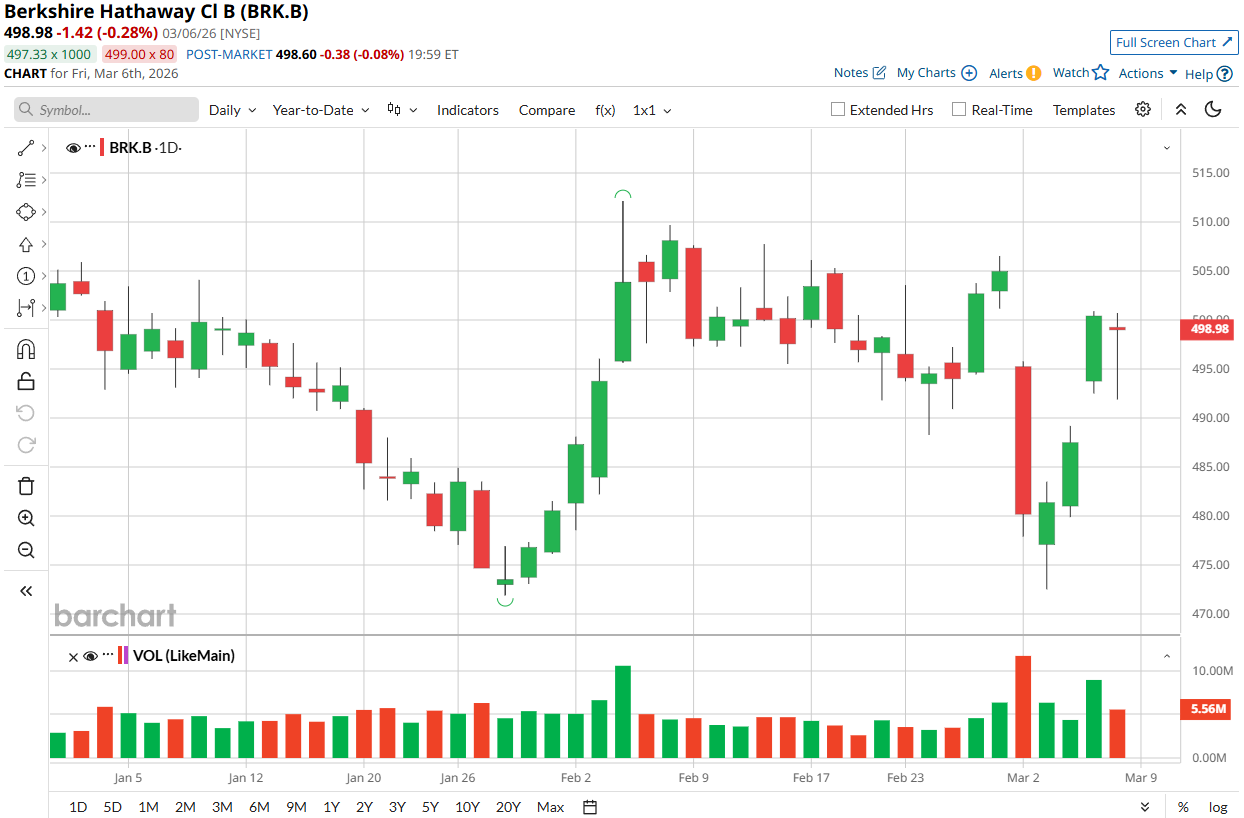
Shares of the conglomerate have fallen 1.7% on a year-to-date (YTD) basis. The stock’s latest leg down came last week after the company posted a nearly 30% drop in Q4 operating earnings, largely driven by weakness in its insurance business. However, news of the buyback resumption helped the stock recover most of those losses.
Berkshire Resumes Share Buybacks
Berkshire Hathaway started repurchasing its own shares (Class A and Class B) last Wednesday. The move marked a departure from former CEO Warren Buffett’s reluctance to buy back shares in recent quarters. Notably, the company did not repurchase any shares in the fourth quarter, extending a pause that began in May 2024. Some investors had grown mildly frustrated by the absence of stock buybacks, especially given the company’s significant cash pile, so the resumption came as a welcome relief.
Under Berkshire’s long-standing buyback policy, the company repurchases shares when it believes they are trading at a discount to the stock’s intrinsic value, conservatively determined. Berkshire’s policy does not require the company to repurchase any specific number of shares. Shares can be repurchased in the open market or through privately negotiated transactions, with the timing and size of buybacks determined by stock prices, market conditions, and other relevant factors.
Berkshire Hathaway CEO Greg Abel told CNBC that he consulted former CEO Warren Buffett before deciding to resume share repurchases. “So how I approached it was, obviously looking at the value, having a view of intrinsic value [and then] consulted with Warren relative to the value and the timing,” Abel said. Abel also said the company chose to disclose the resumption of buybacks due to its recent leadership change, but going forward, it will not announce when it is repurchasing shares in the market. Meanwhile, the company stated in a filing that buybacks may be suspended or discontinued at any time without prior notice and that it assumes no obligation to update or revise any disclosures.
CEO Greg Abel also personally bought nearly $15 million worth of the company’s stock, an amount equal to his after-tax annual salary, according to an SEC filing. Abel told CNBC that he plans to use his entire annual salary to buy Berkshire shares each year for as long as he leads the company, which he said he hopes will be “20 years.” With that, Abel’s purchases could total hundreds of millions of dollars over that period of time. Abel said the goal is to show “absolute alignment with our shareholders,” adding that he has strong confidence in Berkshire’s future opportunities. “Our shareholders, our owners use their after-tax dollars to buy Berkshire. I’ll do the same.”
What Could Berkshire’s Buyback Signal About the Market?
The resumption of buybacks is a positive signal for Berkshire Hathaway, as it suggests the company views its shares as undervalued. However, the move is a less bullish signal for the broader market. Let me explain this in more detail.
When Berkshire repurchases its own shares, it typically indicates that management does not see more attractive investment opportunities elsewhere in the market for its cash. In other words, it demonstrates a commitment to deploying cash to create shareholder value when “elephant-sized” acquisitions or equity investments are absent. The move also suggests that new CEO Greg Abel is sticking to the disciplined capital allocation philosophy established by Buffett—repurchasing shares when they are undervalued rather than overpaying for acquisitions. Notably, Berkshire has made only a handful of acquisitions and has been a net seller of other stocks in recent years. More precisely, Berkshire was a net seller of stocks for the third consecutive year in 2025.
All in all, it looks like Berkshire remains cautious about the broader market, possibly seeing valuations as elevated. Its $373 billion in cash and equivalents at the end of 2025 underscores a cautious stance toward the market. Notably, Berkshire held $321 billion in Treasury bills at year-end 2025, making it one of the largest holders globally. With that, if a market downturn occurs or an attractive value opportunity emerges, Berkshire is well-positioned to deploy its massive cash pile.
What Do Analysts Expect for Berkshire Stock?
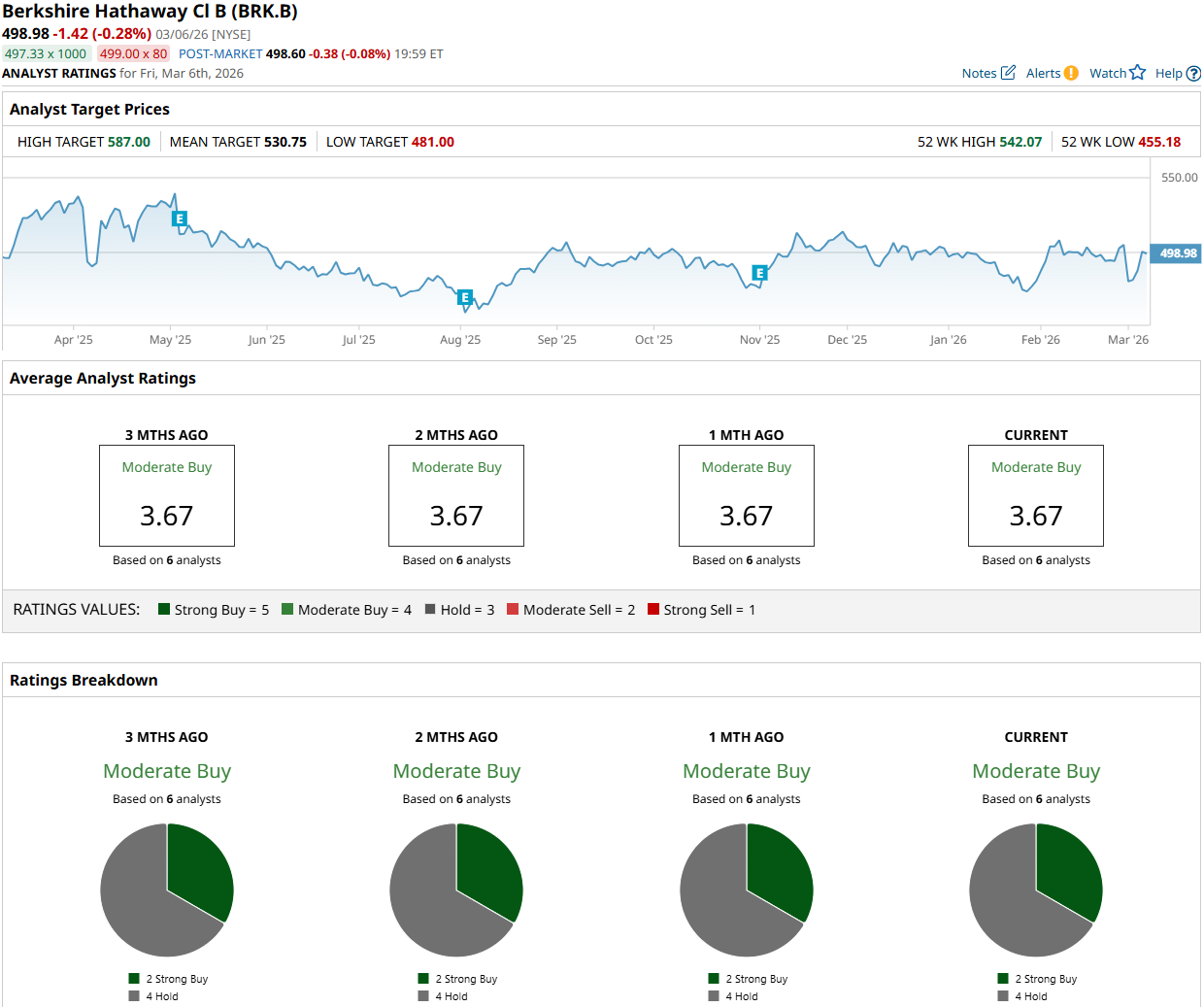
Wall Street analysts have a consensus “Moderate Buy” rating on Berkshire’s Class B shares. Of the six analysts covering the stock, two rate it a “Strong Buy,” while the other four recommend holding it. The mean price target for BRK.B stock stands at $530.75, indicating a modest 6.4% upside potential from Friday’s closing price.
On the date of publication, Oleksandr Pylypenko did not have (either directly or indirectly) positions in any of the securities mentioned in this article. All information and data in this article is solely for informational purposes. For more information please view the Barchart Disclosure Policy here.
More news from Barchart
- ServiceNow Stock May Be Setting Up a Hidden Options Opportunity
- The Real Winner from Broadcom’s Q1 Earnings Is This 1 Lesser-Known Stock
- Drone Contract Wins Are Sending Red Cat Stock Higher. Should You Buy RCAT Here?
- This Software Stock Is Shrugging Off Apocalypse Fears. Should You Chase the Rally Here?