Bengaluru, India – December 9, 2025 – India's space sector is on the cusp of a monumental transformation, driven by an ambitious push towards private sector innovation and the pervasive integration of deep technologies, particularly Artificial Intelligence (AI). Recent insights from Dr. S. Somanath, former Chairman of the Indian Space Research Organisation (ISRO) and a distinguished figure in India's space endeavors, illuminate a strategic redirection aimed at dramatically expanding India's share of the global space economy. His vision, articulated at various forums including a deep tech summit in Chennai on November 3, 2025, signals a pivotal moment for the nation's cosmic aspirations.
Dr. Somanath’s pronouncements underscore India’s strategic goal to elevate its footprint in the global space economy from a mere 2% to a commanding 10%, with targets of reaching $500 billion by 2030 and an astounding $1.5 trillion by 2047. This monumental growth is envisioned through a concerted focus on cutting-edge deep tech domains such as AI, biotechnology, quantum computing, advanced manufacturing, and semiconductor production. This paradigm shift reflects ISRO’s evolution from a primarily government-centric organization to a powerful catalyst for private enterprise, a transformation spurred by recent landmark space sector reforms and the Indian Space Policy 2023. The immediate significance lies in the resounding call for increased private sector participation and investment, recognizing that the future of India's space sector is inextricably linked to fostering a robust ecosystem of startups and innovators.
Engineering the Future: Technical Leaps and AI Integration
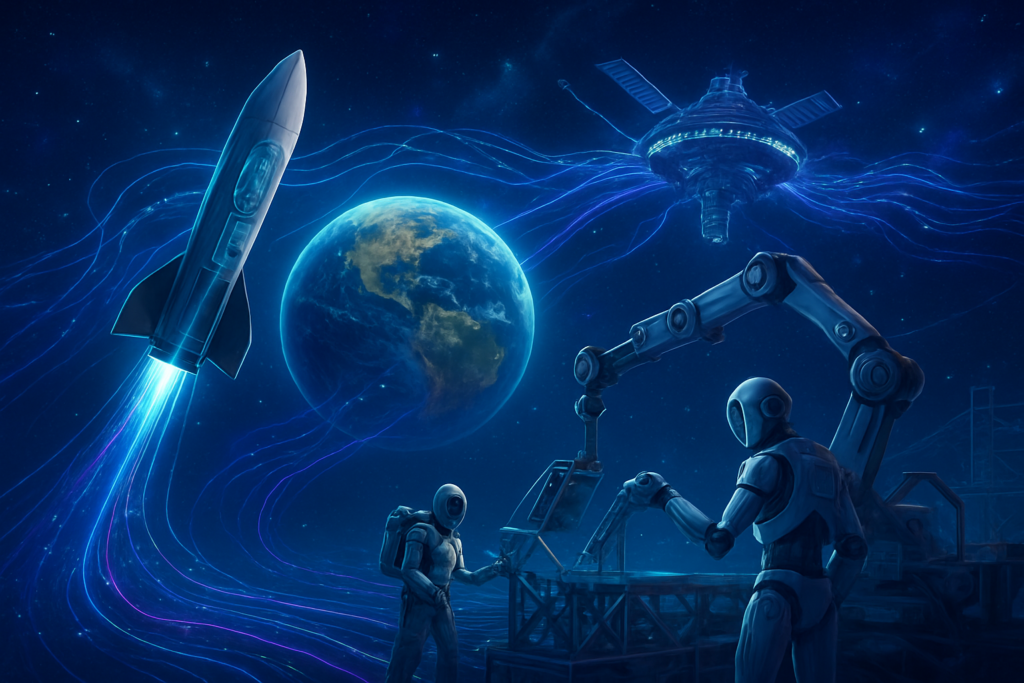
ISRO’s future trajectory, heavily influenced by Dr. Somanath’s leadership, is characterized by a strong push for advanced, indigenous, and cost-effective space technologies. This includes a significant emphasis on reusable launch vehicles, efficient propulsion systems, sophisticated satellite capabilities, and the pervasive integration of AI across all mission phases.
At the forefront of these advancements is the Next Generation Launch Vehicle (NGLV), also known as Project Soorya. Designed as a successor to the Polar Satellite Launch Vehicle (PSLV) and Geosynchronous Satellite Launch Vehicle (GSLV), the NGLV is envisioned as a three-stage, partially reusable medium to super heavy-lift launch vehicle. Its planned first and second stages will utilize Liquid Oxygen (LOX) and Methane (CH4) propellants, with the first stage, LM470 Core, powered by nine LME-110 engines. A key differentiator is its partial reusability, particularly for its first stage and boosters, incorporating Vertical Take-off, Vertical Landing (VTVL) capabilities – a significant departure from ISRO's traditionally expendable rockets. This move towards reusability, akin to global trends, aims to drastically reduce launch costs and increase launch frequency.
Complementing the NGLV is the Reusable Launch Vehicle (RLV) program, with Pushpak as its technology demonstrator (RLV-TD). Configured like an aircraft, Pushpak is designed for Vertical Take-off, Horizontal Landing (VTHL), aiming to prove technologies for a fully reusable two-stage orbital launch vehicle. This promises to slash the cost per kilogram of payload to orbit. In propulsion, ISRO is developing an indigenous electric propulsion system (EPS) with a 300 millinewton (mN) thruster, significantly reducing propellant requirements for satellites, making them five to six times more efficient than chemical propulsion. The Semi-Cryogenic Engine (SE-2000), using LOX and Kerosene, is also under development to enhance payload capacity of the LVM3, while the CE20 cryogenic engine has been upgraded to 20 tonnes of thrust and demonstrated restart capabilities, crucial for manned missions like Gaganyaan.
Advanced satellite technologies are also a key focus, with ISRO working on High-Throughput Satellites (HTS) for increased data throughputs (up to 20 Gbps initially), optical and inter-satellite communication, and miniaturization of electronics. Crucially, Dr. Somanath emphasizes that India's space future will be powered by software excellence and the integration of AI. AI is being applied to analyze vast datasets from space missions for object identification, pattern matching, and interpretation. A significant technical leap is the embedding of AI directly into space machines to enable autonomous, data-driven decisions during missions, moving beyond reliance on ground control. Initial reactions from the space research community and industry experts have been largely enthusiastic, seeing these developments as crucial for cost reduction, sustainability, and fostering a "Next SpaceX in India" aspiration.
Market Dynamics: AI, Tech Giants, and the Startup Surge
Dr. Somanath’s vision for a stakeholder-based space ecosystem is set to dramatically reshape the competitive landscape, creating unprecedented opportunities for AI companies, tech giants, and a burgeoning ecosystem of startups. ISRO is transitioning from a direct operator to a facilitator, transferring technologies and operational tasks to the private sector, allowing it to focus on advanced R&D and interplanetary missions.
AI companies and startups are poised for significant growth, particularly in areas like satellite data analytics, autonomous space systems, predictive maintenance, space traffic management, and advanced communication systems. Companies specializing in AI models for Earth observation data (e.g., crop monitoring, disaster management, urban planning) will find vast markets. The development of AI for autonomous navigation and real-time hazard detection for lunar/planetary landings, as well as AI-powered space robotics, presents immense opportunities. Tech giants with strong capabilities in cloud computing, big data analytics, and AI infrastructure stand to benefit by providing scalable cloud solutions for processing immense satellite data, developing AI/ML platforms for space data analysis, and forming strategic partnerships with space-tech startups.
The Indian space sector has witnessed an explosion of space startups, surging from just one in 2014 to over 250 by 2024, attracting substantial investments. These companies, such as Skyroot Aerospace, Agnikul Cosmos, Pixxel, and Dhruva Space, are innovating across the entire value chain, from indigenous launch vehicles and satellite manufacturing to downstream applications like earth imaging and geospatial solutions. The competitive implications are profound: ISRO's evolving role reduces its direct involvement in commercial production, allowing domestic private players to grow indigenous capabilities and reduce reliance on foreign suppliers. This could position India as a formidable player in the global space market, attracting international customers from African and South American countries seeking affordable launch and satellite services, intensifying competition with established global players like SpaceX (NASDAQ: TSLA) and Arianespace.
Potential disruptions include Indian private players offering satellite internet services, similar to Starlink, and AI-powered analysis of satellite imagery disrupting traditional, less efficient geospatial data providers. India's acceleration of AI-powered satellite constellations for defense and intelligence, such as the I-STAR constellation with Synthetic Aperture Radar (SAR) technology, aims to move away from reliance on foreign commercial imagery for military intelligence, posing a potential disruption to external providers in this strategic sector. The market positioning is driven by a "Made in India" space economy, leveraging India's reputation for cost-effective engineering. The robust AI/IT ecosystem and government as an anchor customer further de-risk investments for startups, fostering a diversified application landscape and promoting strategic autonomy in space access.
Broader Horizons: AI in the Cosmic Tapestry
The integration of AI into India's space technology, as championed by Dr. Somanath, signifies a profound shift that resonates deeply with the broader global AI landscape and its evolving trends. This is not merely about using AI as a tool, but embedding it as an intrinsic component of future space endeavors, moving towards increasingly autonomous and intelligent systems.
ISRO's data-centric approach, applying machine learning and deep learning to vast datasets from space missions, aligns perfectly with the global trend of leveraging big data for insights and predictions across industries. The emphasis on onboard AI for autonomous decision-making in satellites and rockets is a critical step towards greater autonomy in space exploration, minimizing reliance on real-time human intervention. This is particularly vital for deep-space missions where communication delays are substantial, mirroring advancements seen in NASA's Mars rovers for autonomous navigation. The development of AI tools capable of understanding natural language, even in Indian languages, further demonstrates a commitment to advanced human-computer interaction in complex operational environments.
The impacts of this integration are multifaceted. Positively, AI promises enhanced efficiency, speed, and reliability in spacecraft design, manufacturing, flight operations, and data analysis, leading to faster scientific discoveries and reduced operational costs. Autonomous operations, improved safety through predictive maintenance, and advanced data analysis for scientific discovery are already being realized, as seen with AI's role in Chandrayaan-3's safe landing. AI also aids in optimizing flight paths, discovering new materials, and revolutionizing manufacturing through generative design and AI-driven 3D printing. However, concerns loom, including new cybersecurity threats to critical space infrastructure, supply chain vulnerabilities for complex AI components, and the significant challenge of developing AI systems that reliably function in harsh space environments with limited computational resources and data scarcity for novel missions. Ethical considerations also arise regarding autonomous AI decisions, responsible resource exploitation, and potential impacts on any extraterrestrial life.
Comparing this to previous AI milestones, the current integration represents a significant evolution. While early AI in the 1970s focused on basic automation and image analysis, and the 1990s saw breakthroughs in autonomous navigation (like NASA’s Sojourner rover), modern AI, powered by machine learning and deep learning, enables truly autonomous and adaptive decision-making. This is a qualitative leap from pre-programmed responses to cognitive systems that can learn and adapt to unpredictable space environments, process unprecedented scales of data, and identify complex patterns far beyond human capabilities. ISRO's vision places India at the forefront of this new wave, moving beyond human-in-the-loop control towards increasing human-on-the-loop and, for many operational aspects, human-out-of-the-loop autonomy.
The Next Frontier: Future Trajectories and AI's Guiding Hand
Looking ahead, India's space sector, under the strategic guidance of ISRO and Dr. Somanath, is set for an era of exponential growth and transformative change, with AI serving as a core enabler for ambitious near-term and long-term developments.
In the near term, AI will continue to revolutionize automated data analysis for Earth observation, providing near real-time insights for agriculture, disaster management, and geo-intelligence. Predictive maintenance and mission optimization will become standard, with AI algorithms detecting anomalies and optimizing mission parameters. Autonomous navigation and operations, as demonstrated in Chandrayaan-3, will be deepened in future missions like Chandrayaan-4 and Mangalyaan-2, featuring AI-driven instrument control and onboard data compression. Critically, AI is central to India's defense strategy, with the National Space-Based Surveillance (SBS) programme launching 52 dedicated AI-powered I-STAR (intelligence, surveillance, target acquisition, and reconnaissance) satellites over the next five years. The Gaganyaan human space mission, tentatively scheduled for late 2026, will feature the AI-enabled half-humanoid robot, Vyommitra, to test systems and monitor the crew module.
The long-term vision is even more audacious. India aims to establish a space station by 2035 and achieve an Indian presence on the moon by 2040, with a broader goal of a permanent human presence in space by 2047. AI will be indispensable for supporting human spaceflight programs by automating tasks, improving decision-making, countering cybersecurity threats, and enhancing biomonitoring and Earth-independent healthcare for long-duration missions. The Bharatiya Antariksh Station will conduct experiments with advanced robotics, including humanoid robots and chatbots for smart manufacturing in space. AI will also power deep space exploration, including astroinformatics for new celestial body discovery and AI-driven robots for space resource exploration like asteroid or lunar mining. Furthermore, AI and Machine Learning (ML) models are expected to refine optical communication systems and potentially integrate with quantum computing for enhanced security and computational capabilities for intricate space missions.
However, significant challenges must be addressed. Data security and privacy, coupled with the ethical and legal implications of AI decisions, are paramount. Ensuring the accuracy and reliability of AI predictions in critical mission scenarios, especially in harsh space environments with limited computational power and specific training data, remains a hurdle. Integrating advanced AI systems with existing legacy hardware and software, along with addressing supply chain vulnerabilities for AI components, requires careful planning. Moreover, talent retention, new training pathways, and robust academic-industry collaboration are crucial for fostering the deep tech ecosystem. The "mindset change" within the government space sector to openly share facilities and collaborate with private entities is also vital.
Experts predict an era of exponential growth, with the private sector driving innovation and cost reduction. Dr. Somanath himself believes AI will "start ruling many things" in the future, encompassing not only space missions but also everyday life. India is poised to become a global deep tech powerhouse, leveraging its strong IT and software industry to integrate AI, biotechnology, and quantum computing. Space will be increasingly prioritized as critical national infrastructure, forming the basis for future 6G communication technologies and significantly increasing India's satellite fleet.
Cosmic Conclusion: India's AI-Powered Leap
India's space sector stands at a pivotal juncture, poised for an unprecedented era of growth and innovation, largely propelled by the strategic integration of Artificial Intelligence and a robust embrace of private sector participation. Dr. S. Somanath's vision for ISRO underscores a profound shift, transforming the nation's space endeavors from a primarily government-led initiative to a dynamic, collaborative ecosystem designed to capture a significant share of the global space economy.
The key takeaways from this transformation are clear: a relentless pursuit of advanced, indigenous technologies like reusable launch vehicles and efficient propulsion systems; a deep embedding of AI for autonomous operations, data analysis, and mission optimization; and a vibrant private sector, including a burgeoning startup scene, driving innovation across the entire space value chain. This strategy positions India not just as a participant, but as a formidable leader in the global space race, aiming for strategic autonomy and cost-effective solutions. The move towards AI-powered defense capabilities, human spaceflight, and deep space exploration highlights the comprehensive nature of this ambition.
The significance of this development in AI history cannot be overstated. It represents a mature application of AI, moving beyond theoretical models to practical, mission-critical deployment in one of humanity's most challenging frontiers. This shift from human-in-the-loop to human-on-the-loop, and eventually human-out-of-the-loop autonomy, marks a new chapter in how we explore and utilize space. While challenges related to cybersecurity, computational limits, and ethical considerations persist, the concerted efforts of government, industry, and academia are geared towards overcoming these hurdles.
In the coming weeks and months, watch for further announcements regarding private sector partnerships, the progress of ISRO's next-generation launch vehicles, and the initial deployments of AI-powered satellite constellations. The trajectory set by Dr. Somanath and ISRO indicates that India is not just reaching for the stars, but building an intelligent pathway to them, fundamentally reshaping the future of space exploration and the role of AI within it.
This content is intended for informational purposes only and represents analysis of current AI developments.
TokenRing AI delivers enterprise-grade solutions for multi-agent AI workflow orchestration, AI-powered development tools, and seamless remote collaboration platforms.
For more information, visit https://www.tokenring.ai/.