Retail behemoth Walmart (NYSE: WMT) met Wall Street’s revenue expectations in Q4 CY2025, with sales up 5.6% year on year to $190.7 billion. On the other hand, next quarter’s revenue guidance of $172.2 billion was less impressive, coming in 1.3% below analysts’ estimates. Its non-GAAP profit of $0.74 per share was 1.8% above analysts’ consensus estimates.
Is now the time to buy Walmart? Find out by accessing our full research report, it’s free.
Walmart (WMT) Q4 CY2025 Highlights:
- Revenue: $190.7 billion vs analyst estimates of $190.6 billion (5.6% year-on-year growth, in line)
- Adjusted EPS: $0.74 vs analyst estimates of $0.73 (1.8% beat)
- Adjusted EBITDA: $12.45 billion vs analyst estimates of $12.27 billion (6.5% margin, 1.5% beat)
- Revenue Guidance for Q1 CY2026 is $172.2 billion at the midpoint, below analyst estimates of $174.5 billion
- Adjusted EPS guidance for the upcoming financial year 2027 is $2.80 at the midpoint, missing analyst estimates by 5.6%
- Operating Margin: 4.6%, in line with the same quarter last year
- Free Cash Flow Margin: 3.2%, similar to the same quarter last year
- Same-Store Sales rose 4.6% year on year, in line with the same quarter last year
- Market Capitalization: $1.01 trillion
Company Overview
Known for its large-format Supercenters, Walmart (NYSE: WMT) is a retail pioneer that serves a budget-conscious consumer who is looking for a wide range of products under one roof.
Revenue Growth
A company’s long-term performance is an indicator of its overall quality. Any business can put up a good quarter or two, but many enduring ones grow for years.
With $713.2 billion in revenue over the past 12 months, Walmart is a behemoth in the consumer retail sector and benefits from economies of scale, giving it an edge in distribution. This also enables it to gain more leverage on its fixed costs than smaller competitors and the flexibility to offer lower prices. However, its scale is a double-edged sword because there is only so much real estate to build new stores, placing a ceiling on its growth. To expand meaningfully, Walmart likely needs to tweak its prices or enter new markets.
As you can see below, Walmart’s 5.3% annualized revenue growth over the last three years was tepid, but to its credit, it opened new stores and increased sales at existing, established locations.
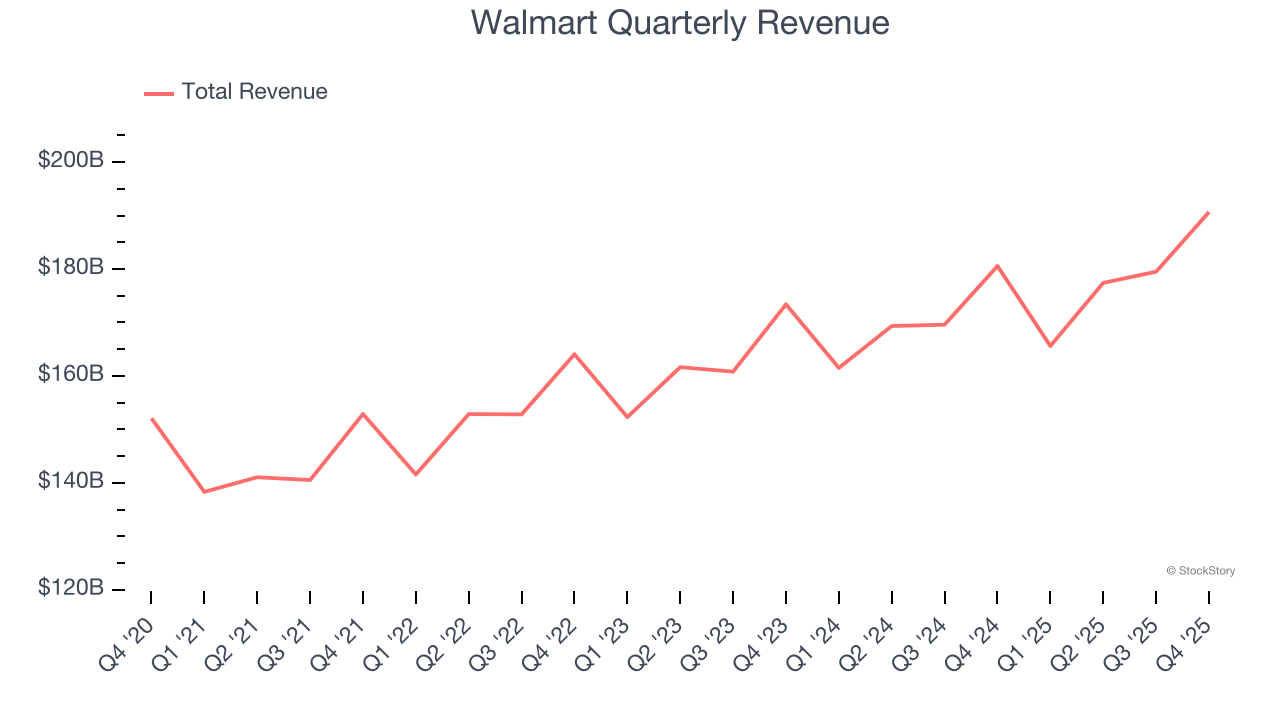
This quarter, Walmart grew its revenue by 5.6% year on year, and its $190.7 billion of revenue was in line with Wall Street’s estimates. Company management is currently guiding for a 4% year-on-year increase in sales next quarter.
Looking further ahead, sell-side analysts expect revenue to grow 4.9% over the next 12 months, similar to its three-year rate. This projection is particularly noteworthy for a company of its scale and suggests the market sees success for its products.
While Wall Street chases Nvidia at all-time highs, an under-the-radar semiconductor supplier is dominating a critical AI component these giants can’t build without. Click here to access our free report one of our favorites growth stories.
Store Performance
Number of Stores
A retailer’s store count influences how much it can sell and how quickly revenue can grow.
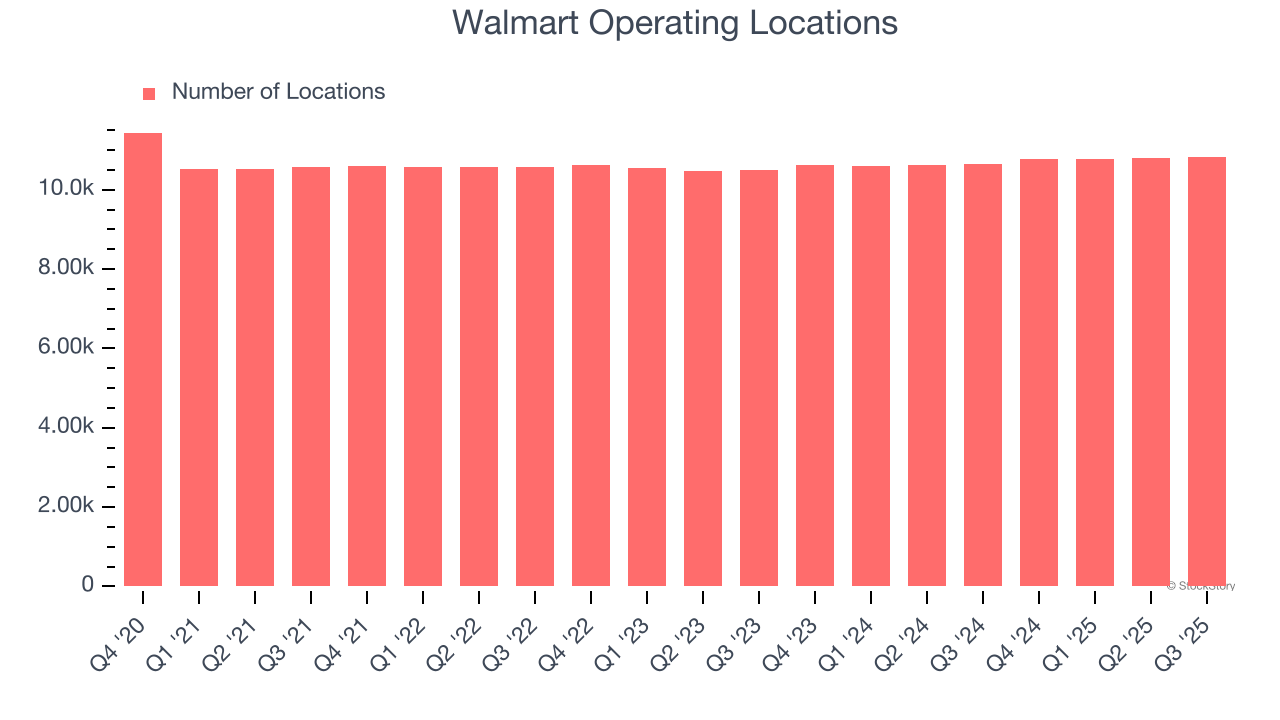
Walmart has generally opened new stores over the last two years and averaged 1.4% annual growth, faster than the broader consumer retail sector.
When a retailer opens new stores, it usually means it’s investing for growth because demand is greater than supply, especially in areas where consumers may not have a store within reasonable driving distance.
Note that Walmart reports its store count intermittently, so some data points are missing in the chart below.
Same-Store Sales
The change in a company's store base only tells one side of the story. The other is the performance of its existing locations and e-commerce sales, which informs management teams whether they should expand or downsize their physical footprints. Same-store sales provides a deeper understanding of this issue because it measures organic growth at brick-and-mortar shops for at least a year.
Walmart has been one of the most successful retailers over the last two years thanks to skyrocketing demand within its existing locations. On average, the company has posted exceptional year-on-year same-store sales growth of 4.6%. This performance suggests its measured rollout of new stores is beneficial for shareholders. We like this backdrop because it gives Walmart multiple ways to win: revenue growth can come from new stores, e-commerce, or increased foot traffic and higher sales per customer at existing locations.
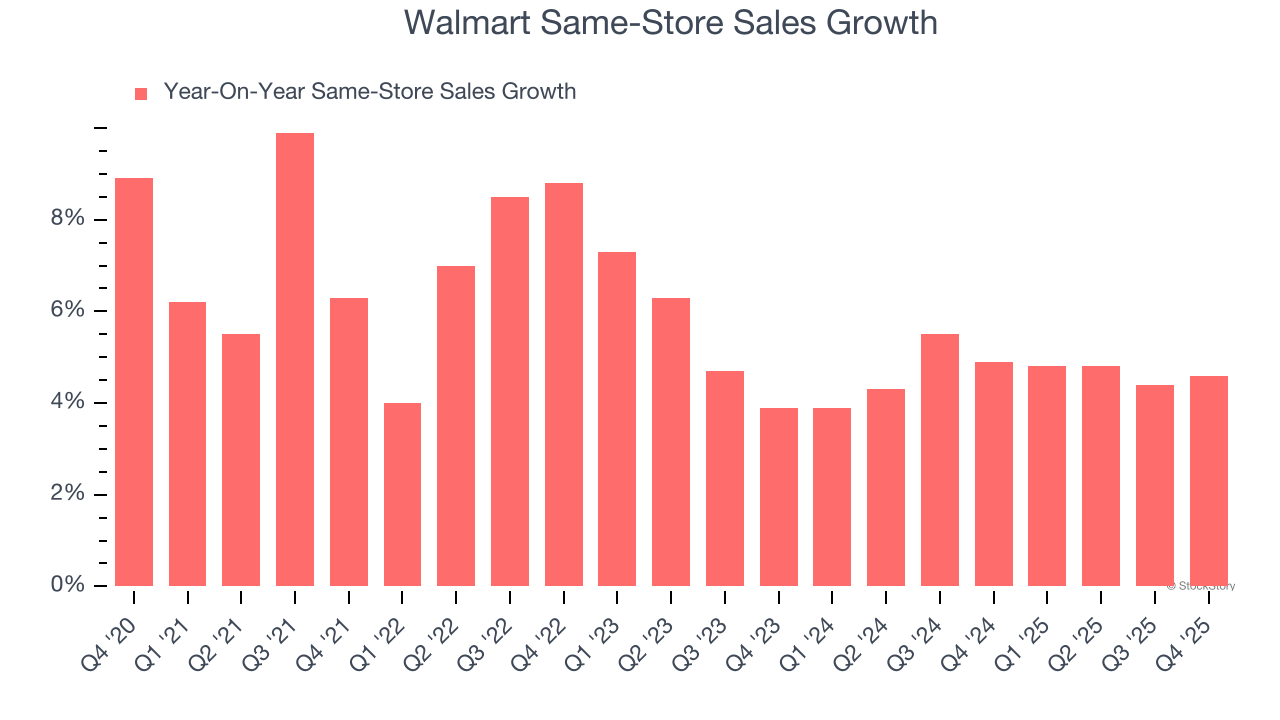
In the latest quarter, Walmart’s same-store sales rose 4.6% year on year. This performance was more or less in line with its historical levels.
Key Takeaways from Walmart’s Q4 Results
It was encouraging to see Walmart beat analysts’ gross margin expectations this quarter. We were also happy its EBITDA narrowly outperformed Wall Street’s estimates. On the other hand, its full-year EPS guidance missed and its EPS guidance for next quarter fell short of Wall Street’s estimates. Overall, this quarter could have been better. The stock traded down 3.3% to $122.56 immediately after reporting.
Walmart may have had a tough quarter, but does that actually create an opportunity to invest right now? What happened in the latest quarter matters, but not as much as longer-term business quality and valuation, when deciding whether to invest in this stock. We cover that in our actionable full research report which you can read here (it’s free).