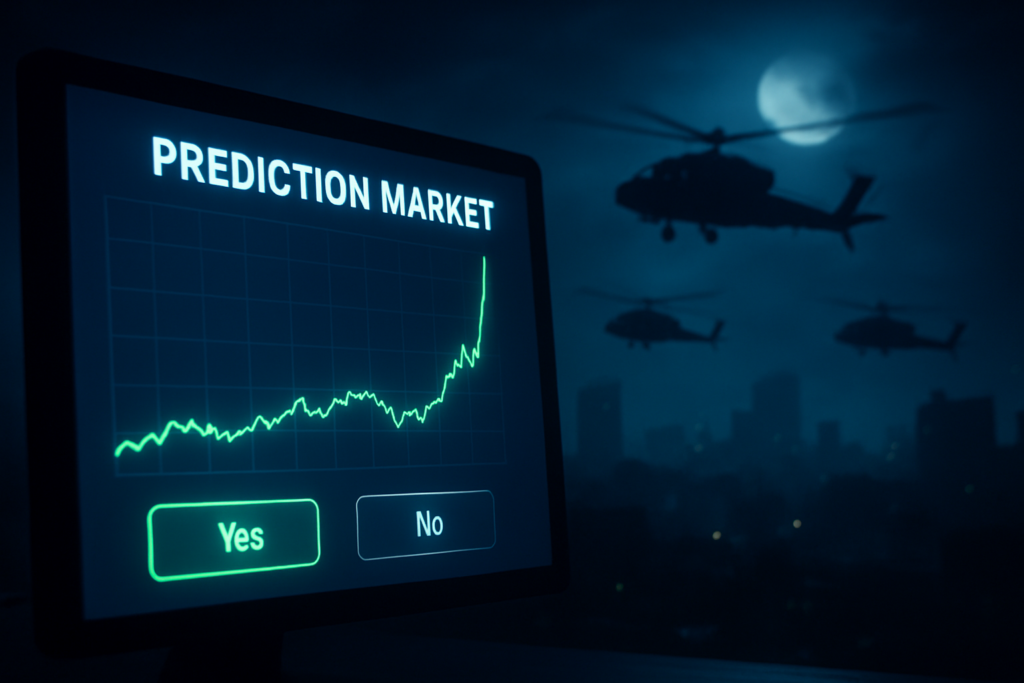
In the early morning hours of January 3, 2026, the world woke to the stunning news that U.S. Army Delta Force commandos had successfully captured Nicolás Maduro in a daring raid codenamed Operation Absolute Resolve. While the geopolitical shockwaves were immediate, a different kind of explosion was occurring in the world of "InfoFi" or information finance. On the decentralized prediction platform Polymarket, a single anonymous trader had just completed one of the most controversial "perfect" trades in the history of prediction markets.
The trader, known only by the username "Burdensome-Mix," managed to turn a relatively modest investment of roughly $32,537 into a staggering $436,000. The timing was more than just lucky; the bulk of the "Yes" shares on Maduro’s ouster were purchased on January 2—less than 24 hours before 150 aircraft, many manufactured by defense giants like Lockheed Martin (NYSE: LMT) and Boeing (NYSE: BA), crossed into Venezuelan airspace. As the news of Maduro’s capture in Caracas broke, the market for "Maduro out by January 31, 2026" instantly hit 100%, sparking a firestorm of allegations regarding insider trading and the ethics of profiting from classified military operations.
The Market: What's Being Predicted
The specific contract at the center of the controversy was "Maduro out by January 31, 2026." For months, the market had traded at low probabilities, reflecting a general skepticism that the long-standing Venezuelan leader would be unseated anytime soon. Most geopolitical analysts and traders on Polymarket had priced the "Yes" shares between 5¢ and 12¢ throughout late 2025, suggesting a less than 15% chance of his removal.
Trading volume on the Maduro contract was relatively thin until the final 48 hours. While other political markets, such as those tracking the U.S. midterm elections, saw millions in liquidity, the Maduro market was a niche corner of the platform. However, the sudden influx of capital from "Burdensome-Mix" and a few other newly created accounts on January 2 caused the odds to spike sharply just before the resolution event.
The resolution criteria for the market were straightforward: the market would resolve to "Yes" if Nicolás Maduro ceased to be the de facto or de jure head of state of Venezuela by the end of January. When Maduro was transported to New York City to face federal charges of narco-terrorism—a story widely covered by major outlets including The New York Times (NYSE: NYT)—the market was settled, and the "Maduro Payout" was officially cemented.
Why Traders Are Betting
The "Maduro Trade" has become a case study in the power and peril of prediction markets. Most traders in the weeks leading up to the raid were betting based on public sentiment, sanctions analysis, and diplomatic posturing. Traditional forecasting methods and mainstream news outlets had given no indication that a military intervention of this scale was imminent.
However, the activity of "Burdensome-Mix" suggests a different strategy entirely. The trader did not gradually build a position; they executed a high-conviction "snipe." Analysis of the blockchain data reveals that the account was funded specifically to make this play, with almost no prior history of trading on Polymarket. This "pitch-perfect" timing led many to conclude that the trader had access to non-public information—potentially as a government official, military contractor, or high-level staffer with knowledge of the January 3 deadline.
Large "whale" activity in prediction markets often acts as a signal to other participants. In this case, the sudden movement in the Maduro market caused a minor flurry of "follow-the-leader" trades, but the sheer speed of the military operation meant that only those already in the market by midnight on January 2 were able to reap the massive 1,200% returns.
Broader Context and Implications
The "Maduro Payout" has pushed prediction markets into the crosshairs of federal regulators and lawmakers. The controversy centers on whether these platforms are providing a valuable public service by aggregating information or if they are simply creating a new, unregulated venue for corruption.
In response to the scandal, Representative Ritchie Torres (D-NY) introduced H.R. 7004, titled the "Public Integrity in Financial Prediction Markets Act of 2026." Introduced on January 9, just six days after the raid, the bill seeks to apply the ethical guardrails of the 2012 STOCK Act to the prediction market space. If passed, the law would explicitly prohibit federal employees, members of Congress, and military personnel from trading on markets that are directly influenced by their official duties or access to classified data.
Historically, prediction markets have been praised for their accuracy, often outperforming traditional polling or expert pundits. However, when that accuracy is derived from "insider" knowledge rather than collective intelligence, the "integrity of the signal" is compromised. The debate now raging in Washington is whether a ban on insider participation will make these markets more ethical but less accurate, or if it is a necessary step to prevent the "gamification" of national security.
What to Watch Next
The immediate focus for the prediction market community is the movement of H.R. 7004 through the House Committees on Oversight and Government Reform. Supporters of the bill argue it is essential for the long-term legitimacy of the industry. Conversely, some industry leaders at firms like Kalshi—which recently fought its own legal battles with the CFTC—have expressed a cautious willingness to accept "rules of the road" if it means avoiding a total ban on event contracts.
In the coming weeks, market participants should watch for:
- Subpoenas and Investigations: There is a strong possibility that the Department of Justice will attempt to identify "Burdensome-Mix." If the trader is found to be a U.S. government employee, it could lead to the first-ever criminal prosecution for "prediction market insider trading."
- Platform Response: Polymarket and other decentralized platforms may implement more stringent KYC (Know Your Customer) protocols to appease regulators, potentially ending the era of truly anonymous high-stakes political betting.
- New Defense Markets: In the wake of Maduro’s capture, new markets are already appearing regarding the stability of the transition government in Venezuela and the potential for similar operations in other regions.
Bottom Line
The "Maduro Payout" is a landmark moment that proves prediction markets can be the most accurate forecasters in the world—but for all the wrong reasons. While the $400,000 profit for "Burdensome-Mix" is a legendary "win" in the annals of crypto-betting, it has also become a lightning rod for legislative reform that could fundamentally change how these platforms operate.
Prediction markets are transitionary tools, moving from the fringe of the internet to the center of the financial and political discourse. As H.R. 7004 moves through Congress, the industry faces a choice: embrace regulation and institutionalize "InfoFi," or remain a "Wild West" where the person with the most classified briefcase also has the most profitable portfolio. For now, the Maduro trade remains a stark reminder that in the world of prediction markets, some "predictions" are actually certainties in disguise.
This article is for informational purposes only and does not constitute financial or betting advice. Prediction market participation may be subject to legal restrictions in your jurisdiction.
PredictStreet focuses on covering the latest developments in prediction markets.
Visit the PredictStreet website at https://www.predictstreet.ai/.