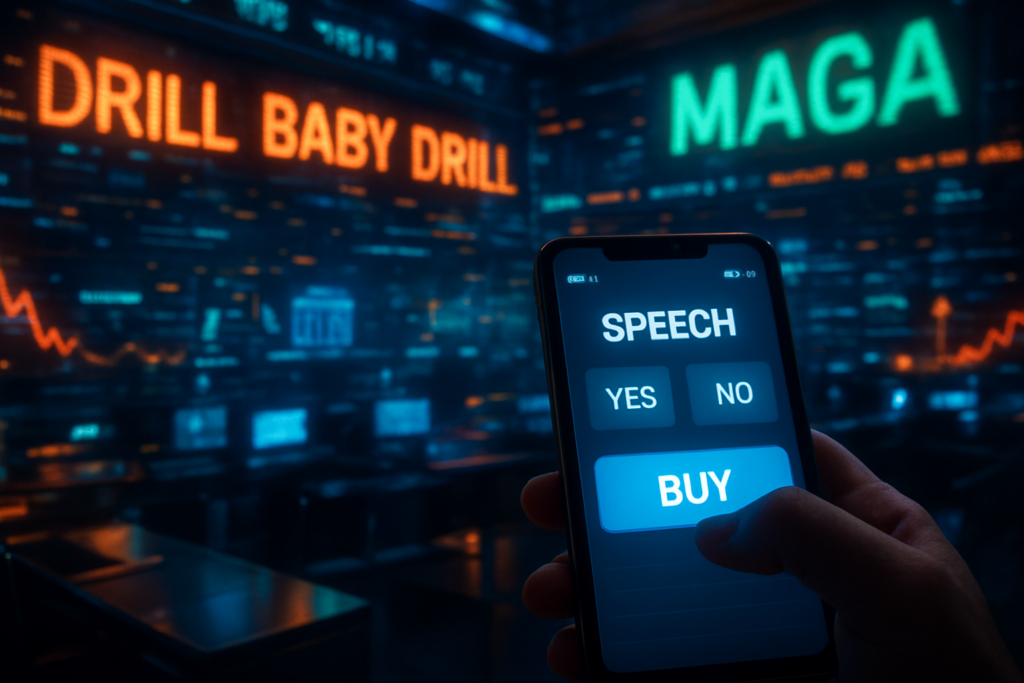
WASHINGTON, D.C. — January 20, 2026 — Exactly one year after Donald Trump was sworn in as the 47th President of the United States, a new kind of ticker tape is dominating the financial landscape. It isn't tracking the S&P 500 or the price of gold, but rather the specific syllables spoken by the Commander-in-Chief. As President Trump arrives in Davos, Switzerland, today for the World Economic Forum, thousands of traders are glued to their screens, wagering millions on whether he will utter his signature catchphrase: "drill, baby, drill."
On leading prediction platforms like Polymarket and Kalshi, these "rhetoric markets" have evolved from niche political curiosities into high-volume financial instruments. As of this morning, the probability of Trump saying "drill, baby, drill" during his Davos address tomorrow stands at a steady 54%, while more aggressive bets on his first-year anniversary comments have seen nearly $1.5 billion in weekly volume. What started as a "prop bet" culture has transformed into a sophisticated ecosystem where linguistic patterns are traded with the same intensity as tech stocks.
The Market: What’s Being Predicted
The mechanics of betting on presidential speech have become remarkably granular. While traditional markets focus on policy outcomes—such as the likelihood of a Fed Chair appointment—the "mention markets" track the specific vocabulary used in public addresses, tweets (now officially integrated into Truth Social and X), and press conferences. These contracts are typically structured as binary "Yes/No" outcomes: “Will Trump say ‘Drill Baby Drill’ by Jan 31?”
Currently, the epicenter of this activity is Kalshi, which has seen its total volume skyrocket to over $23.8 billion in 2025 following a landmark regulatory year. For the upcoming 2026 State of the Union, the "Drill Baby Drill" contract is one of the most liquid on the platform, attracting professional market makers and retail "vibe traders" alike. These markets are joined by other high-stakes linguistic wagers, including the odds of Trump mentioning "Bitcoin" (currently 53%) or using the term "Trump Derangement Syndrome" (trading at 47%).
The resolution criteria for these bets are handled with judicial precision. Platforms employ dedicated verification teams to scan official White House transcripts and high-fidelity audio recordings. On Polymarket, which recently normalized its U.S. operations through a partnership with a CFTC-licensed exchange, these contracts often resolve within minutes of a speech's conclusion, triggering massive liquidity flows.
Why Traders Are Betting
The surge in rhetoric betting is driven by the unique predictability of Donald Trump’s linguistic "greatest hits." Unlike traditional politicians whose speeches are vetted by committees of speechwriters for nuance, Trump’s reliance on branding and repetition—what some analysts call "The Billboard Effect"—makes him the perfect subject for event contracts.
"It’s about sentiment analysis and pattern recognition," says Logan Sudeith, a professional trader who has reportedly earned six figures annually by tracking the President's frequency of specific adjectives. Traders are not just guessing; they are using sophisticated AI tools, often powered by Alphabet Inc. (NASDAQ: GOOGL) and other tech giants, to analyze the President's recent Truth Social posts as leading indicators for his verbal speeches. If "drill" appears in a 3:00 AM post, the "Yes" contracts on Kalshi usually see a 10-15% bump by dawn.
There is also a significant "whale" presence in these markets. Famous accounts like "Freddy9999," who netted an estimated $50 million during the 2024 election cycle, continue to move the needle. These large-scale positions often act as a hedge; energy sector investors may buy "Yes" contracts on "drill, baby, drill" to offset potential volatility in oil prices, using the President's rhetoric as a proxy for upcoming deregulation.
Broader Context and Implications
The institutionalization of these markets marks a paradigm shift in how the public consumes political news. Major media outlets like CNBC, owned by Comcast Corp. (NASDAQ: CMCSA), and CNN now incorporate prediction market odds directly into their chyrons, viewing the "wisdom of the crowd" as a more accurate "truth signal" than traditional polling or punditry.
The entry of retail powerhouses like Robinhood Markets, Inc. (NASDAQ: HOOD) and Interactive Brokers Group, Inc. (NASDAQ: IBKR) into the event-contract space has further democratized this "culture of the bet." Even the Intercontinental Exchange, Inc. (NYSE: ICE), the parent company of the New York Stock Exchange, has moved into the infrastructure of these markets, reflecting a belief that event-based hedging is the next frontier of finance.
However, this trend raises significant questions about the "gamification" of governance. Critics argue that when millions of dollars are riding on a single phrase, it creates an incentive for the President to intentionally move markets—or for staff to leak speech drafts to favored traders. Despite these concerns, the CFTC has largely pivoted toward a "regulated expansion" model, acknowledging that these markets provide valuable data on public expectations.
What to Watch Next
The immediate focus is the President's Davos address on Wednesday, January 21, 2026. While "drill, baby, drill" is the legacy bet, "Greenland" has become the dark horse of the week. Following reports of renewed interest in the island’s natural resources, "mention markets" for the word "Greenland" have climbed to near 100% certainty for the Davos trip.
Beyond the vocabulary, the market is awaiting the nomination of the next Federal Reserve Chair. Currently, Kevin Warsh leads the prediction pools with a 61% probability, and traders are listening for specific keywords—like "sound money" or "interest rate cuts"—that might signal his official appointment during tomorrow's speech.
Investors should also monitor the growing influence of AI trading agents. By early 2026, an estimated 40% of the volume in rhetoric markets is driven by bots that execute trades faster than human speech can be processed by the ear. This "high-frequency linguistics" is expected to create extreme volatility in the seconds after the President approaches a microphone.
Bottom Line
The culture of betting on "drill, baby, drill" is more than just a political gimmick; it is the birth of a new asset class. By turning presidential rhetoric into a tradable commodity, prediction markets have provided a real-time, financially-backed sentiment gauge that traditional media can no longer ignore.
As we cross the one-year mark of the 47th presidency, the lesson for investors is clear: in the modern era, a politician's words are no longer just "talk"—they are a price point. Whether this leads to a more informed electorate or simply a more volatile one remains to be seen, but for now, the markets are waiting with bated breath for the next "drill."
This article is for informational purposes only and does not constitute financial or betting advice. Prediction market participation may be subject to legal restrictions in your jurisdiction.
PredictStreet focuses on covering the latest developments in prediction markets. Visit the PredictStreet website at https://www.predictstreet.ai/.