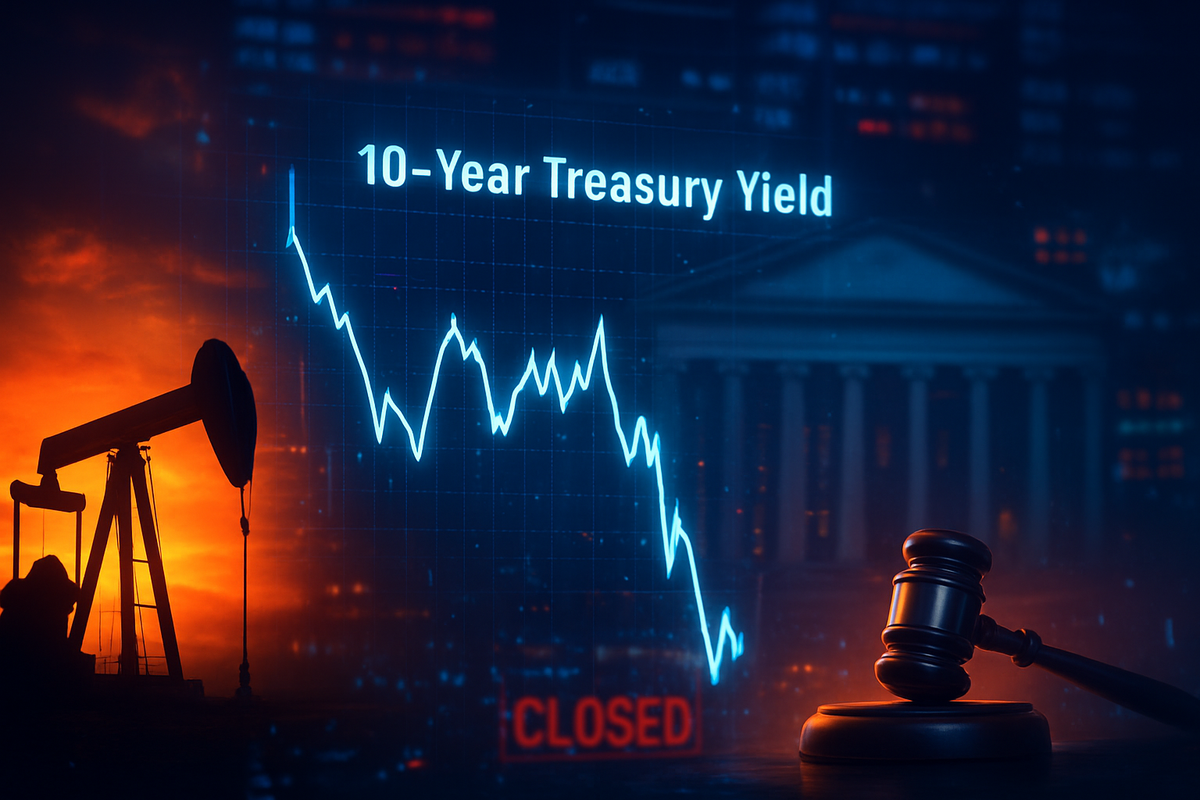
The U.S. Treasury market has entered a period of extraordinary turbulence as of March 10, 2026, with the benchmark 10-year yield completing a "wild ride" that saw it briefly touch 3.96%. This significant decline from January’s highs of 4.26% was initially sparked by a flight-to-safety as geopolitical tensions in the Middle East and the lingering economic scars of a historic 43-day government shutdown combined to fuel recession fears. For the first time in over three years, the 30-year fixed mortgage rate dipped to 5.98%, offering a fleeting moment of relief to a frozen housing market.
However, this downward pressure on yields is now colliding with a massive inflationary headwind: a surge in crude oil prices. As the conflict with Iran escalates and maritime traffic through the Strait of Hormuz comes to a near-halt, Brent crude has skyrocketed toward $120 per barrel. This "stagflationary cocktail"—weakening economic growth coupled with rising energy costs—is forcing investors to recalibrate their expectations for the Federal Reserve's next moves, leading to sharp intra-day swings that have kept bond traders on edge.
A Perfect Storm: From Shutdowns to Shocks
The current volatility is the culmination of a series of systemic shocks that began in late 2025. A historic 43-day government shutdown, which concluded in mid-November, significantly hampered U.S. economic momentum, dragging Q4 2025 GDP growth down to a sluggish 1.4%. The "data fog" created by this lapse in federal reporting left the Federal Reserve and market participants flying blind for weeks, a situation exacerbated by a subsequent partial shutdown of the Department of Homeland Security in early 2026. These disruptions have led to a "reset" in growth expectations, with the February jobs report confirming a net loss of 92,000 positions and pushing the unemployment rate up to 4.4%.
The pivot toward the 3.96% yield level was accelerated on February 28, 2026, when the U.S. and Israel entered a direct military confrontation with Iran. Initially, this sparked a classic "flight-to-quality," with investors dumping volatile AI-heavy tech stocks and piling into the perceived safety of U.S. Treasuries. This massive influx of capital drove bond prices up and yields down, briefly pushing the 10-year yield below the psychological 4% barrier. This downward trend was further supported by a rotation out of risk assets as the market braced for a potential recession.
Yet, by the first week of March, the narrative began to shift. The very conflict that drove yields down also triggered a massive supply-side shock in the energy sector. With 20% of the world’s oil flow threatened by the blockade of the Strait of Hormuz, energy prices surged by more than 35% in just ten days. This has created a paradoxical market environment where recessionary data (job losses) is fighting inflationary data (oil spikes), causing the 10-year yield to reverse course and climb back toward 4.11% as of today, March 10.
Corporate Giants and the Housing Market: Winners and Losers
The brief window of sub-4% yields triggered a massive wave of corporate borrowing, with over $244 billion in new debt issuance in early March alone. Companies like Eaton Corp (NYSE: ETN) and Fidelity National Information Services (NYSE: FIS) moved aggressively to lock in financing, with Eaton launching an $8.5 billion six-part senior note deal. These firms are seen as temporary "winners" who successfully navigated the volatility to secure lower-cost capital before the recent rebound in yields. Similarly, European banking giant HSBC (NYSE: HSBC) led the international markets with an $8.0 billion issuance, capitalizing on the transient dip in global borrowing costs.
The housing sector experienced a "thawing" of its long-standing "lock-in effect" when 30-year fixed mortgage rates hit 5.98%. This psychological breakthrough led to a 10% year-over-year jump in purchase applications and a staggering 109% surge in refinancing activity. Major homebuilders such as D.R. Horton (NYSE: DHI) and Lennar (NYSE: LEN) saw a brief boost in sentiment as the lower rates made new home inventory more accessible. However, with yields now trending back up above 4.1%, there are growing concerns that this spring housing recovery may be short-lived.
Conversely, traditional banking institutions like JPMorgan Chase (NYSE: JPM) and Bank of America (NYSE: BAC) are facing a more complex landscape. While high volatility typically benefits trading desks, the narrowing net interest margins (NIM) caused by the "higher-for-longer" energy inflation and the potential for a weakening consumer base present significant headwinds. On the flip side, the energy sector has emerged as a clear beneficiary of the geopolitical chaos. ExxonMobil (NYSE: XOM) and Chevron (NYSE: CVX) have seen their valuations supported by the surge in crude prices, while defense contractors like Lockheed Martin (NYSE: LMT) are seeing increased demand for sophisticated munitions and missile defense systems amid the escalating conflict in the Middle East.
Global Fragility and the Shadow of Stagflation
The current Treasury market volatility fits into a broader trend of "global fragmentation" that has defined the 2020s. Much like the 2011 U.S. debt ceiling crisis or the 2013 "Taper Tantrum," the current environment is characterized by a loss of policy predictability. The 43-day government shutdown has left a lasting scar on investor confidence in U.S. governance, leading to an elevated "term premium" as bondholders demand higher returns for the risk of future political dysfunction. This is further complicated by the use of Section 122 tariffs on various imports, which have added persistent inflationary pressure to the U.S. economy.
The wider significance of the 10-year yield's "wild ride" lies in the emergence of a stagflationary threat. Historical precedents, such as the 1970s oil shocks, suggest that when energy prices spike during a period of slowing economic growth, central banks face an impossible choice: hike rates to kill inflation and risk a deep depression, or cut rates to save jobs and risk a hyperinflationary spiral. The Federal Reserve's dilemma is now the market's primary focus, with traders divided on whether the Fed will prioritize the 4.4% unemployment rate or the $120-per-barrel oil price.
Furthermore, the "data fog" from the shutdown means the Fed is operating with delayed or incomplete information. This increases the likelihood of a policy error—either waiting too long to cut rates as the labor market softens, or cutting too soon and allowing energy-driven inflation to become entrenched. The ripple effects are already being felt internationally, as central banks in Europe and Asia are forced to respond to the volatility of the U.S. dollar, which remains the "safe haven" of choice despite the domestic political turmoil.
The Path Forward: Navigating the Fog
In the short term, market participants should expect continued "choppiness" as the geopolitical situation in Iran evolves. If the conflict enters a "mop-up phase" and shipping lanes reopen, we could see a rapid cooling of oil prices and a return to the 3.96% yield level or lower. However, if the blockade of the Strait of Hormuz persists, the 10-year yield could easily test the 4.5% mark, effectively ending the brief window of 5.98% mortgage rates and plunging the housing market back into a deep freeze.
Strategic pivots are already underway in the corporate world. Many firms are shifting from a focus on growth to a focus on "carry"—prioritizing coupon income and cash preservation over capital appreciation. Investors should watch for a potential "flight-to-quality" that persists even if yields rise, as the risk of a broader regional war or a deeper U.S. recession remains high. The ability of the U.S. government to resolve the remaining DHS funding dispute will also be a key signal for the markets; a return to functional governance could help stabilize the bond market, while further gridlock would likely keep volatility at historic highs.
Potential scenarios range from a "soft landing" if the energy shock is temporary, to a "hard landing" if the oil price spike forces the Fed to keep rates high despite the 92,000 job losses reported in February. For investors, the next several months will be defined by the tension between "safety" (Treasuries) and "scarcity" (Energy), as the market attempts to find a new equilibrium in a world of persistent geopolitical and political risk.
Summary and Investor Outlook
The descent of the 10-year Treasury yield to 3.96% was a pivotal moment in early 2026, marking a collision between recessionary fears and geopolitical safety-seeking. While this provided a brief window for corporate refinancing and a historic dip in mortgage rates to 5.98%, the subsequent spike in oil prices has introduced a new era of volatility. The "wild ride" is far from over, and the market's direction will now depend on the delicate balance between a cooling labor market and a red-hot energy sector.
As we move forward, the key takeaway for investors is that the "old rules" of the bond market are being rewritten by geopolitical fragmentation and domestic political instability. The 10-year yield is no longer just a reflection of economic growth; it is now a barometer of global risk and federal dysfunction. Investors should closely monitor crude oil inventories, Middle East military developments, and upcoming inflation data to gauge the Fed's next move.
In the coming months, the resilience of the U.S. consumer in the face of $4.00+ gasoline prices and the ability of the labor market to rebound from the February losses will be the most critical factors to watch. For now, the Treasury market remains the center of the financial universe, and its current volatility suggests that the "wild ride" of 2026 has only just begun.
This content is intended for informational purposes only and is not financial advice