WASHINGTON D.C. — In a dramatic shift of the global economic landscape, the United States is currently witnessing a massive "repatriation" of industrial capacity, commonly referred to as the US Manufacturing Renaissance. As of February 23, 2026, over $3 trillion in reshoring-related investments have been announced since early 2025, driven by a combination of aggressive trade protections and lucrative domestic subsidies. This movement reached a fever pitch this past week following a landmark Supreme Court ruling that briefly threatened the new trade regime, only to be met by a swift and decisive executive pivot that has kept the pressure on global supply chains to return home.
The immediate implications are profound: the U.S. industrial sector is shifting from a decades-long "just-in-time" global model to a "just-in-case" domestic fortress. This transition is not merely about avoiding duties; it is a structural redesign of the American economy. While the S&P Global US Manufacturing PMI stood at a healthy 51.2 in February 2026, the rapid pace of reshoring is creating a unique set of challenges, including a persistent labor shortage of 500,000 workers and a frantic race toward industrial automation.
The Push and Pull of 2025-2026 Trade Policy
The current manufacturing boom was ignited by the "Liberation Day" Tariffs enacted in April 2025 via Executive Order 14257. This policy established a 10-15% baseline tariff on most imports and a staggering 125% punitive duty on goods from China. To complement these "sticks," the "One Big Beautiful Bill Act" (OBBBA), signed in July 2025, provided the "carrots," including permanent 100% bonus depreciation for new machinery and a full deduction for the construction of domestic manufacturing facilities through 2030. These policies collectively forced multi-nationals to choose between paying exorbitant duties or building state-of-the-art facilities on American soil.
However, the path has not been without legal hurdles. On February 20, 2026, the Supreme Court ruled 6-3 in Learning Resources, Inc. v. Trump that the executive branch overstepped its authority under the International Emergency Economic Powers Act (IEEPA) to impose such broad, unilateral tariffs. The ruling briefly sent shockwaves through the markets, as investors feared a sudden flood of cheap imports would undermine the newly built domestic infrastructure. Within hours of the decision, the administration counter-moved, invoking Section 122 of the Trade Act of 1974 to impose a 10% "Global Surcharge" to address balance-of-payment deficits. This rapid-fire legal maneuvering has underscored the government's commitment to maintaining a protectionist barrier, effectively cementing the manufacturing renaissance.
Industrial Giants and Tech Titans Leading the Charge
The primary beneficiaries of this shift are companies that have successfully leveraged federal subsidies to build domestic capacity. Intel Corp (NASDAQ: INTC) has become a poster child for the movement, scaling up its massive semiconductor "mega-fabs" in Ohio and Arizona with the help of expanded tax credits under the OBBBA. Similarly, Amkor Technology (NASDAQ: AMKR) has committed $7 billion to a new advanced packaging facility in Arizona, a critical move to fix the domestic "packaging bottleneck" that previously required chips to be sent to Asia for final assembly. In the heavy industrial sector, Caterpillar Inc. (NYSE: CAT) and Deere & Co. (NYSE: DE) are seeing record demand as domestic construction of new factories and infrastructure hits heights not seen since the post-WWII era.
Conversely, the transition has been painful for retailers and consumer goods companies that have historically relied on the $800 de minimis exemption, which was eliminated in 2025. While Whirlpool Corp (NYSE: WHR) successfully repatriated much of its component manufacturing to Ohio to avoid the new global surcharge, other consumer-facing firms are struggling with compressed margins. Steel and aluminum producers like Nucor Corp (NYSE: NUE) and Cleveland-Cliffs Inc. (NYSE: CLF) have seen their market share surge as import competition has been effectively neutralized by 50% duties under Section 232, but they now face the challenge of meeting the overwhelming domestic demand without causing an inflationary spiral in raw material costs.
A Wider Significance: The End of Globalism as We Knew It
The US Manufacturing Renaissance is more than just a reaction to tariffs; it represents a fundamental break from the globalization trends of the late 20th century. By eliminating the de minimis exemption and implementing reciprocal tariffs, the U.S. has effectively ended the era of ultra-cheap, cross-border e-commerce that dominated the 2010s. This shift has forced a massive reconfiguration of logistics, benefiting real estate investment trusts like Prologis Inc. (NYSE: PLD), which are seeing unprecedented demand for warehouse space near emerging domestic manufacturing hubs like the "Battery Belt" in the Southeast and the "Silicon Desert" in the Southwest.
Geopolitically, the move toward self-sufficiency in critical sectors—particularly in pharmaceuticals and energy—is being framed as a national security imperative. Eli Lilly and Co (NYSE: LLY) is currently leading the largest domestic expansion in the history of the pharmaceutical industry, with a $27 billion investment aimed at bringing active pharmaceutical ingredient (API) production back to U.S. shores. This trend toward "national security manufacturing" is likely to have long-lasting ripple effects, as allies and competitors alike are forced to reconsider their own industrial policies in the face of a more insular and self-reliant American economy.
The Road Ahead: Automation and Regulatory Hurdles
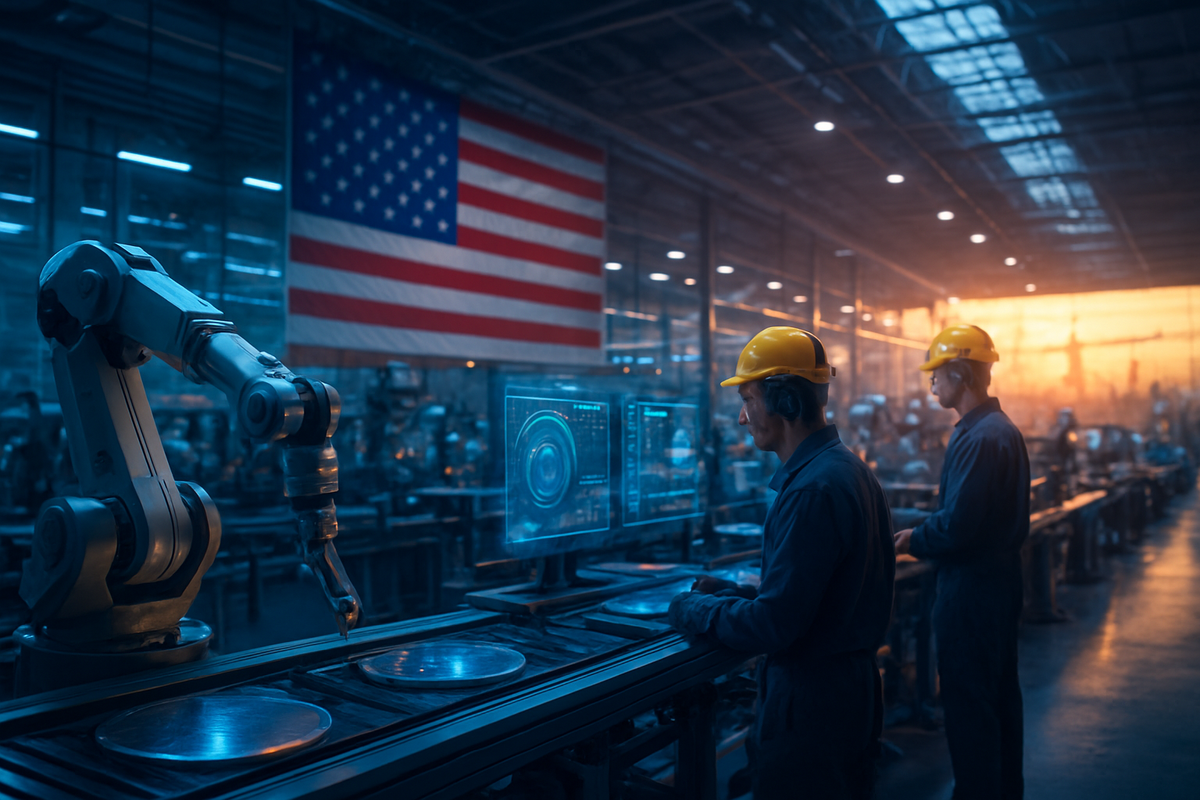
As we look toward the remainder of 2026, the primary challenge for the manufacturing renaissance will be the labor market. With half a million manufacturing roles currently vacant, the success of this repatriation effort will hinge on "automation-led reshoring." Companies like Tesla Inc. (NASDAQ: TSLA) are already leading this charge, utilizing highly automated production lines in their Texas and Nevada gigafactories to mitigate high domestic labor costs. Investors should expect a surge in capital expenditure toward robotics and AI-driven supply chain management as firms seek to maintain productivity in a tight labor environment.
In the short term, all eyes will be on Congress. The new Section 122 "Global Surcharge" has a 150-day window for legislative approval. While the political appetite for protectionism remains high across both parties, any delay or modification in the surcharge could introduce fresh volatility into the markets. Companies that have already broken ground on domestic plants are "locked in," but those still in the planning stages may wait for more definitive regulatory certainty before committing the billions required for domestic expansion.
Summary and Investor Outlook
The US Manufacturing Renaissance of 2026 is a historic pivot that has transformed the American economic landscape in less than two years. The combination of the "One Big Beautiful Bill Act" and the relentless application of tariffs has successfully lured trillions of dollars back to domestic soil. Key takeaways for investors include the continued dominance of the semiconductor and green energy sectors, the rising importance of industrial automation, and the resilience of domestic steel and aluminum providers.
Moving forward, the market will likely be defined by a "sorting of the wheat from the chaff"—separating companies that can successfully adapt to higher domestic production costs through technology from those that are simply burdened by the loss of global supply chains. Investors should keep a close watch on the Congressional response to the Section 122 surcharge and the pace of automation adoption in the coming months. While the transition is fraught with legal and logistical hurdles, the momentum behind the "Made in America" movement has reached a point of no return.
This content is intended for informational purposes only and is not financial advice.