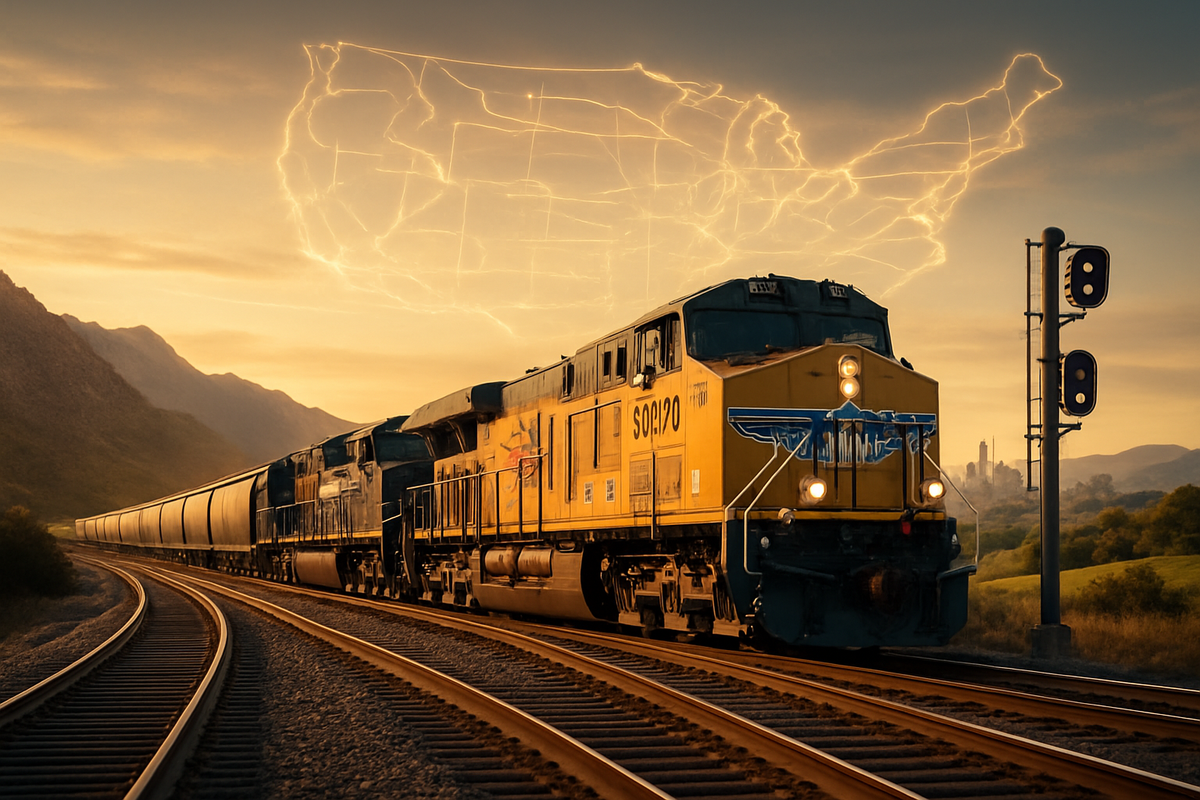
In a move that could fundamentally redefine American logistics, Union Pacific (NYSE: UNP) and Norfolk Southern (NYSE: NSC) are currently locked in a high-stakes regulatory battle to finalize their historic $85 billion merger. Announced in mid-2025, the deal proposes to create the first truly transcontinental railroad in United States history, a sprawling 50,000-mile network that would link the Atlantic, Pacific, and Gulf Coasts under a single banner. As of February 19, 2026, the industry stands at a crossroads following a recent procedural setback from federal regulators, leaving investors and supply chain experts weighing the promise of unprecedented efficiency against the risks of a domestic rail duopoly.
The proposed "mega-merger" represents more than just a corporate consolidation; it signals a profound shift in U.S. economic policy toward "Regulatory Pragmatism." Proponents argue that by fostering "National Champions" in critical infrastructure, the U.S. can better secure its supply chains against global volatility and compete with state-subsidized logistics giants abroad. However, the path forward remains fraught with challenges as the Surface Transportation Board (STB) demands more transparency regarding the deal’s long-term impact on competition and market access.
A New Era of Iron: The Path to the $85 Billion Mega-Deal
The journey toward this historic consolidation began in earnest on July 29, 2025, when Union Pacific and Norfolk Southern stunned the market with a definitive merger agreement. Under the terms of the $85 billion deal, Norfolk Southern shareholders are slated to receive 1.0 Union Pacific common share plus $88.82 in cash for each share held, valuing NSC at approximately $320 per share—a 25% premium at the time of the announcement. If completed, Norfolk Southern shareholders would retain a 27% stake in the combined entity, which is projected to have a pro-forma enterprise value exceeding $250 billion.
The momentum of the deal hit a significant speed bump on January 16, 2026, when the STB unanimously rejected the initial 6,600-page merger application. The Board labeled the filing "incomplete," citing a lack of forward-looking market share data and the failure to disclose critical "walk-away" terms in the merger agreement. Despite this procedural blow, the two companies remained defiant. On February 17, 2026, just days ago, they officially informed the STB of their intent to refile a comprehensive application by April 30, 2026, aiming to address every regulatory deficiency and keep the 2027 closing target alive.
Key players in this drama include Union Pacific CEO Jim Vena and Norfolk Southern’s leadership, who have spent the last six months lobbying Washington on the merits of a unified rail spine. They argue that the merger will eliminate the "hand-off" delays in gateways like Chicago and St. Louis, where freight currently sits for days as it moves between Eastern and Western carriers. By creating a single-line service, the companies expect to divert two million truckloads from highways to rails, significantly reducing carbon emissions and highway wear-and-tear.
Winners, Losers, and the Battle for the High Iron
The primary winners of a successful merger would undoubtedly be the shareholders of Union Pacific and Norfolk Southern, who stand to benefit from an estimated $2.75 billion in annual synergies. Of this, $1.75 billion is expected from revenue growth driven by new transcontinental routes, while $1 billion would come from cost efficiencies. Labor has also carved out an early victory; the SMART-TD union secured a "Jobs for Life" agreement, ensuring seniority and job security for existing workers—a tactical move by the railroads to neutralize organized labor's traditional opposition to consolidation.
Conversely, BNSF Railway—owned by Berkshire Hathaway (NYSE: BRK.A)—has emerged as the merger’s most vocal opponent. BNSF CEO Katie Farmer has publicly criticized the deal, warning that it would create a "coast-to-coast duopoly" that controls 90% of certain commodity traffic. BNSF fears that the merged UNP-NSC giant would use its control over "bottleneck" segments to price out competitors. Meanwhile, CSX (NASDAQ: CSX) has taken a more nimble approach. Rather than pursuing its own defensive merger, CSX is reportedly exploring "virtual merger" agreements with BNSF to create seamless coast-to-coast service through technology and operational coordination, attempting to mimic the benefits of the UNP-NSC deal without the $85 billion price tag.
Shippers, particularly in the agricultural and automotive sectors, remain divided. Large-scale exporters see the potential for lower costs on long-haul routes to coastal ports, but smaller regional shippers fear they will lose bargaining power. If the merger results in reduced service frequency for less-profitable rural lines, these shippers could face increased costs as they are forced to rely on more expensive trucking options.
National Champions: The Death of Traditional Antitrust?
The UNP-NSC merger is the ultimate test case for a new doctrine of "National Champions" in American infrastructure. For decades, the STB and the Department of Justice followed a strict antitrust philosophy that prioritized intra-modal competition at all costs. However, the supply chain shocks of the early 2020s and the successful 2023 merger of Canadian Pacific and Kansas City Southern (CPKC) have shifted the narrative. Federal regulators now appear more willing to accept "Regulatory Pragmatism"—the idea that a larger, more stable, and more efficient domestic player is preferable to a fragmented network that is vulnerable to disruption.
This shift mirrors broader geopolitical trends where the U.S. seeks to bolster its domestic industrial base to compete with state-backed enterprises from China and Europe. By allowing a transcontinental railroad, the government is essentially betting that a unified "National Champion" can modernize the U.S. freight network faster than a collection of regional players. This follows the historical precedent of the 19th-century rail booms, but with a modern focus on intermodal technology and automated terminals.
However, this policy shift has its detractors. In February 2026, a bipartisan group of 47 members of Congress sent a letter to the STB urging a "rigorous and skeptical" review. They argue that the "National Champions" argument is a convenient cover for monopolistic behavior that will ultimately lead to higher prices for consumers. The comparison to the CPKC merger is also being debated; while that merger was "end-to-end" with little overlap, the UNP-NSC deal involves more complex regional intersections, making the competitive analysis far more grueling for the STB.
The Road Ahead: 2027 and Beyond
The immediate focus for the market is April 30, 2026—the deadline for the companies to submit their revised merger application. This filing will need to include granular detail on how the Terminal Railroad Association of St. Louis (TRRA) will be managed, as the STB has flagged this as a "significant" transaction rather than a minor one. If the STB accepts the new filing, a year-long review process will follow, involving public hearings, environmental impact assessments, and intense lobbying from rival railroads and shipping groups.
In the short term, Union Pacific and Norfolk Southern must navigate a period of operational uncertainty. Integrating two massive rail systems while maintaining current service levels is a Herculean task, and any "merger meltdowns" during the transition could embolden regulators to block the deal or impose draconian conditions. Strategically, if the deal faces further delays, we may see the companies pivot toward more aggressive joint ventures or "iron-clad" interline agreements to achieve some of the merger's benefits while they wait for a final verdict in 2027.
The long-term scenario could lead to a final "Two-System" reality in the U.S. rail industry. If UNP and NSC successfully merge, pressure will mount on BNSF and CSX to pursue a similar consolidation. This would leave the United States with two massive transcontinental networks, effectively ending the era of regional Class I railroads and ushering in a duopoly that would require a entirely new framework for federal oversight and price regulation.
A Transcontinental Legacy in the Balance
The proposed merger between Union Pacific and Norfolk Southern is a watershed moment for the American economy. It represents a bold gamble that the efficiencies of a 50,000-mile transcontinental network will outweigh the risks of reduced competition. The "National Champions" strategy signals that the U.S. government is increasingly viewing infrastructure through the lens of national security and global competitiveness, rather than just consumer price protection.
As of February 2026, the market remains cautiously optimistic but wary of the regulatory "procedural wall" the deal has hit. Investors should keep a close eye on the April 30 refiling and any subsequent commentary from the STB regarding "bottleneck" protections. These details will determine whether the merger creates a streamlined engine of American commerce or a cumbersome monopoly that stifles it.
Ultimately, the success of this $85 billion deal will depend on whether the companies can prove that a bigger railroad is truly a better one. For the public, the stakes are high: the outcome will decide the future of how goods move across the continent and whether the "National Champions" of the 21st century can deliver on the promise of a more resilient America.
This content is intended for informational purposes only and is not financial advice.