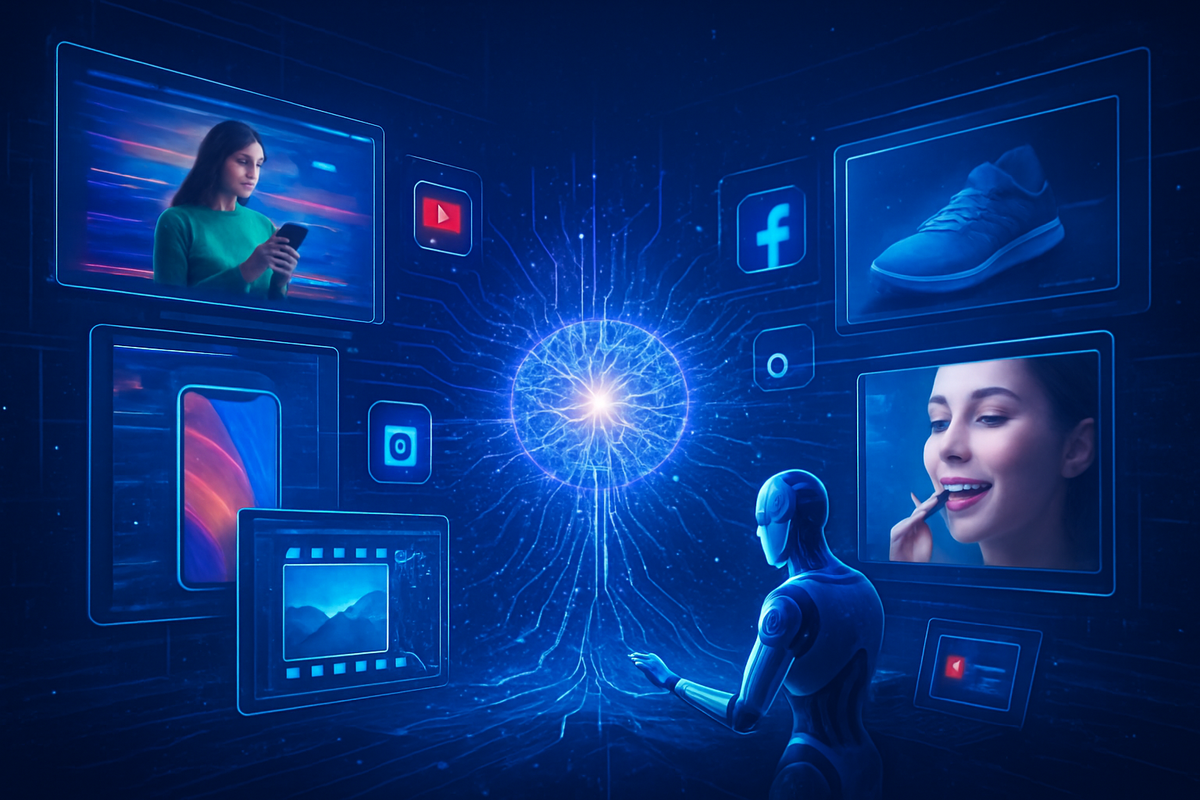
As of February 18, 2026, the digital advertising landscape has undergone its most radical transformation since the invention of the search engine. Generative AI (GenAI) has transitioned from a experimental tool for copywriters to the core operating system of the global ad market. Major tech platforms have moved toward "Goal-Only" advertising, where marketers simply provide a business objective and a budget, leaving the AI to handle creative production, hyper-personalized targeting, and real-time optimization across trillions of data signals.
The immediate implications are staggering: creative production timelines that once spanned weeks have collapsed into minutes, and early data suggests a massive "AI dividend" for the platforms that own the most sophisticated models. While the shift has led to a reported 22% increase in Return on Ad Spend (ROAS) for some, it has also triggered a "Great Decoupling" in the industry, widening the gap between AI-native giants and traditional players struggling to adapt to an automated world.
The Era of Agentic Advertising
The road to this moment began in late 2023 with the first iterations of automated creative tools, but 2025 marked the true turning point. Google (Alphabet Inc., NASDAQ: GOOGL) spent much of the last year scaling its "AI Max for Search," a maximalist optimization layer that uses keywordless matching to capture billions of net-new searches. By early 2026, Google’s Asset Studio has evolved to support seamless image-to-video generation, allowing brands to transform a single product shot into a high-fidelity YouTube Shorts ad in under 60 seconds.
Meta Platforms Inc. (NASDAQ: META) has responded with its "Lattice" architecture, an AI engine that predicts ad performance across its entire family of apps. Meta’s latest 2026 update, the "Meta GEM" (Generative Recommendation Model), has fundamentally changed how small businesses interact with the platform. Advertisers now use "Creative Agents" to build 50+ active creative variations per ad set, refreshed weekly by AI to combat creative fatigue. This level of volume was previously only possible for brands with multimillion-dollar agency retainers.
Meanwhile, Amazon.com Inc. (NASDAQ: AMZN) has leveraged its unique position in "Agentic Commerce." Its new Creative Agent, launched in beta earlier this year, conducts its own audience research and produces complete full-funnel campaigns in under five minutes. For Amazon, the focus is "Ads Agent," a tool that allows sellers to manage complex campaigns via natural language. A seller can simply type, "Launch a campaign for my new sustainable coffee pods," and the AI builds the entire structure—from creative to bidding—in approximately 60 seconds.
Winners, Losers, and the Great Decoupling
The financial markets have reacted sharply to this AI-driven consolidation. Meta and Amazon have emerged as the primary "AI Utilities" of 2026, both reporting ad revenue surges of over 20% in recent quarters as their closed-loop AI systems offer guaranteed ROI. The Trade Desk Inc. (NASDAQ: TTD) has also secured a winning position as the "neutral gateway" for the open internet, with its Kokai AI platform successfully routing massive shifts in advertiser spend toward Connected TV (CTV) and Retail Media Networks.
However, the "Great Decoupling" has left mid-scale platforms and traditional intermediaries in a precarious position. Snap Inc. (NYSE: SNAP) and Pinterest Inc. (NYSE: PINS) have struggled to keep pace with the massive R&D requirements of state-of-the-art AI. Pinterest recently saw its shares plummet after a revenue miss, leading to a 15% workforce reduction as it attempts to pivot toward an AI-centric model. These platforms are facing "budget drift," where advertisers consolidate their spending on the larger platforms that offer superior automated performance.
Traditional ad agencies like WPP plc (NYSE: WPP) and Omnicom Group Inc. (NYSE: OMC) are perhaps facing the steepest uphill battle. Their historical reliance on labor-based fee models is being deflated by AI automation. WPP's stock has faced significant pressure over the last year, leading to the merger of its flagship creative agencies into a single "WPP Creative" unit. To survive, these giants are desperately trying to move from billing human hours to "outcome-based" pricing, positioning their proprietary AI platforms—like WPP Open—as the "human-in-the-loop" layer that ensures brand safety and strategic oversight.
A Wider Significance: The Rise of GEO and the Authenticity Premium
Beyond the stock tickers, this event signals a broader shift in how information is consumed and monetized. As 25% of traditional search volume has moved to AI chatbots like Gemini and ChatGPT, a new field known as Generative Engine Optimization (GEO) has replaced SEO. Advertisers are no longer just fighting for a blue link; they are optimizing their brand data to be the primary source cited in an AI’s conversational response. This has created a "traffic collapse" for traditional publishers, many of whom have seen referral traffic drop by as much as 50% since early 2025.
The industry is also grappling with what many are calling the "AI Slop" crisis. With the internet flooded with synthetic content, consumers are beginning to experience "AI fatigue." Data from early 2026 suggests a growing "human authenticity premium," where preference for human-created creator content has actually risen as a reaction to over-manicured AI ads. This has led to strict "AI-Generated" labeling requirements across all major platforms, a regulatory move aimed at maintaining consumer trust in an era of digital deepfakes.
This trend mirrors the historical shift from print to digital in the early 2000s, but at ten times the speed. Just as the internet decentralized media, GenAI is decentralizing production. The "moat" for a business is no longer the ability to create an ad—it is the possession of proprietary first-party data that the AI can use to make that ad effective.
What Comes Next: Agentic Commerce and Regulatory Crossroads
In the short term, expect a wave of consolidation. Smaller tech firms that cannot afford the "AI ante" will likely be acquired by the "Big Three" or by rising retail media networks. We are also likely to see a strategic pivot toward "Agentic Commerce," where AI agents don't just show you an ad, but actually negotiate and complete a purchase on your behalf. This would turn the advertising funnel on its head, moving from "impression-based" to "transaction-based" almost entirely.
The long-term challenge will be regulatory. As AI models become the primary gatekeepers of commercial information, antitrust scrutiny will likely shift from "search dominance" to "model dominance." We may also see the emergence of tiered licensing models, where high-quality publishers like the New York Times or major content creators sell "monetized access" to their data for AI training, effectively turning their competitors into their biggest customers.
Summary and Investor Outlook
The intersection of GenAI and digital advertising has reached a fever pitch in early 2026. The key takeaways are clear: the "Big Three" (Meta, Google, and Amazon) have successfully turned AI into a performance-driving utility, while traditional agencies and mid-tier platforms are facing a structural existential crisis. The collapse of creative production costs has commoditized "the ad," making data and "human authenticity" the new premium assets.
Investors should closely watch the "ROAS gap" between AI-automated platforms and manual ones in the coming months. Furthermore, keep an eye on the development of GEO (Generative Engine Optimization) as a successor to search advertising. The market is no longer about who can spend the most on a creative agency; it’s about who has the most efficient "AI loop" to turn data into dollars.
This content is intended for informational purposes only and is not financial advice