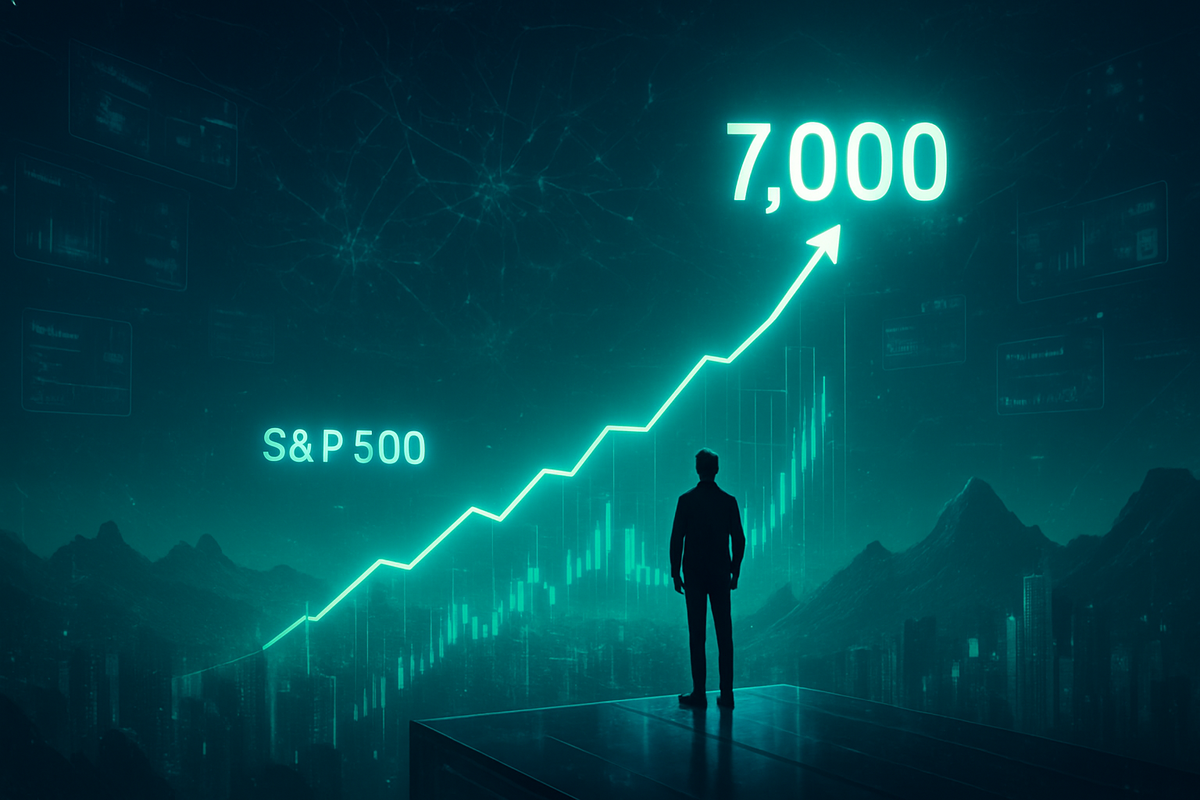
As of January 9, 2026, the S&P 500 (NYSE: SPY) continues to defy gravity, hovering near the psychological milestone of 7,000. Trading at approximately 6,970, the index has entered the new year with a "January Effect" rally that has already seen it climb 1.1% in just a few trading days. This surge follows a remarkably resilient 2025, a year that began in the shadow of trade-war fears but ended with a 16.4% price return, fueled by a pivot in Federal Reserve policy and the relentless maturation of the artificial intelligence (AI) supercycle.
For investors, the view from the summit is both exhilarating and vertigo-inducing. While the momentum is undeniably bullish, the market's forward price-to-earnings (P/E) ratio has stretched to roughly 23x, a level not seen since the peak of the dot-com era. The immediate implication is a market that demands perfection; with valuations at historic highs, any deviation from projected earnings growth or a hawkish shift in central bank rhetoric could trigger a swift "multiple compression." However, historical data offers a counter-narrative: since 1926, the S&P 500 has been at an all-time high roughly 31% of the time, and returns over the following 12 months have averaged a robust 10.4%.
The Road to 7,000: A Timeline of Resilience
The path to the current record highs was anything but a straight line. The first half of 2025 was marked by extreme volatility, as the S&P 500 suffered a sharp correction of nearly 20% in the spring. This "trough" was sparked by the implementation of aggressive trade tariffs and fears of a recessionary spiral. However, the narrative shifted dramatically in May 2025 when a "temporary truce" in trade tensions was reached, and the Federal Reserve began a series of three interest rate cuts. By the end of the year, the index had surged nearly 39% from its April lows, closing 2025 at approximately 6,845.
Key players in this recovery included the Federal Open Market Committee (FOMC), which successfully navigated a "soft landing" by transitioning from a restrictive to a neutral policy stance. Simultaneously, the passage of the "One Big Beautiful Bill Act" (OBBBA) provided significant fiscal tailwinds, offering tax incentives for domestic manufacturing and capital expenditures. This legislative boost, combined with a staggering $400 billion in AI-related capital spending by tech "hyperscalers," created a fundamental floor for corporate earnings that skeptics had previously doubted.
Initial market reactions to the start of 2026 have been characterized by "consensus clustering," where institutional giants like Goldman Sachs (NYSE: GS) and J.P. Morgan (NYSE: JPM) have raised their year-end targets to between 7,500 and 8,000. This optimism is underpinned by the expectation of two to three additional rate cuts in 2026, assuming inflation remains anchored near the 2% target. The market is no longer just betting on a recovery; it is betting on an era of sustained, AI-driven productivity gains.
Winners, Losers, and the "Great Rotation"
The record run has not lifted all boats equally, creating a stark divide between the "AI-haves" and "AI-have-nots." Alphabet Inc. (NASDAQ: GOOGL) emerged as the redemption story of 2025, outperforming its "Magnificent Seven" peers with a nearly 60% return as its Gemini 3 model significantly enhanced advertising margins. Similarly, the "memory chip supercycle" propelled Micron Technology (NASDAQ: MU) and Western Digital (NASDAQ: WDC) to gains exceeding 200% over the past 12 months. In the software space, Palantir Technologies (NYSE: PLTR) became a retail and institutional favorite, gaining 135% as its AI Operating System saw mass commercial adoption.
Conversely, some former tech darlings have struggled to keep pace. Adobe Inc. (NASDAQ: ADBE) saw its shares decline roughly 20% in 2025 as investors fretted over competition from generative AI platforms like OpenAI and Canva. Oracle Corporation (NYSE: ORCL) also faced a significant Q4 drawdown due to concerns over its capital-intensive infrastructure deals. In the banking sector, while giants like JPMorgan Chase & Co. (NYSE: JPM) thrived on record return on equity, regional players such as Columbia Banking System (NASDAQ: COLB) and KeyCorp (NYSE: KEY) underperformed, squeezed by an inverted yield curve and a looming "maturity wall" for commercial real estate.
As we move into 2026, a "Great Rotation" appears to be underway. The Russell 2000 index, represented by the iShares Russell 2000 ETF (NYSEARCA: IWM), hit new highs in late 2025, signaling that market leadership is finally broadening. Small-cap standouts like Root Inc. (NASDAQ: ROOT), which gained 800% after achieving profitability through AI-driven pricing, suggest that the next phase of the bull market may belong to "quality" small-caps and value-oriented sectors like Financials and Utilities, rather than just the mega-cap tech titans.
Broader Significance and Historical Precedents
The current market environment fits into a broader industry trend toward "Agentic AI"—systems that can not only generate content but also execute complex tasks autonomously. This shift is being compared to the industrial revolution in terms of its potential impact on corporate margins. However, the regulatory landscape is also shifting. The OBBBA's incentives for domestic production have sparked a global "subsidy race," with competitors in Europe and Asia launching similar industrial policies to protect their own tech sectors.
Historically, the current setup draws parallels to the late 1990s, but with a crucial difference: today’s leaders are generating massive cash flows. Unlike the dot-com bubble, where companies were valued on "eyeballs" and clicks, the 2026 leaders are backed by multi-billion dollar earnings. Nevertheless, the high CAPE (Cyclically Adjusted Price-to-Earnings) ratio suggests that the "margin for error" is razor-thin. If the anticipated 2026 IPOs—rumored to include OpenAI and SpaceX—fail to meet expectations, it could signal a peak in the current liquidity cycle.
The ripple effects are also being felt in the fixed-income markets. As the Fed eases, the "competition for capital" has shifted. Investors who were content with 5% yields in money market funds in 2024 are now being forced back into equities to maintain returns, a phenomenon known as "TINA" (There Is No Alternative) 2.0. This forced buying is a powerful momentum driver but also increases the risk of a "melt-up" followed by a painful correction if the economic data turns sour.
The 2026 Playbook: Strategic Pivots and Scenarios
Looking ahead, the short-term possibility remains a continued "melt-up" toward the 7,200 level by mid-year, driven by the anticipated "Dealmaking Renaissance" in the financial sector. Strategic pivots for investors in 2026 will likely involve moving away from "AI infrastructure" (chips and hardware) and toward "AI applications" (software and services) that can prove tangible return on investment. The emergence of autonomous robotics and "Agentic AI" will be the key narrative to watch at major industry events throughout the year.
However, challenges loom. A potential scenario involves a "re-inflation" scare if the Fed cuts rates too aggressively, which would force a sudden hawkish pivot and a sharp re-pricing of equity risk. Additionally, the "maturity wall" for commercial real estate in late 2026 could provide a headwind for the broader financial system. Investors are increasingly adopting "Collar" strategies—buying protective puts while selling covered calls—to lock in the massive gains of 2025 while still participating in the potential upside of 2026.
Market opportunities may also emerge in "Boring Tech" and dividend-paying industrials. Companies like The Gorman-Rupp Company (NYSE: GRC) and Ultra Clean Holdings (NASDAQ: UCTT) are being eyed by value-seekers as a way to play the semiconductor equipment rebound without the extreme volatility of the mega-cap names. The key for 2026 will be "valuation discipline"—a phrase that was largely ignored in 2025 but will be essential if the market enters a period of multiple compression.
Wrap-Up: Wisdom at the Peak
The S&P 500’s journey to the doorstep of 7,000 is a testament to the transformative power of AI and the resilience of the American consumer. The key takeaway for investors is that while all-time highs are not a reason to sell, they are a reason to refine. The "easy money" of the initial AI surge has likely been made, and the next phase of the bull market will require a more surgical approach to stock selection and risk management.
Moving forward, the market will be hyper-focused on two things: the Federal Reserve's "neutral" rate destination and the actual ROI of the hundreds of billions spent on AI infrastructure. If the "Agentic AI" promised at CES 2026 begins to show up in corporate bottom lines, the targets of 8,000 and beyond may not be as far-fetched as they seem. However, investors must remain vigilant, watching for "weakening internals"—such as a declining number of stocks making new highs—as an early warning sign of a trend reversal.
In the coming months, the most critical indicators will be the Q1 earnings season and the trajectory of the 2026 IPO market. For now, the trend is undeniably the investor's friend, but at 6,970, it is a friend that requires constant supervision. As the saying goes on Wall Street: "The bull walks up the stairs and the bear jumps out the window." At these heights, the window is a long way down.
This content is intended for informational purposes only and is not financial advice