As the opening bells of 2026 ring across the New York Stock Exchange, the atmosphere on Wall Street is not just bullish—it is historically, perhaps even precariously, unanimous. Equity analysts have entered the new year with a level of optimism that has effectively erased the word "sell" from the professional vocabulary. With the S&P 500 coming off a robust 2025, major financial institutions are projecting double-digit gains for the year ahead, fueled by a "triple tailwind" of accelerating artificial intelligence (AI) profits, a dovish Federal Reserve, and a wave of corporate deregulation.
However, this lack of dissent is raising alarms among market historians and contrarian investors. According to recent FactSet data, "Buy" recommendations on S&P 500 stocks have climbed to 57.5%, tying a record high, while "Sell" ratings have plummeted to just 4.8%. In a market where almost everyone is betting on the same outcome, the margin for error has become razor-thin. The "Great Consensus" of 2026 suggests a market priced for perfection, leaving investors to wonder if the biggest risk is not a recession, but the sheer weight of universal expectation.
The 7,800 Horizon: A Timeline of Rising Targets
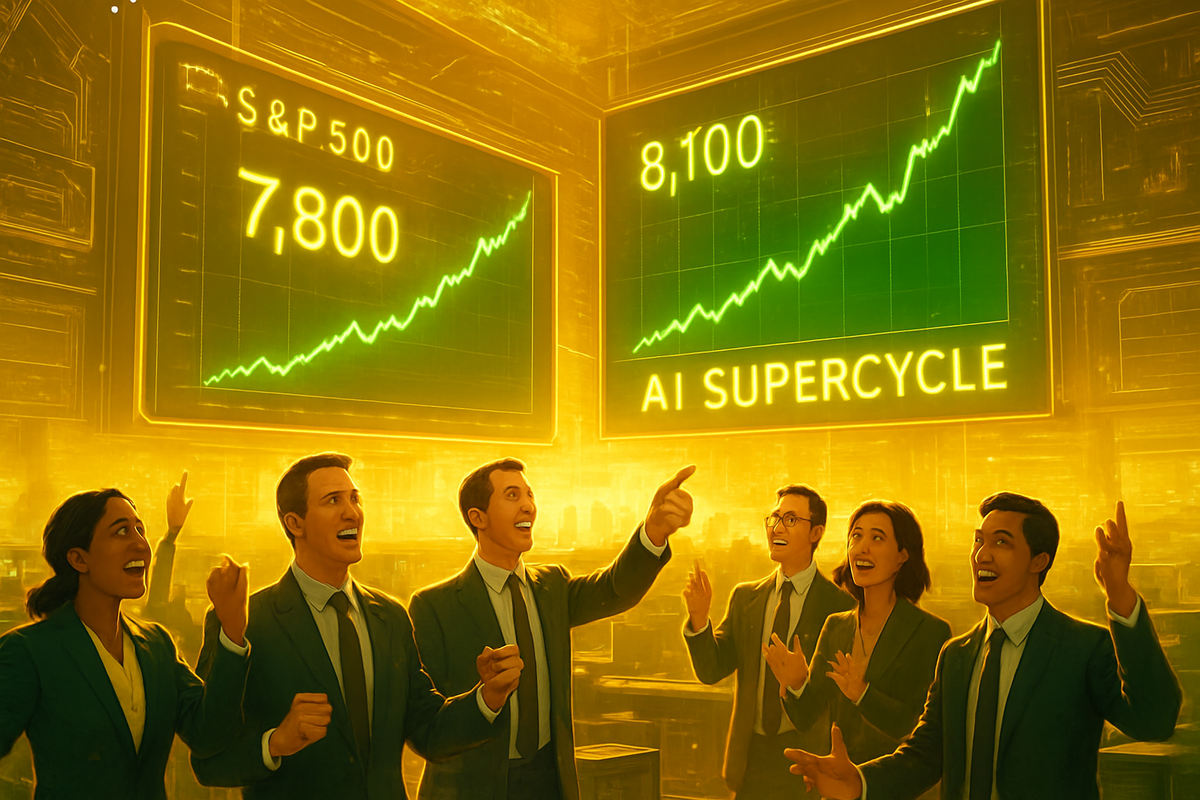
The road to this unprecedented bullishness began in late 2025, as the initial "AI hype" transitioned into what analysts now call "AI Industrialization." Throughout the fourth quarter of last year, major banks systematically raised their 2026 year-end targets for the S&P 500. Morgan Stanley (NYSE: MS) led the charge, with Chief Strategist Mike Wilson setting a target of 7,800, citing a "rolling recovery" that has finally expanded beyond the mega-cap tech sector. Not far behind, Goldman Sachs (NYSE: GS) issued a forecast of 7,600, while Oppenheimer took the "Street High" position with a staggering 8,100 projection.
The stakeholders driving this sentiment are the heavyweights of institutional research. JPMorgan Chase (NYSE: JPM) strategists, who remained cautious for much of early 2025, pivoted sharply in December, citing a projected 14% growth in earnings-per-share (EPS) for the coming year. This shift reflects a broader belief that the massive capital expenditures of the past two years are finally translating into tangible margin expansion. The initial market reaction in the first week of January has been a continuation of the "everything rally," as retail and institutional capital alike flows into equities, fearful of missing out on what many are calling the "Super-Cycle of the late 2020s."
The Winners of the "AI Supercycle" and the Rare Pariahs
The primary beneficiaries of this collective optimism are the companies at the heart of the AI and energy infrastructure. Nvidia (NASDAQ: NVDA) continues to be the consensus "AI Captain," with analysts projecting that data center spending will show no signs of slowing in 2026. Similarly, Broadcom (NASDAQ: AVGO) has emerged as a top pick, with JPMorgan forecasting upwards of $60 billion in AI-related revenue for the fiscal year. In the energy sector, the demand for 24/7 power to fuel data centers has turned GE Vernova (NYSE: GEV) and Constellation Energy (NASDAQ: CEG) into Wall Street darlings, with GEV targets reaching as high as $1,000 per share.
Conversely, the few companies burdened with "Sell" or "Underperform" ratings are those facing extreme valuation hurdles or structural headwinds. Tesla (NASDAQ: TSLA) remains a polarizing figure; despite its technological strides, several analysts have issued "Sell" warnings, citing a price-to-earnings ratio exceeding 180 against slowing delivery growth. Other notable outliers include Wells Fargo (NYSE: WFC) and Lennar Corp (NYSE: LEN), which have seen downgrades from firms like Robert W. Baird and Bank of America (NYSE: BAC) due to concerns over a cooling housing market and saturated valuations in the banking sector. These "pariahs" represent the only pockets of skepticism in an otherwise exuberant landscape.
Historical Echoes and the Danger of the Crowded Trade
The current lack of "Sell" recommendations—less than 5% of all ratings—is a phenomenon rarely seen in financial history, and it often serves as a contrarian warning. The most famous precedent is the Dot-com peak of 1999–2000, when "Sell" ratings famously dwindled to nearly 1% just before the bubble burst. A similar lack of dissent was noted in late 2007, prior to the Global Financial Crisis, and again in early 2022, which preceded a 20% decline in the S&P 500. This "groupthink" can lead to "crowded trades," where everyone is positioned on the same side of the boat, making the market vulnerable to sharp, sudden "air pockets" if even a single piece of bad news emerges.
The wider significance of this sentiment lies in the concept of "American Exceptionalism." Wall Street is currently betting that the U.S. economy can remain insulated from global headwinds through aggressive deregulation and a "winner-takes-all" dominance in the AI sector. This trend has regulatory implications as well; the market is pricing in a hands-off approach from Washington, which analysts believe will allow for massive stock buybacks and M&A activity. However, this assumes that inflation remains dormant and that the Federal Reserve will continue to prioritize growth—a delicate balance that has historically been difficult to maintain.
Scenarios for 2026: Melt-Up or Correction?
Looking ahead, the market faces two primary paths. The short-term possibility is a "melt-up," where the momentum of universal bullishness pushes indices past even the most aggressive targets by mid-year. In this scenario, the "FOMO" (fear of missing out) factor becomes the primary driver, and companies like Palantir (NYSE: PLTR) and Amazon (NASDAQ: AMZN) could see their valuations reach unprecedented heights as they prove the efficacy of enterprise AI. Strategic pivots will be required for fund managers who have remained defensive; they may be forced to "chase" the rally to maintain competitive returns, further fueling the upward spiral.
However, the long-term challenge is the inevitable "valuation reset." If 2026 earnings do not meet the lofty 14% growth targets, or if the "crowded" trades in tech begin to unwind, the market could face a high-dispersion year where the gap between winners and losers widens dramatically. Investors should watch for a potential rotation into the Russell 2000 (INDEXRUSSELL: RUT) and other small-cap indices, as lower interest rates finally begin to benefit the broader economy beyond the tech giants. The "Great Consensus" may hold for the first half of the year, but the second half will likely be a test of whether the fundamentals can truly support the hype.
Navigating the Year of No Dissent
In summary, Wall Street has entered 2026 with a level of confidence that borders on the absolute. The disappearance of "Sell" recommendations and the aggressive price targets from firms like Morgan Stanley and Goldman Sachs suggest a market that is fully committed to the "AI Supercycle" and a soft landing. While the immediate outlook is bright, the historical precedents of such universal optimism serve as a reminder that the most significant risks are often the ones no one is looking for.
Moving forward, the market will be hypersensitive to any deviation from the expected script. Investors should keep a close eye on quarterly earnings reports—particularly from the "Mag 7" and energy infrastructure plays—and monitor inflation data for any signs of a rebound that could stall the Fed's easing cycle. The key takeaway for 2026 is that while the trend is undeniably your friend, the room is getting very crowded. Success in the coming months will require a balance of riding the momentum while remaining vigilant for the moment the consensus begins to crack.
This content is intended for informational purposes only and is not financial advice.